
Women danim jacket
$249.00

Red formal dress
$129.00

Man winter blazer
$149.00$99.00
Subtotal$477

 General
Buying wholesale saree stock is one of the biggest sourcing decisions a boutique or retail business makes each season. Every bulk order affects your margins, your delivery timelines and the trust your customers place in your store. This guide walks retailers, boutique owners and institutional buyers through what wholesale saree buying actually involves, where to source stock, how to vet a supplier, what minimum order quantities and pricing to expect, and how a partner like Honour Agencies runs its own wholesale process from first enquiry to final delivery.
Wholesale saree buying means purchasing sarees in bulk, directly from a manufacturer, dealer or authorized distributor, at a per piece price lower than retail. Retailers then resell that stock to individual customers at a margin, or use it to fulfil institutional and uniform orders. Unlike a single retail purchase, a wholesale saree sourcing guide usually involves a minimum order quantity, negotiated pricing tiers, and a longer relationship between buyer and supplier rather than a one time transaction.
This distinction matters because wholesaling is fundamentally a different business relationship than retail shopping. A wholesale buyer is evaluating a supplier the way a business partner would, checking production capacity, fabric quality consistency, delivery reliability and after sales support, not just the look of a single saree. Understanding this shift early saves new boutique owners from treating their first bulk order like a shopping trip.
Retail saree buying is about a single piece for a single occasion, chosen mostly on appearance. Wholesale buying is about consistent stock for resale, chosen on fabric quality, price per unit, delivery timeline and how well a design range will sell across a season. A wholesale buyer also needs to think about assortment planning, since a shop cannot survive on a single design or color.
Wholesale saree buyers include boutique owners building a retail collection, institutional and uniform procurement teams sourcing formal sarees for schools, hotels and corporate front offices, wedding and event planners stocking fancy sarees for large orders, and increasingly international fashion retailers and diaspora buyers looking for authentic Indian sarees at bulk pricing. Each buyer type has different priorities around design, fabric and order size.
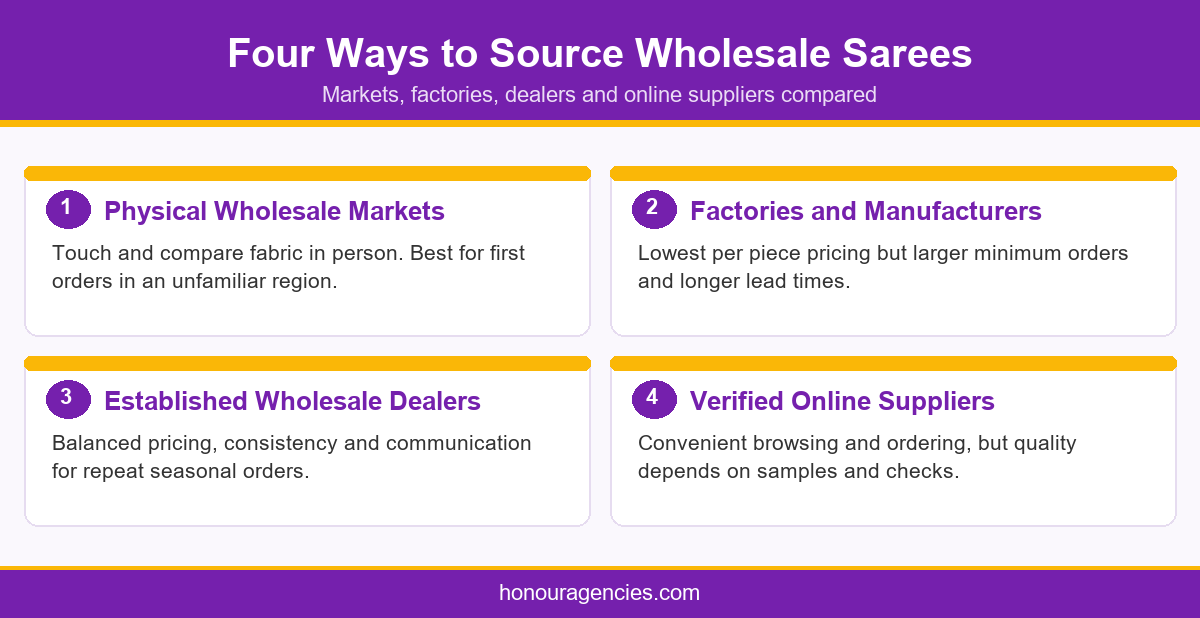
Retailers usually source wholesale saree stock through one of four channels: physical wholesale markets, factories and manufacturers, established wholesale dealers, or verified online suppliers. Each channel offers a different balance of price, minimum order size, quality control and convenience, and most experienced buyers end up using more than one depending on the season and the specific fabric they need. A good starting point is Honour Agencies own top wholesale saree markets in India roundup, which maps out where in India serious bulk buyers actually shop.
New buyers often assume the cheapest source is automatically the best one. In practice, the best saree wholesalers in India balance price with consistency, communication and the ability to repeat an order accurately weeks or months later. That reliability is worth more over a full buying season than a marginally lower per piece rate from an unknown source.
Physical wholesale markets remain the backbone of the Indian saree trade. Buyers can touch fabric, compare weaves side by side, and negotiate in person, which is especially useful for a first order with a new region or fabric type. Kerala's own market is a strong example, covered in detail in exploring the Kerala saree wholesale market, where local dealers and Broadway area shops operate at genuine wholesale scale.
Buying directly from a factory or manufacturer usually offers the best pricing and the most control over fabric and design specifications, but it also demands larger minimum orders and longer lead times. Top fabrics and designs found in wholesale saree factories is a useful reference for what a factory floor actually produces, while why a reliable saree manufacturer matters and top saree manufacturers for resellers both dig into how to evaluate a manufacturer before committing to a large order.
Online wholesale saree dealers have grown quickly because they let a boutique owner browse catalogues, request video calls and place orders without travelling to a physical market. The tradeoff is that quality control depends entirely on the dealer's honesty, so ensuring quality when buying wholesale sarees online and where to buy wholesale sarees for business in India both cover practical checks every online buyer should run before paying.
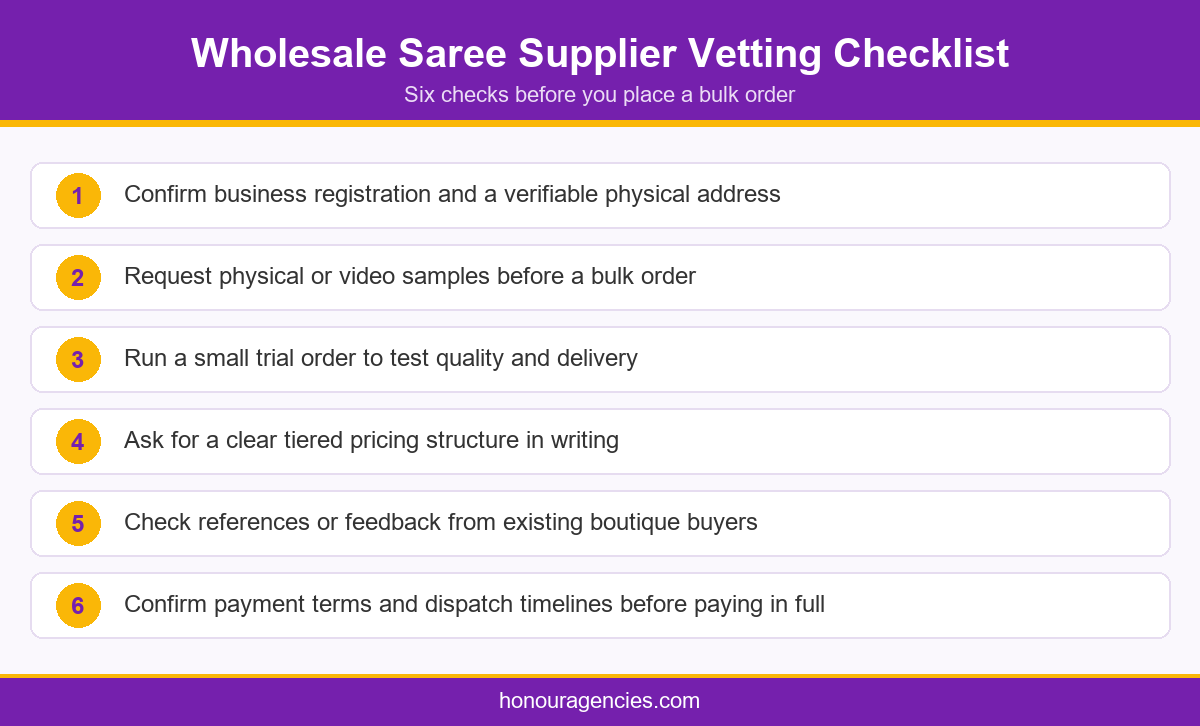
Vetting a wholesale saree supplier is the single step that most affects whether a bulk order becomes a profitable stock line or a costly mistake. Start with business basics: registration details, years of operation, and whether the supplier can show a genuine production or sourcing base rather than just a catalogue of photos borrowed from elsewhere. Honour Agencies has built its own reputation over 35 years by being transparent about exactly this kind of information.
Beyond paperwork, ask for physical or video samples before committing to a full order, check turnaround time on a small trial order, and read how past buyers describe consistency across repeat orders. Choosing the right wholesale saree supplier, what to check before choosing a supplier and reliable wholesale saree supplier guide each walk through a fuller checklist for this exact stage.
It also helps to compare more than one option side by side rather than committing to the first supplier contacted. Choosing the right wholesale partner and choosing the right saree wholesale dealers both cover how to shortlist and compare dealers fairly, while benefits of partnering with local suppliers explains why a local, visitable supplier often reduces risk compared to a purely remote relationship.
Minimum order quantity, usually shortened to MOQ, is the smallest quantity a supplier will accept for wholesale pricing. MOQs vary by fabric, design complexity and supplier scale, and understanding the underlying economic order quantity logic behind them helps a buyer negotiate realistic terms rather than pushing for an order size the supplier cannot fulfil profitably.
Pricing in the wholesale saree trade typically drops in tiers as order volume increases, so a buyer ordering fifty pieces should expect a different per unit rate than one ordering five hundred. Ask suppliers to lay out their pricing tiers clearly up front rather than negotiating blind. Honour Agencies own wholesale program publishes exactly this kind of structured pricing so boutique buyers know what to expect before they place a first order.
Payment terms deserve equal attention. Reputable wholesale suppliers usually ask for an advance against a confirmed order and balance payment on or before dispatch, with clear documentation at every stage. Buyers should be cautious of any dealer demanding full payment upfront with no sample, no order confirmation and no traceable business address.
A wholesale saree buyer needs at least a working knowledge of fabric categories, since fabric choice drives both pricing and customer demand. Cotton sarees remain a steady, everyday category with strong year round demand, while silk and semi silk designs carry higher price points and are typically bought for festive and wedding season stock. Lighter fabrics such as georgette and chiffon sell well for both formal wear and comfortable daily wear ranges.
For buyers sourcing beyond finished sarees, fabric suppliers for fashion designers and wholesale designer fabric suppliers both cover how boutiques working with in house tailoring can source fabric by the roll rather than as finished garments, often at better margins for a custom product line.
Understanding which fabric categories move fastest in your specific market, whether that is a boutique focused on daily wear, an institutional buyer sourcing uniform fabric, or a wedding planner needing fancy occasion pieces, should directly shape which suppliers and which markets a buyer prioritises first.
Kerala has long been a serious hub for wholesale saree trade, and Ernakulam in particular has built a genuine reputation among retailers across South India. The state's weaving tradition, including the well known handloom sector, gives Kerala based wholesalers access to design ranges that buyers cannot always source elsewhere. Wholesale sarees in Kerala covers what buyers can expect when shopping this market specifically.
The market has also kept evolving. Future trends in Kerala's wholesale textile market tracks how demand and design preferences are shifting, while Kerala saree wholesale dealers stock alerts explains how buyers can stay ahead of seasonal stock releases rather than reacting after popular designs sell out.
Many boutique owners specifically choose Kerala suppliers for reasons covered in why Kerala saree wholesale dealers are the first choice for boutiques and retailers turning to Kerala saree wholesale dealers, from fabric variety to pricing to the simple advantage of dealing with an established, visitable market rather than an unfamiliar one.
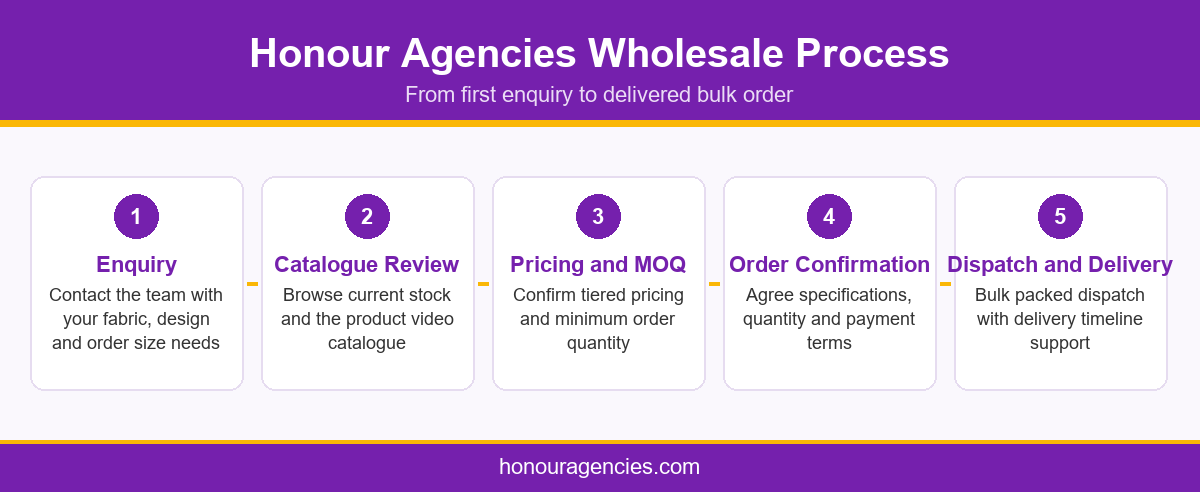
Honour Agencies, trading as Tonart International, has operated as a wholesale saree and fabric business from Broadway, Ernakulam for 35 years. About Honour Agencies covers the fuller history, but the practical process for a new buyer is straightforward and built around the same vetting principles covered earlier in this guide.
A typical order begins with an enquiry through the contact our team page, followed by a review of current stock, often supported by the product videos catalogue so buyers can see fabric drape and design detail before committing. From there, Honour Agencies confirms pricing tiers and minimum order quantities based on the buyer's needs, whether that is a boutique building a seasonal range or an institutional buyer sourcing uniform stock.
Once an order is confirmed, buyers can expect clear communication on dispatch timelines, packaging suited to bulk transport, and support for any quality concerns raised after delivery. This structured process is what has let Honour Agencies serve boutique owners, institutional buyers and increasingly international retailers through the same wholesale ordering channel for over three decades.
The buyers who get the most value from wholesale saree sourcing are the ones who treat a good supplier as a long term partner rather than a one time transaction. Repeat buyers typically get earlier access to new stock, more flexible order sizes over time, and pricing that reflects an established relationship rather than a first time negotiation.
A single supplier relationship, however strong, rarely covers every need a growing boutique will have. Buyers benefit from building a small network of two or three trusted wholesale sources, each strong in a different fabric category or price point, so that stock planning is not dependent on any single supplier's availability.
For buyers ready to place their first bulk order, a comprehensive guide to buying wholesale sarees for your boutique, making a bulk saree order without hassle and the checklist for purchasing bulk sarees online all cover the practical steps of the ordering process itself, from confirming specifications to arranging payment and delivery.
For ongoing learning beyond this guide, our blog carries further buying guides covering specific fabrics, markets and buyer types, updated as sourcing conditions and design trends shift across the year.
Buying wholesale saree stock well comes down to understanding what wholesale actually means, sourcing from the right mix of markets, factories, dealers and online suppliers, vetting each supplier properly, and negotiating fair MOQs and pricing. Retailers who treat this as a structured process, not a one off purchase, build stronger margins and steadier stock over time. Honour Agencies has supported boutique owners, institutional buyers and retailers with wholesale saree sourcing from Ernakulam for 35 years. To discuss your next bulk order, get in touch or explore the wholesale program directly.


Or login with