
Women danim jacket
$249.00

Red formal dress
$129.00

Man winter blazer
$149.00$99.00
Subtotal$477
 Wholesale Sarees
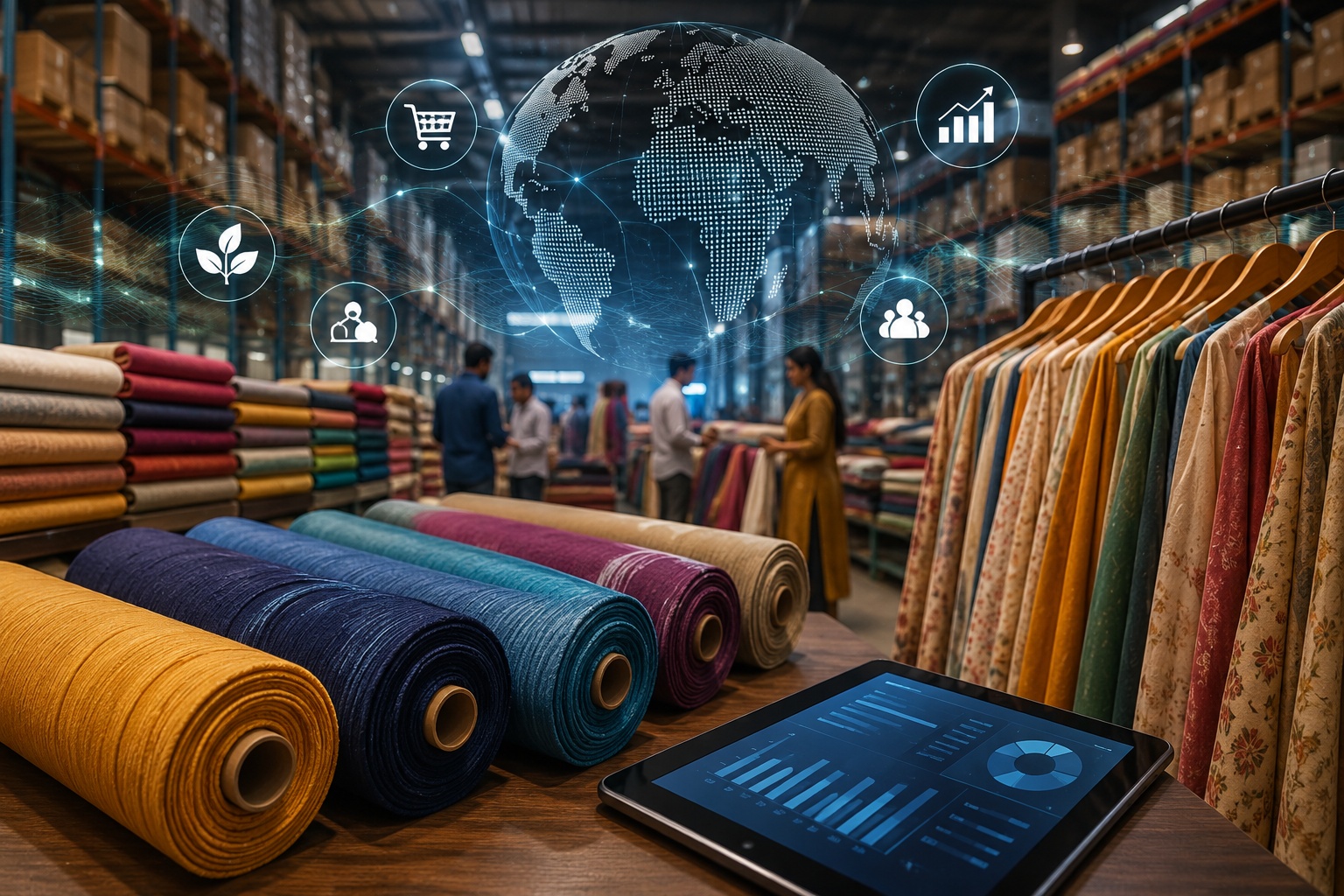
Kerala's wholesale textile market has grown from a regional sourcing hub into a supply base that boutiques, institutional buyers, and resellers across India now depend on for sarees, uniform fabric, and bulk material. That growth is not standing still. Digital ordering, sustainability expectations, shifting institutional demand, regional weaves finding new markets, and raw material cost swings are all changing how buyers source and how suppliers operate within this market at the same time. Buyers who sourced the same way for a decade are now finding that the suppliers winning repeat business look and operate differently than they did even a few years ago. This guide walks through the trends most likely to shape Kerala's wholesale textile market over the next few years, and what each one means practically for retailers, boutique owners, and institutional buyers planning their sourcing strategy for the seasons ahead.
Digital sourcing channels, sustainability expectations, and institutional demand are the three forces doing the most to reshape how buyers source from Kerala's wholesale textile market right now. Retailers who track raw material pricing trends and build direct manufacturer relationships tend to secure more stable margins than those buying reactively month to month. Kerala's traditional weaves, from kasavu to set mundu, are increasingly finding demand well beyond the state, which is opening export-adjacent opportunities for wholesale suppliers positioned to meet it, while supply chain consolidation is quietly changing who buyers choose to source from in the first place.
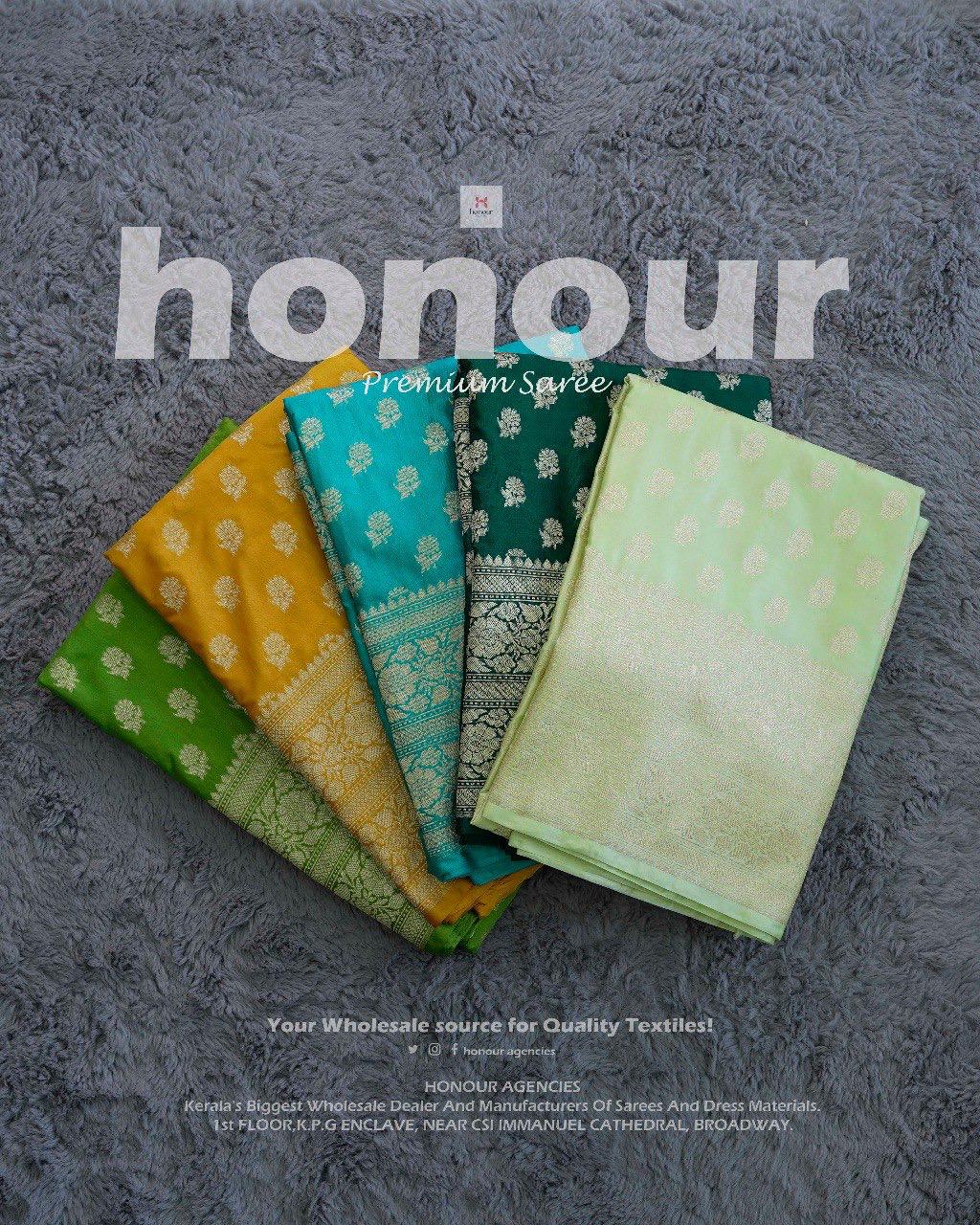
Kerala's wholesale textile sector spans saree wholesalers, uniform fabric suppliers, blouse material and running fabric dealers, and traditional weave specialists concentrated around hubs like Ernakulam, alongside a wider network of manufacturers and resellers spread across the state. The market serves two distinct buyer groups with meaningfully different needs: institutional buyers sourcing uniform sarees for schools, hospitals, hotels, and airlines, who prioritize consistency and bulk reliability over design trends, and retail-facing boutiques and resellers buying general wholesale saree and fabric stock aimed at fashion-conscious end customers who expect fresher designs each season. Both buyer groups have historically sourced through in-person market visits, trade relationships built over years, and word-of-mouth supplier referrals, and this relationship-driven foundation is still the backbone of how most large orders get placed today. That baseline is still active and still valuable, but it is no longer the only way buyers engage with the market, and suppliers who only operate through it are starting to see slower growth relative to competitors layering in newer sourcing channels alongside it. Government data from the Ministry of Textiles continues to show textiles as one of India's largest employment-generating sectors nationally, and Kerala's wholesale saree and fabric trade is a meaningful regional contributor within that broader industry, which means shifts at the national policy and demand level, from raw cotton availability to export incentives, tend to eventually show up in local wholesale pricing and supply too, even when the connection isn't immediately obvious to a retail-facing buyer. Buyers who follow national textile industry news alongside their day-to-day supplier relationships tend to anticipate local price and supply shifts a season earlier than those who only react once a change reaches their own supplier's quoted pricing.
The single biggest operational shift in Kerala's wholesale textile market over the past few years has been the move toward digital-first ordering, even among buyers who still value in-person relationships for larger or more customized orders. This is not a replacement of traditional sourcing so much as a layering of new channels on top of it, and buyers who ignore the digital layer entirely are increasingly at a disadvantage when it comes to speed, price transparency, and access to new stock ahead of competitors. This shift has also lowered the barrier for smaller boutiques and first-time buyers to engage with the market at all, since browsing a digital catalog or messaging a supplier for indicative pricing carries far less friction than arranging a physical market visit, particularly for buyers based outside Kerala who previously needed to plan a dedicated sourcing trip before placing even a modest first order.
More Kerala wholesale saree and fabric suppliers now maintain digital catalogs, allowing retailers to browse available stock, check indicative pricing, and place preliminary bulk orders without a physical market visit for every single reorder. This matters most for repeat buyers who already know their supplier and specification requirements, since it cuts down the lead time between deciding to reorder and actually placing that order, which can matter significantly during a fast-moving festive season when stock moves quickly. See our guide on running material wholesale online for how this shift plays out specifically in the running fabric category, where reorder speed tends to matter more than in slower-moving design-led categories.
Direct messaging and social platforms have become an unofficial but genuinely important B2B sales channel, with suppliers sharing new stock arrivals, pricing updates, and even taking bulk orders directly through WhatsApp Business accounts rather than requiring a formal order form. Retailers who build a direct messaging relationship with their supplier often get earlier access to new arrivals and seasonal stock than those relying purely on periodic market visits, which is increasingly worth factoring into how a buyer chooses and maintains a supplier relationship over time, not just how they place a single order.
Despite this shift, very few buyers in this market are sourcing purely online, and for good reason. Fabric quality, drape, and color accuracy are genuinely difficult to judge from a photo alone, and most experienced buyers still want to physically inspect a sample before committing to a large bulk order, particularly for higher-value categories like kasavu or designer fabric. The realistic near-term picture is a hybrid model, where digital channels handle discovery, reordering, and price checking, while physical inspection remains part of the process for new suppliers or new fabric categories.
Sustainability has moved from a niche preference to a baseline expectation among a growing share of boutique and retail buyers, particularly those selling to environmentally conscious end customers in metro markets who now ask sourcing questions their own customers are asking them. Wholesale suppliers who cannot speak to their sourcing and production practices are starting to lose ground to those who can, even when the underlying fabric quality is genuinely comparable between the two. This shift is happening gradually rather than all at once, but it is happening consistently enough across enough buyer segments that suppliers treating it as a passing fashion-industry trend, rather than a lasting change in buyer expectations, risk being caught off guard within the next few buying cycles.
Interest in organic cotton, natural dyes, and zero-waste production methods has grown steadily among fashion designers and boutique buyers sourcing wholesale fabric, not just among niche sustainable-fashion brands operating at a small scale. Our piece on the zero-waste challenge facing fabric suppliers covers how this demand is changing supplier practices in more detail, including how offcut and scrap fabric is increasingly being repurposed rather than discarded as waste.
Traceability and Ethical Sourcing Expectations
Buyers increasingly want to know where fabric was woven, dyed, and finished, particularly for institutional and corporate contracts where the end client may ask sourcing questions directly as part of a formal procurement process. Suppliers who can document their supply chain clearly, even informally through photos, supplier names, or basic certifications, are better positioned to win and retain these larger institutional accounts as this expectation continues to grow across both government and private-sector procurement.
Formal certifications like GOTS organic cotton or OEKO-TEX are still uncommon among Kerala wholesale suppliers compared to larger export-focused manufacturers, but buyer awareness of these labels is rising, particularly among younger boutique owners building brands with a sustainability angle from day one. Suppliers do not necessarily need formal certification to compete effectively today, but being able to answer basic questions about dye process, water usage, and offcut handling in plain language is quickly becoming table stakes for winning business from this buyer segment, even before formal certification becomes a widespread requirement in this market.
Institutional demand for uniform sarees, from schools and hospitals to hotels and airlines, has remained one of the steadiest growth segments in Kerala's wholesale textile market, and current indicators suggest this will continue over the coming years rather than slow down. Institutional buyers value consistency, bulk reliability, and durability over trend-driven design, which makes this segment considerably less exposed to the same fast-changing preferences that affect general fashion wholesale demand season to season. Growing formalization across schools, healthcare facilities, and hospitality chains in and beyond Kerala continues to feed steady bulk order volume for uniform saree specialists, and this pattern shows no signs of slowing given how many institutions are only now standardizing uniform policies for staff and students for the first time. Front office and hospitality-facing roles in particular have seen growing demand for uniform sarees that balance a professional appearance with all-day wearability, a combination that pushes suppliers toward specific fabric weights and finishes rather than the broadest possible design range. Healthcare institutions add another layer of specification on top of this, since hospital uniform sarees need to withstand frequent, high-temperature industrial laundering without losing color or shape, which rules out several fabric and dye combinations that work perfectly well in a lower-wash-frequency office setting. Suppliers who understand these sector-specific durability requirements, rather than treating all institutional orders as interchangeable, are increasingly the ones winning repeat annual contracts rather than one-off orders. Read our overview of top uniform saree collection ideas for institutions for how supplier ranges are evolving to match this steady, less cyclical demand.
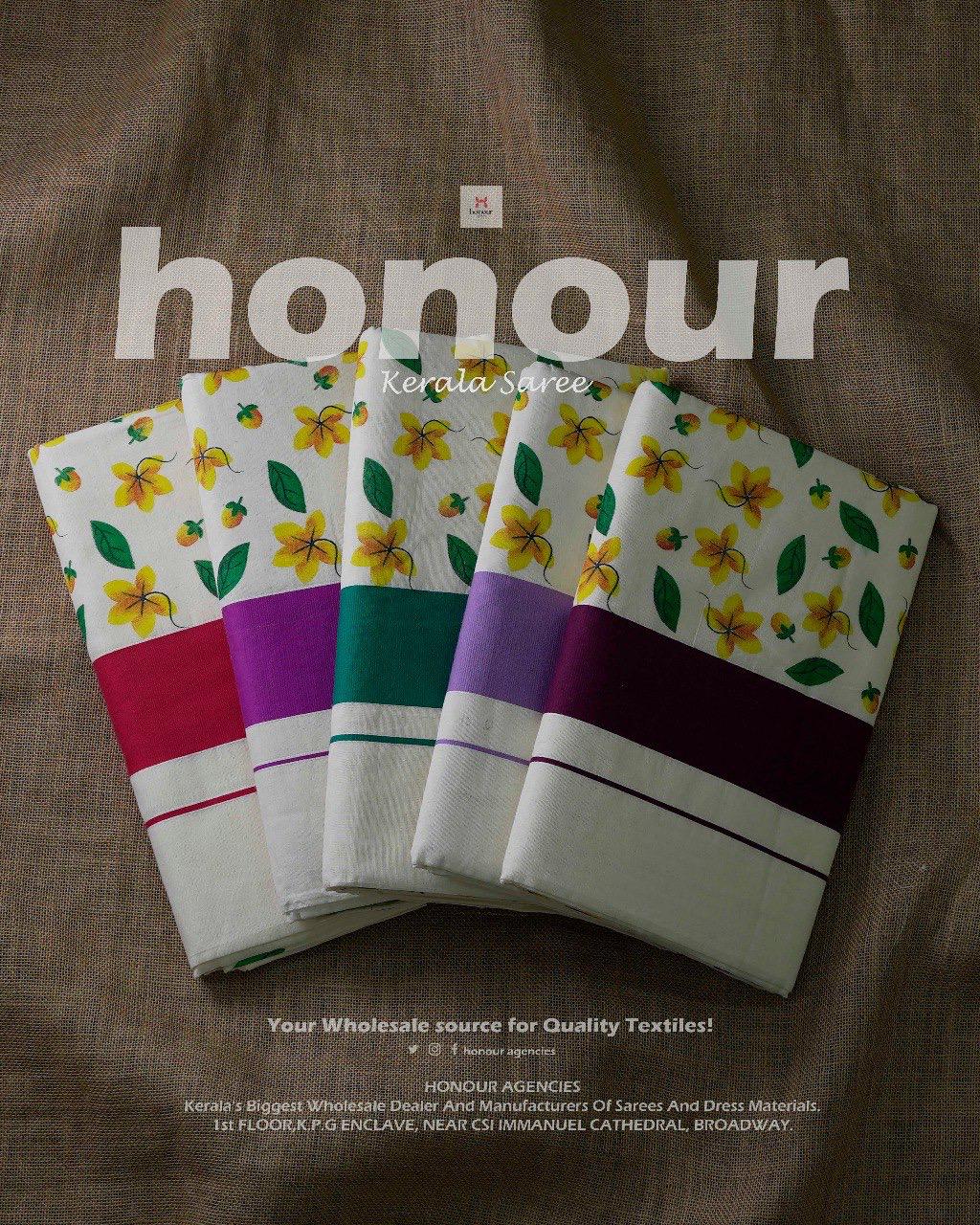
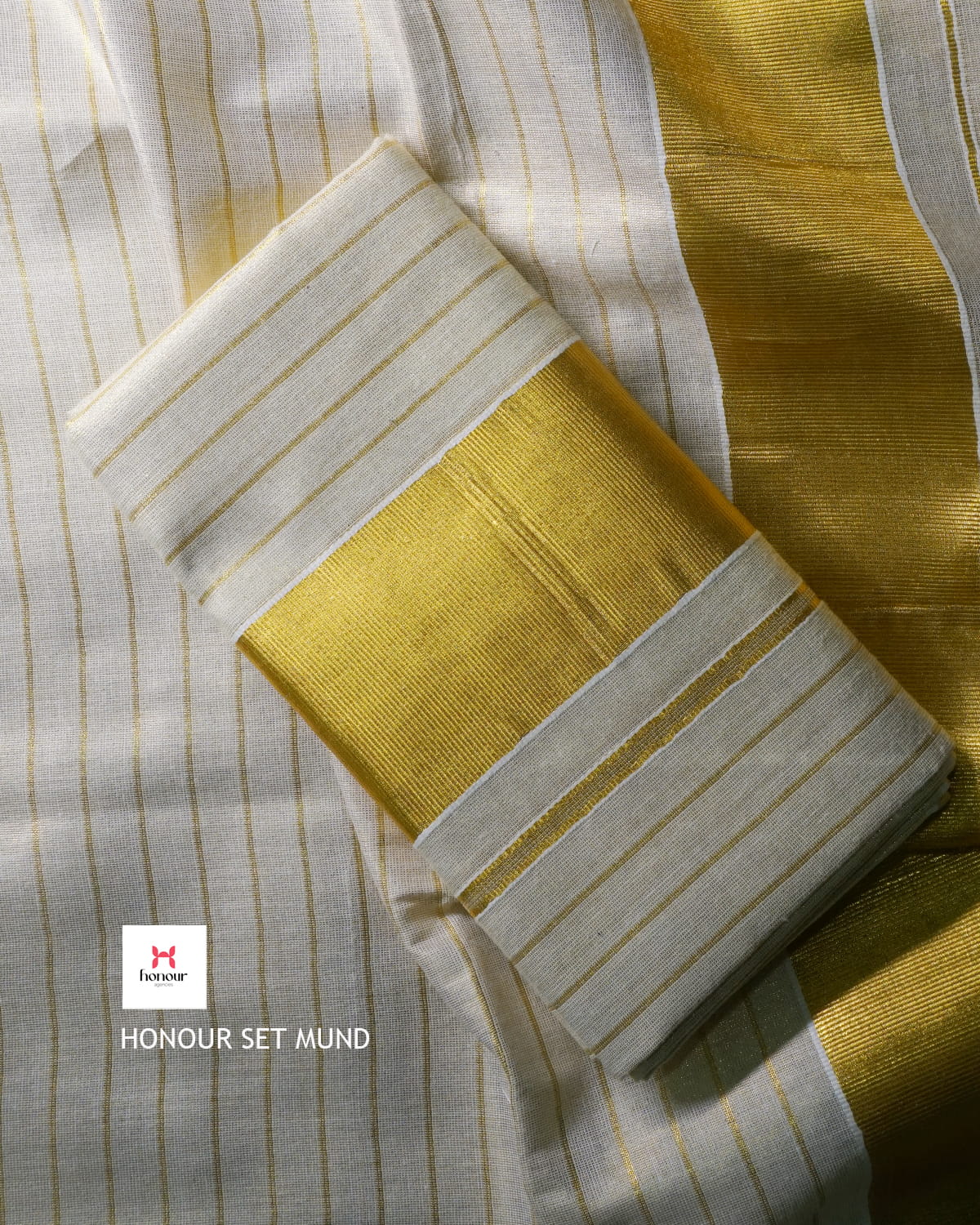
Kasavu, set mundu, and other traditional Kerala weaves are increasingly finding demand from buyers well outside the state, driven partly by growing national interest in regional Indian textiles and partly by diaspora demand during festival seasons like Onam, when demand for authentic kasavu spikes well beyond what local Kerala demand alone would generate. Wholesale suppliers who can fulfil larger, non-local orders reliably, including shipping logistics and consistent quality across a large batch, are capturing a growing share of this demand, while suppliers limited to purely local supply relationships are missing an expanding opportunity that did not exist at this scale even a few years ago. Industry tracking from IBEF's textile sector overview points to continued growth in regional and handloom-adjacent textile demand nationally, a pattern broadly consistent with what Kerala wholesale suppliers are reporting anecdotally in kasavu and set mundu categories specifically. This growing national appetite also means Kerala suppliers are increasingly competing, in a good way, for attention alongside handloom clusters from other states, which is pushing quality and authenticity expectations upward across the category as a whole. Buyers outside Kerala sourcing kasavu or set mundu for the first time often underestimate how much genuine weave and zari quality can vary within what gets marketed under the same broad category name, which makes a trustworthy supplier relationship even more important for out-of-state buyers who cannot easily inspect a sample in person before a large order ships. Our guide to exploring the Kerala saree wholesale market covers how this segment fits into the broader wholesale landscape for buyers considering sourcing it for the first time.
More retailers and boutique owners are choosing to buy directly from manufacturers rather than through multiple layers of distributors, a shift driven mainly by margin pressure and a growing preference for direct quality control over the fabric being purchased at scale. This does not mean distributors are disappearing from the market, since many smaller retailers still value the lower minimum order quantities and greater flexibility distributors offer compared to manufacturers, who often require larger minimum orders to make direct dealing worthwhile. It does mean, however, that suppliers positioned to serve both direct buyers and distributor-mediated buyers under one roof have a genuine advantage over those built to serve only one model, since buyer preference on this question increasingly depends on order size rather than a fixed preference either way. Our guide on why retailers prefer buying sarees from wholesale fabric suppliers instead of manufacturers walks through both sides of this decision in more depth, since the right choice depends heavily on order volume, how much quality control the buyer wants to retain directly, and how much flexibility they need on order size from one season to the next. A related pattern showing up alongside this shift is consolidation among the distributors themselves, with smaller, single-category distributors increasingly partnering with or being absorbed by larger multi-category wholesalers who can offer sarees, uniform fabric, and blouse material under one relationship, reducing the number of separate suppliers a retailer needs to manage.
Cotton and silk yarn prices have shown more volatility over recent years than wholesale buyers were historically used to, driven by a mix of global cotton supply swings, monsoon variability affecting domestic crop yields, and input cost changes across the dyeing and finishing stages that eventually feed into finished fabric pricing. Retailers who lock in supply agreements or place larger seasonal orders ahead of expected price movement, particularly before major festive seasons when demand and pricing both tend to move upward together, generally manage this volatility better than those buying reactively month to month without any forward planning. Suppliers who communicate pricing changes transparently, rather than passing through sudden increases without warning close to a festive deadline, are also becoming a meaningfully more attractive long-term sourcing partner for buyers trying to plan budgets accurately across a full buying season rather than reacting order by order. Buyers newer to bulk sourcing sometimes assume wholesale pricing is largely fixed once negotiated, when in practice it tends to shift gradually across a season in response to these underlying raw material pressures, making a supplier relationship built on clear communication genuinely valuable rather than a nice-to-have. Buyers sourcing higher-value categories like kasavu or designer fabric feel this volatility even more acutely than buyers of basic cotton, since zari and silk content prices can move independently of general cotton trends, which is another reason to ask a supplier directly how they price these categories rather than assuming a flat percentage markup applies uniformly across the whole catalog.
Taken together, these trends point toward a wholesale textile market that rewards buyers who diversify their sourcing channels, ask suppliers direct questions about sustainability and traceability, and plan bulk orders ahead of expected price movement rather than reactively placing orders as stock runs low. Retailers who treat their wholesale supplier relationship as a genuine ongoing partnership, rather than a purely transactional one renegotiated from scratch every order, are best positioned to benefit from earlier access to new stock, more transparent pricing, and more consistent quality across repeat orders over time. None of these shifts require abandoning the relationship-driven sourcing style Kerala's textile market has always run on; they simply add new layers worth paying attention to alongside it, whether that means asking a long-standing supplier about their sustainability practices for the first time or checking their digital catalog before the next physical market visit. Buyers who start incorporating even one or two of these practices, rather than waiting to overhaul their entire sourcing approach at once, tend to see the benefits show up gradually across subsequent orders rather than all at once. It is also worth building in a periodic check-in with existing suppliers, even long-standing ones, to confirm their sustainability practices, digital ordering options, and pricing communication still match what the buyer's own end customers or institutional clients now expect, rather than assuming a supplier relationship that worked well five years ago has automatically kept pace with these changes on its own.
Kerala's wholesale textile market is not being disrupted so much as it is layering new sourcing channels, sustainability expectations, and buying behaviors on top of a foundation that has worked for decades. Digital ordering, growing institutional demand, rising interest in traditional weaves beyond the state, supply chain consolidation toward direct manufacturer buying, and closer attention to raw material pricing are the trends most worth tracking over the next few years. Retailers and boutique buyers who stay ahead of these shifts, while still valuing the direct supplier relationships this market has always been built on, are best placed to source confidently as Kerala's wholesale textile market continues to evolve around them. None of these trends require a complete overhaul of how a retailer sources today; the buyers who benefit most tend to be the ones who adopt these changes gradually, order by order, rather than waiting for a single moment to switch their entire sourcing approach at once. To source sarees, uniform fabric, or wholesale material directly from an established Kerala supplier built for how this market is changing, get in touch with Honour Agencies through our wholesale inquiry page.
What are the biggest trends shaping Kerala's wholesale textile market right now?

Digital sourcing channels, growing sustainability expectations, steady institutional uniform demand, rising interest in traditional weaves beyond Kerala, and raw material price volatility are the trends currently having the most impact on how buyers source from this market.
Is online sourcing replacing traditional wholesale saree markets in Kerala?
Not entirely. Online catalogs and messaging-based ordering are layering onto traditional market visits and supplier relationships rather than replacing them, giving buyers more channels to source through without losing the in-person trust this market has always relied on.
How is sustainability changing wholesale fabric sourcing in Kerala?
Boutique and retail buyers increasingly expect suppliers to speak to their sourcing and production practices, including organic cotton use and dye methods, which is pushing more wholesale suppliers to document and communicate their supply chain practices clearly.
Will demand for uniform sarees keep growing?
Current indicators suggest yes. Institutional buyers value consistency and bulk reliability over trend-driven design, and continued formalization of uniform policies across schools, hospitals, and hospitality chains is feeding steady, less cyclical demand for this category.
Are Kerala's traditional weaves gaining demand outside the state?
Yes. Kasavu, set mundu, and other traditional weaves are seeing growing national interest alongside diaspora demand during festival seasons, and suppliers able to fulfil larger non-local orders are capturing an increasing share of this expanding market.
How is raw material price volatility affecting wholesale saree and fabric pricing?
Cotton and silk yarn prices have become more volatile due to global supply swings and monsoon variability, making seasonal supply agreements and advance bulk ordering more valuable tools for retailers trying to manage costs predictably across a full buying season.
Should retailers buy directly from manufacturers instead of distributors?
It depends on order volume and how much quality control the buyer wants. Direct manufacturer buying suits larger, consistent orders, while distributors still offer flexibility and lower minimum order quantities that many smaller retailers continue to value.
What should boutique owners look for in a future-ready wholesale supplier in Kerala?
Look for suppliers offering both traditional and digital ordering channels, clear communication on sourcing and pricing, and a track record of reliable bulk fulfilment, since these traits increasingly separate suppliers adapting well from those falling behind.
Is Kerala's wholesale textile market only relevant to buyers within the state?
No. Retailers and institutional buyers across India increasingly source uniform sarees, kasavu, set mundu, and wholesale fabric from Kerala, one of the notable current growth trends. See our guide to choosing the best Kerala saree wholesale supplier for tips.
How can retailers stay ahead of these wholesale textile market trends?
Diversify sourcing channels, ask suppliers direct questions about sustainability and traceability, place seasonal orders ahead of expected price movement, and prioritize suppliers who treat the relationship as an ongoing partnership rather than a one-time transaction.
Or login with