
Women danim jacket
$249.00

Red formal dress
$129.00

Man winter blazer
$149.00$99.00
Subtotal$477

 Running Material
Designers lose more money at the sampling stage than anywhere else in production, usually by skipping it. A cloth that looked right as a swatch behaves differently as a garment, and by the time that is discovered the bulk roll is paid for. Fabric sampling for fashion designers is a sequence, not a single request, and running it properly costs a little time and saves entire collections. This guide sets out the workflow from first swatch to committed bulk order.
Start by collecting rather than deciding, and collect continuously rather than only when a project demands it. A working swatch library, organised by fibre and weight rather than by supplier, lets you answer a design question in minutes instead of waiting for samples to arrive from three sources.
Label every swatch properly at the moment it arrives. Supplier, quality reference, fibre content, GSM, usable width and price. An unlabelled swatch is decorative, and a beautiful cloth you cannot re source is worse than no cloth at all.
Understand what a swatch does and does not prove about the textile itself. It shows colour, surface, hand feel and roughly how the cloth takes light. It tells you almost nothing about drape at garment scale, how it behaves when cut, how it sews or how it survives washing.
Keep the library current. Qualities are discontinued, prices move and suppliers change their ranges, so a board of swatches collected three years ago will send you chasing cloth that no longer exists. A short review each season, marking what is still available, keeps the library useful rather than nostalgic.
Use the library to shortlist, never to commit. Two or three candidates chosen from swatches should then go forward to sample yardage, which is where the real decisions get made. Our note on sourcing premium fabrics from wholesalers covers building supplier relationships that make sampling easy.
Order enough sample yardage to make a complete garment, not a panel. Drape is a function of the whole piece, and a two metre cutting will not show you how a full skirt falls or how a saree behaves over its length.
Sew the sample the way production will. If bulk will be made with a particular seam finish, interfacing and hem, the sample needs those too, because each of them changes how the finished garment hangs and holds shape.
Hang the made up sample for at least twenty four hours before judging it. Many fabrics, particularly bias cut and loosely woven ones, drop and settle after being made up, and a hem that looked level on the table will not be after a day on a hanger.
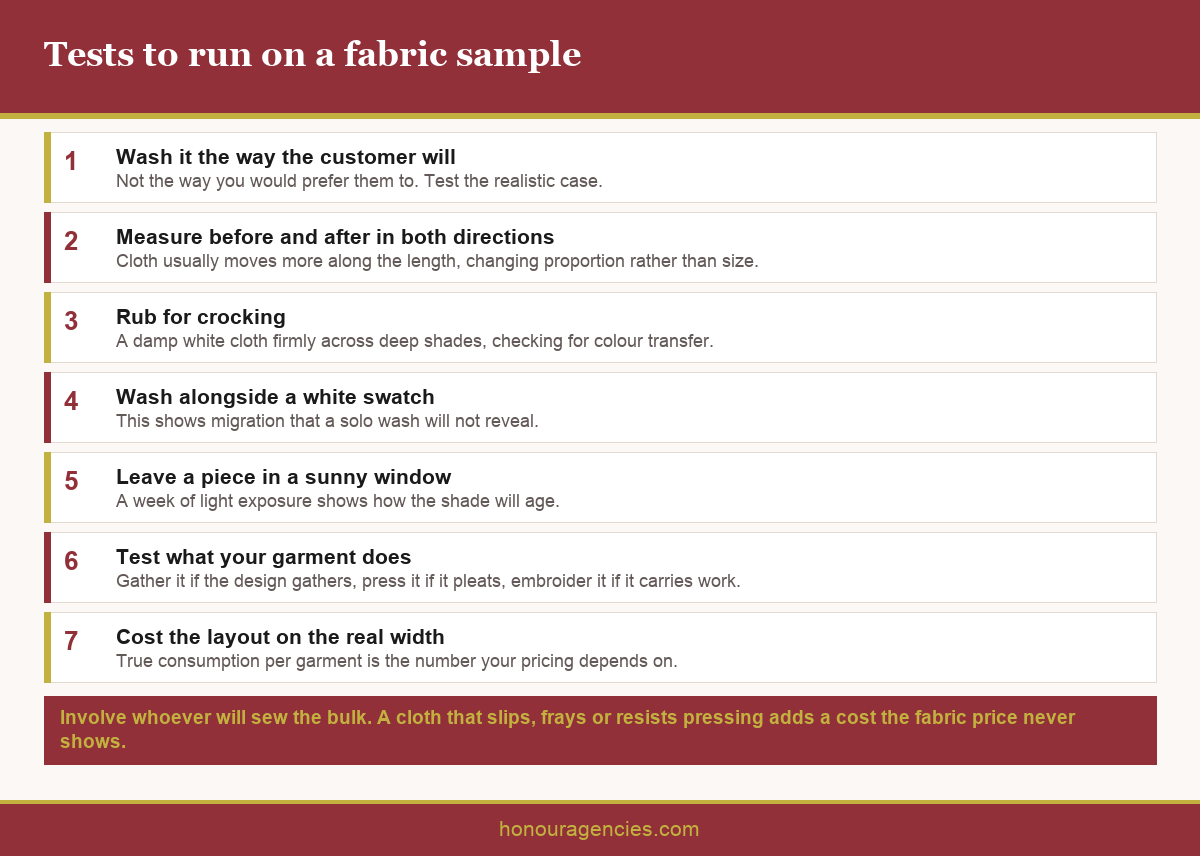
Cost the sample properly while you have it. Laying out the pattern on the actual width tells you the true consumption per garment, which is the number your pricing depends on. Estimating consumption from a similar fabric is where a great many collections quietly lose their margin before a single piece is sold.
Photograph the sample on a person under normal light. Fabrics that look extraordinary in a studio can read as flat or shiny in a shop or in daylight, and a designer selling online in particular needs to know how the cloth photographs before committing.
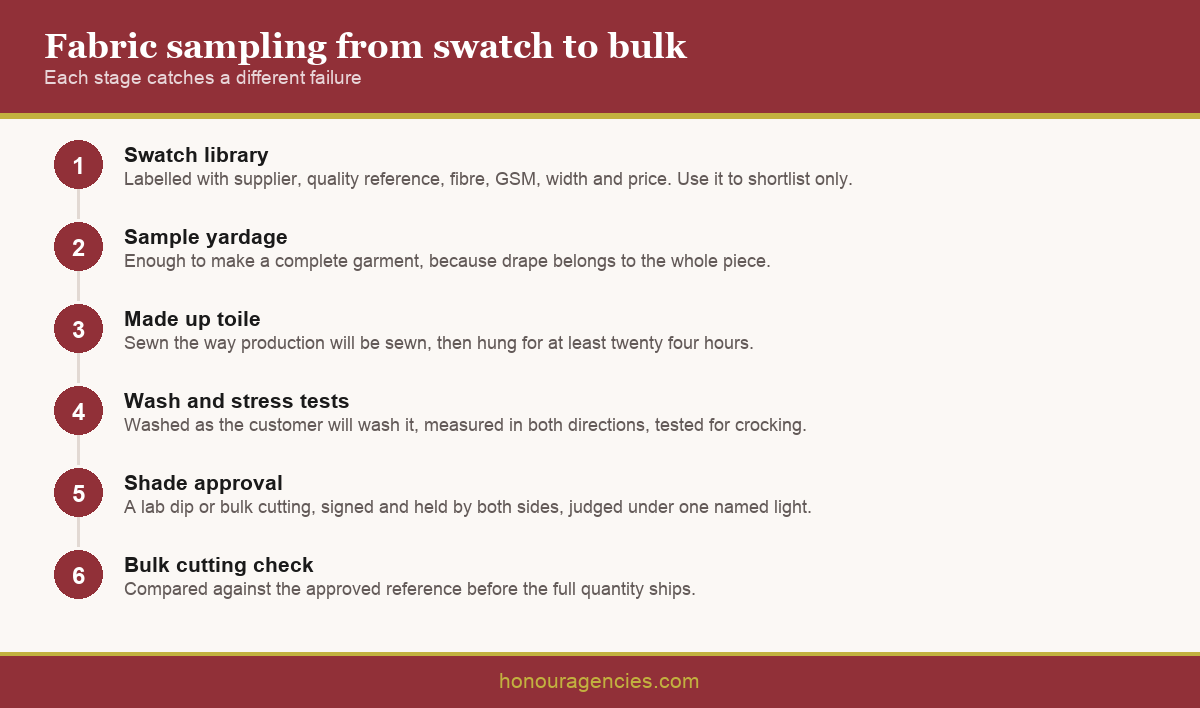
Wash the sample the way the customer will, not the way you would prefer them to. If a garment will realistically go into a domestic machine, test it that way rather than testing a gentle hand wash and hoping.
Measure before and after in both directions. Cloth usually moves more along the length than across the width, so a garment can change proportion rather than simply shrinking. Mark a square on the sample so both axes are captured.
Check colour behaviour under stress. Rub a damp white cloth firmly across deep shades to test colour fastness to crocking, wash the sample alongside a white swatch to check for migration, and leave a piece in a sunny window for a week to see how it fades.
Involve whoever will sew the bulk. A cloth that slips, frays badly or resists pressing creates a production cost that never appears in the fabric price, and the person at the machine will identify it in ten minutes. Designers who sample without consulting production regularly commit to fabrics that are expensive to make up.
Test the things specific to your garment. If the design is heavily gathered, gather a length and look at the bulk. If it will carry embroidery, have a motif worked on a sample to check for puckering. If it needs pressing into pleats, press it and see whether they hold.
Understand that bulk will not come from the sample's dye lot. This single fact causes more production disappointments than any other, and it is why a sample approval is not a shade approval.
Ask for a lab dip or a bulk cutting in the actual shade before the full run. Approve it physically, sign and date it, keep one copy and require the wholesale fabric supplier to hold the matching piece against your account.
Compare under a consistent light source and name it. Shade comparisons made under a shop tube, a north window and warm evening light will not agree, and most colour disputes come down to two people looking at the same cloth in different rooms.
State a tolerance in writing. No two runs are identical, so agree that bulk will be matched to the approved cutting within a stated visual tolerance and that anything outside it is returnable. A stated standard is treated seriously in a way an assumption never is.
Confirm in writing that the bulk specification matches the approved sample exactly. Fibre, count, GSM, usable width, finish and dyeing method should all be identical, because a supplier substituting a near equivalent will produce cloth that samples well and disappoints in production.
Order a cutting from the actual bulk lot before the full quantity is shipped to you. Comparing it against your approved reference takes minutes and catches a problem while it is still the supplier's to solve rather than yours.
Ask about continuity before you build a style around a cloth. Whether it is regular stock or a one time run, what the repeat minimum is, and how long the lead time runs. A signature fabric you cannot re source limits a successful style to whatever you first ordered.
Keep the whole record together. The labelled swatch, the sample garment, the approved shade cutting, the written specification and the test results form a file that makes the second order straightforward and the third one trivial. Designers working with specialist fabric merchants regularly find that this file is what earns them priority.
Fabric sampling for fashion designers runs from a labelled swatch library through sample yardage made into a real garment, wash and stress testing, a signed shade approval and a bulk cutting check before the full run ships. Each stage catches a different failure while it is still cheap. Skipping straight from a beautiful swatch to a bulk order is the most expensive shortcut in the business. Honour Agencies has supplied wholesale fabrics from Ernakulam for 35 years. To discuss a sampling requirement, contact our team.
Q: What does a fabric swatch actually prove? A: Colour, surface, hand feel and how the cloth takes light. It tells you nothing reliable about drape at garment scale, how the fabric cuts and sews, or how it survives washing.
Q: How much sample yardage should I order? A: Enough to make a complete garment rather than a panel. Drape is a property of the whole piece, and a short cutting will not show how a full skirt or a saree length actually falls.
Q: Should the sample be sewn like production? A: Yes. Use the same seam finish, interfacing and hem that bulk will use, because each of those changes how the finished garment hangs and holds its shape.
Q: Why hang a sample before judging it? A: Many fabrics, especially bias cut and loosely woven ones, drop and settle after being made up. A hem that looked level on the table often will not be after a day on a hanger.
Q: How should I wash test a fabric? A: The way the customer realistically will, not the way you would prefer. Mark a square, measure before and after in both directions, and wash alongside a white swatch to check for migration.
Q: Why is a sample approval not a shade approval? A: Because bulk production comes from a different dye lot than the sample. Ask for a lab dip or bulk cutting in the actual shade, approve it physically and have the supplier hold a copy.
Q: What is crocking? A: Colour transferring when the fabric is rubbed. Test it by rubbing a damp white cloth firmly across deep shades, since colour that lifts onto a cloth will lift onto skin and other garments.
Q: What tolerance should be agreed for bulk shade? A: A stated visual tolerance against the approved cutting under a named light source, with anything outside it returnable. Name the light, because most colour disputes come from different viewing conditions.
Q: Should I check the bulk before it ships? A: Always. Request a cutting from the bulk lot and compare it against your approved reference. It takes minutes and catches problems while they remain the supplier's responsibility.
Q: What should I ask before building a style around a fabric? A: Whether it is regular stock or a one time run, the repeat minimum and the lead time. Our guide to fabric suppliers for designers covers working with suppliers long term.

Or login with