
Women danim jacket
$249.00

Red formal dress
$129.00

Man winter blazer
$149.00$99.00
Subtotal$477

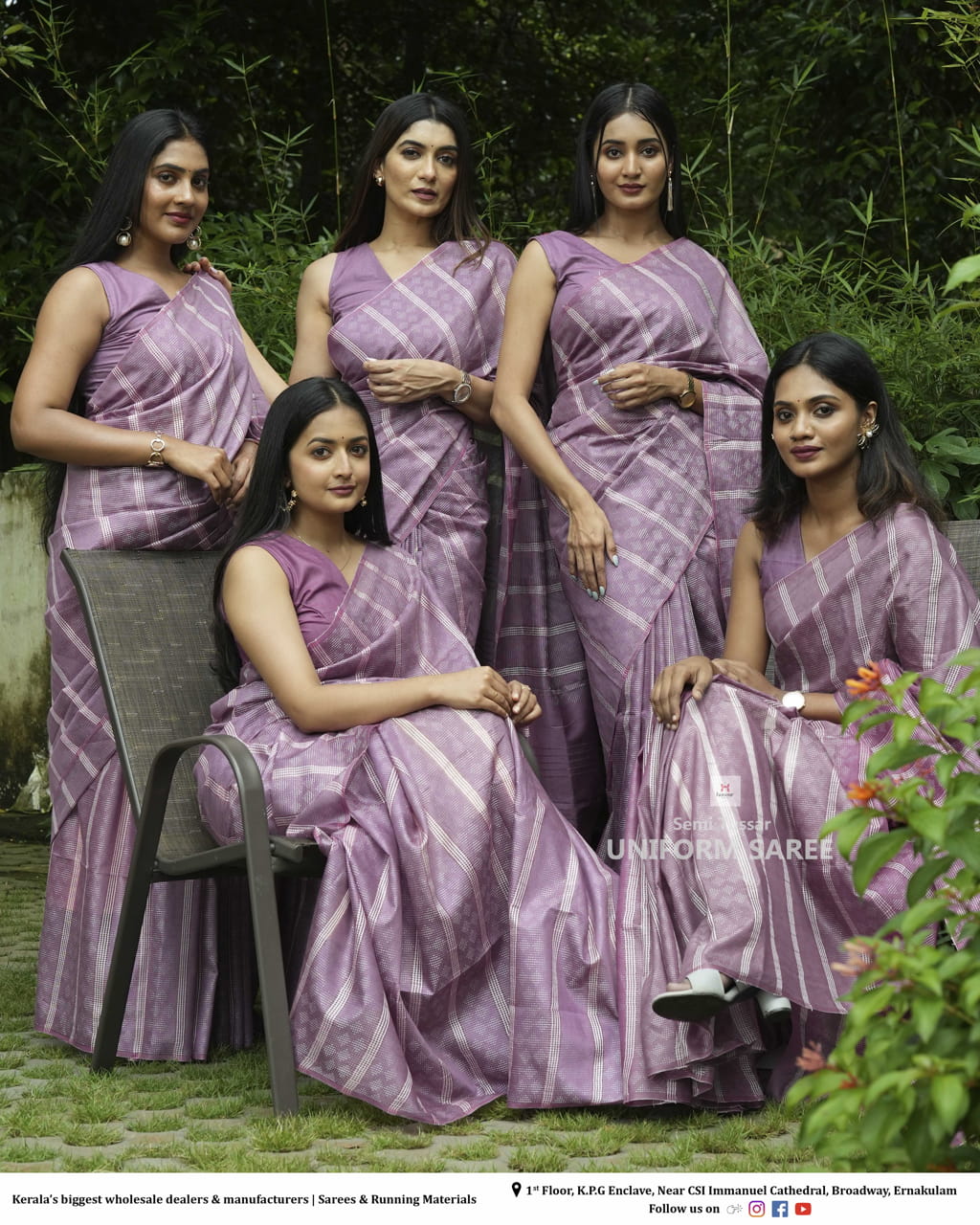
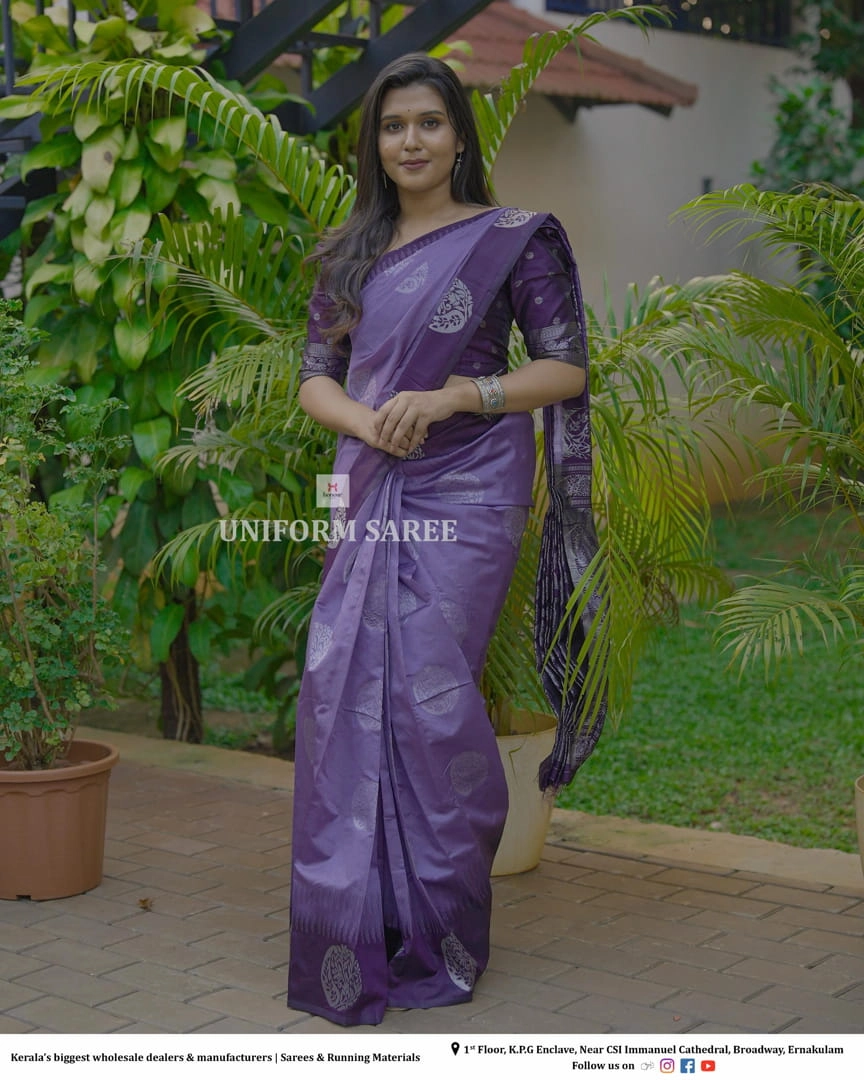
 Uniform Sarees
A hospital uniform saree does a harder job than almost any other garment an institution buys. It is worn through long shifts, washed at high temperature several times a week, and expected to look identical on the fiftieth wash as it did on the first. Buying one like an ordinary saree is where most procurement goes wrong. This guide covers the fabric, colour, sizing and reorder decisions that decide whether a hospital uniform saree lasts a year or three.
Healthcare is a demanding wear environment. Sarees are worn for eight to twelve hour shifts, often under warm conditions, and they are washed far more often than personal clothing. Many hospitals send uniforms to industrial laundry, where wash temperatures, mechanical action and detergent strength all exceed anything a domestic machine applies.
That combination attacks three things. It fades colour, it weakens the weave at fold lines and pleats, and it shrinks fabric that was not pre treated. A saree that performs beautifully in a retail context can fail badly here. The right starting question for any institutional sourcing conversation is not which design looks best, but how the cloth behaves after fifty industrial washes.
Comfort matters too, and it is not a soft consideration. Staff who find a uniform hot or scratchy will stop wearing it correctly, and the institution loses the visual consistency it paid for.
Weight is the quiet variable behind all of this. A lighter cloth feels better through a long shift but shows wear sooner at the pleats. A heavier cloth lasts longer and holds its drape but reads as warm in a Kerala summer. Most hospitals settle in the middle, and the useful move is to handle three weights from the same supplier before committing rather than picking from a description.
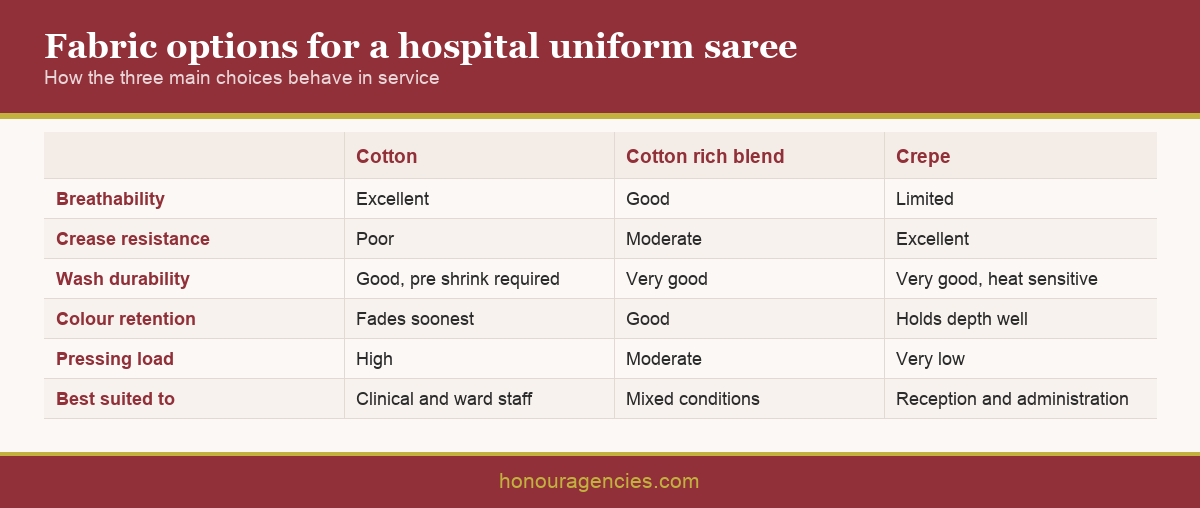
Cotton remains the default for clinical areas because it breathes, absorbs and tolerates hot washing. Its weakness is creasing and shrinkage, both of which are manageable if the fabric is pre shrunk and the specification allows a small tolerance. Polyester cotton blends crease far less and hold colour longer, at some cost to breathability. Crepe and poly blends drape well and suit administrative or reception roles better than clinical wards.
Weave construction deserves as much attention as fibre. A tightly woven plain cloth resists snagging and survives folding at the pleat line, while a loose weave feels softer in the hand and fails earlier at exactly that point. Ask to see the fabric folded and rubbed, not just draped, because folding is what a working day does to it.
There is no single correct answer. There is a correct answer per department. A useful rule is to match fibre to exposure: natural fibres where staff are physically active and warm, blends where appearance across a long day matters more than airflow. The relevant technical property is colour fastness, which describes how well a dyed fabric resists fading under washing, light and rubbing. Ask for it explicitly.
Our guide to choosing the right fabric for institutional wear covers the wider fibre comparison in more detail.
Most hospitals use colour to separate nursing, housekeeping, administration, laboratory and front desk staff. The system only delivers value if the colours stay distinguishable and stay constant. Two failures are common. The first is choosing shades that sit too close together, so a corridor glance cannot separate them. The second is shade drift, where this year's batch does not match last year's.
There is also a practical lighting trap. Shades that separate cleanly under daylight can collapse into each other under the warm fluorescent lighting used in many wards and corridors. Approve the palette under the lighting staff will actually work in, not at a shop counter near a window.
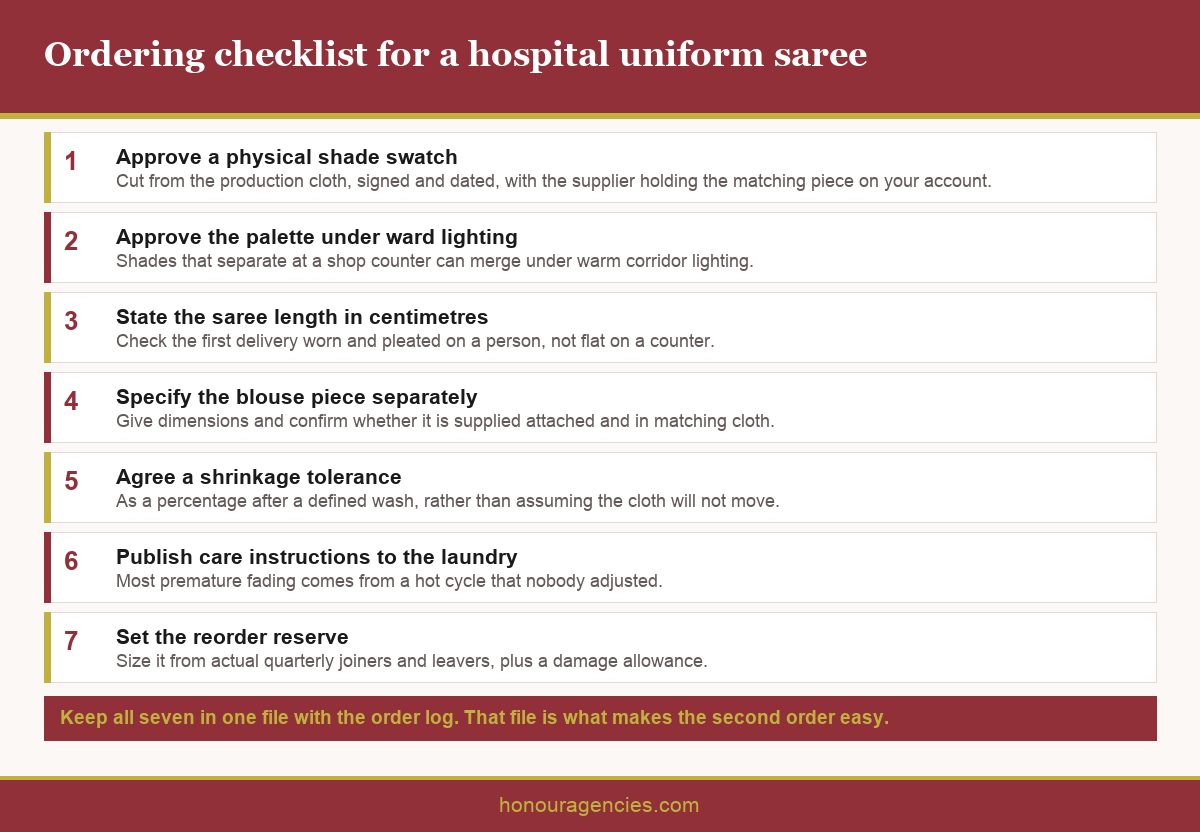
Drift is a sourcing problem, not a dyeing accident. Solve it by approving a physical shade swatch, keeping a signed copy at the hospital and requiring the supplier to keep the matching reference on file against your account. Every reorder is then checked against that swatch rather than a memory or a screen. Our note on choosing a colour that works for your brand explains how brand and function can be balanced when the palette is being set.
Keep the number of shades small. Every additional colour multiplies the stock the supplier has to hold for you, and slow moving shades are the ones that go out of stock first.
White and very pale shades deserve a separate decision. They read as clean and clinical, and they are also the first to show staining and the hardest to keep matched across batches. If a department must wear white, budget for a shorter replacement cycle rather than expecting the same life as a mid tone.
A saree is forgiving on body size but not on length, blouse material and fall. Institutional orders usually cover a wide range of staff, so specify saree length and the blouse piece dimensions in writing rather than assuming a standard. Where the hospital supplies stitched blouses, agree who holds the measurement records and how new joiners are handled.
Fall and pleat allowance are worth naming explicitly. A saree cut slightly short reads as ill fitting on taller staff, and the fault only appears once the garment is worn and pleated rather than when it is inspected flat on a table. Agree the length in centimetres, and check the first delivery on a person rather than on a counter.
Order in a way that matches how staff actually arrive. A hospital rarely recruits its whole workforce at once, so a single large order followed by silence leaves you exposed when twelve nurses join in March. Plan a main order plus a reserve, and confirm the supplier will hold the reserve against your shade reference.
The measure of a good institutional supplier is the second order, not the first. Anyone can match a shade once. Matching it eighteen months later, from the same yarn source, on a partial quantity, is the harder promise. Ask directly how long a supplier will hold a shade reference and what notice they need for a repeat run.
Keep your own records as tightly as theirs. A simple file holding the approved swatch, the agreed saree length, the wash care instruction and the dates and quantities of past orders removes almost all reorder friction. Institutions that manage large repeat orders well tend to be the ones that treat the specification as a living document rather than a one time decision.
Build one review point into the year. A short check at twelve months, comparing a worn saree against the filed swatch and a fresh piece, tells you whether the fabric is performing as specified or whether the laundry has quietly changed something. That single comparison catches problems while they are still a conversation rather than a full replacement cycle.
Finally, publish care instructions to the laundry, not just to staff. Most premature fading traces back to a wash cycle nobody told the laundry to change.
A hospital uniform saree is a technical purchase dressed as a textile one. Specify the fabric against wash performance, lock every department shade to a physical reference, write down lengths and blouse details, and plan reorders around staff turnover rather than the calendar. Get those four right and the uniform stays consistent for years instead of drifting batch by batch. Honour Agencies has supplied wholesale and institutional sarees from Ernakulam for 35 years. To discuss a hospital requirement, contact our team.
Q: What fabric is best for a hospital uniform saree? A: Cotton suits clinical areas because it breathes and tolerates hot washing. Polyester cotton blends suit administrative roles where crease resistance matters more. Match the fibre to each department rather than choosing one fabric for the whole hospital.
Q: How many washes should a hospital uniform saree survive? A: A well specified institutional saree should hold colour and structure through at least fifty industrial washes. Ask your supplier for the colour fastness rating and confirm the fabric is pre shrunk before you approve the order.
Q: Why do uniform saree colours change between orders? A: Dye lots vary. Without a physical shade reference held by the supplier, each production run drifts slightly. Approve a swatch, keep a signed copy and require every reorder to be matched against it.
Q: How many colours should a hospital use for departments? A: Keep it to four or five clearly separable shades. More colours look organised on paper but multiply the stock your supplier must hold, which makes the rarer shades the first to run out.
Q: Should hospitals order all uniforms at once? A: No. Place a main order sized to current staff and agree a reserve quantity against your shade reference. Hospitals recruit continuously, and a single large order leaves no cover for new joiners.
Q: Who should receive the wash care instructions? A: Both staff and the laundry provider. Most premature fading comes from an industrial wash cycle that nobody adjusted. Share the care specification with whoever actually controls the machine settings.
Q: Can hospitals order uniform sarees in small quantities? A: Many wholesale suppliers accept smaller repeat quantities once an account and a shade reference exist. The first order usually needs to be larger. Discuss reorder minimums before you commit to a shade.
Q: Do hospital uniform sarees need matching blouse material? A: Usually yes. Confirm whether the blouse piece is supplied attached, its dimensions, and who holds staff measurements. Leaving this unstated is a common cause of delay after the sarees arrive.
Q: How far ahead should a repeat order be placed? A: Allow four to six weeks for a repeat run in a held shade, and longer during festival season when mills are busy. Ask your supplier for their current lead time in writing rather than assuming last year's.
Q: What records should a hospital keep on its uniform? A: The approved shade swatch, saree length, blouse specification, wash care instruction and a log of past order dates and quantities. This file removes most reorder friction. Our institutional supply chain guide covers the process end to end.

Or login with