
Women danim jacket
$249.00

Red formal dress
$129.00

Man winter blazer
$149.00$99.00
Subtotal$477

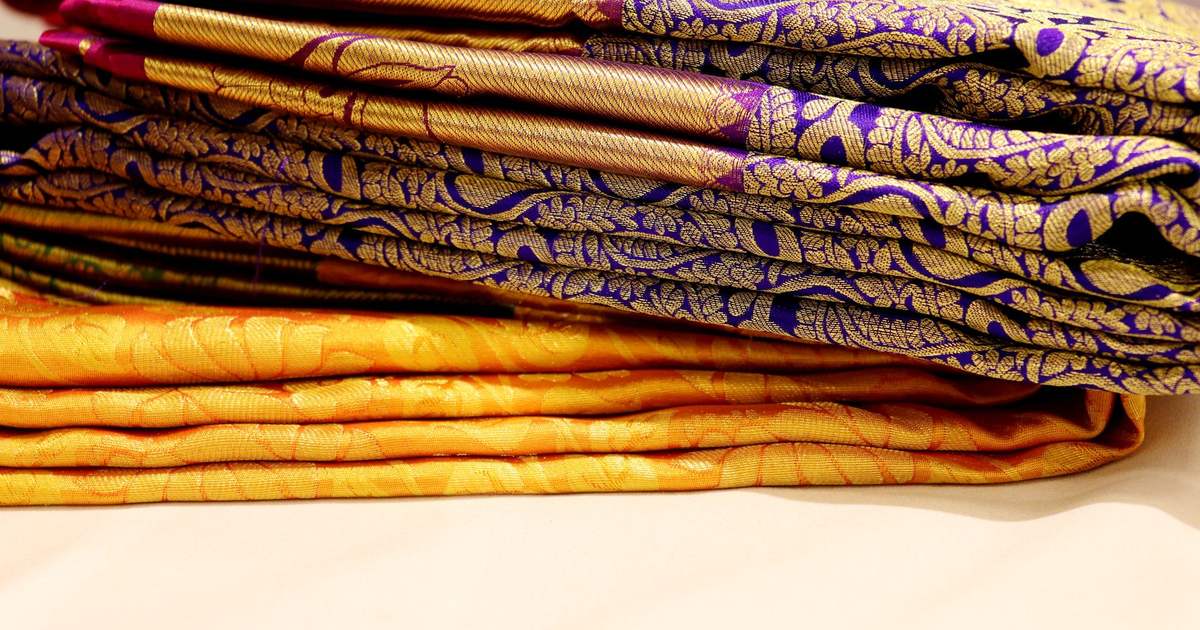 Wholesale Sarees
Designer sarees are the hardest category to buy sight unseen. The value sits in embellishment, drape and finish, and those are exactly the qualities a photograph flattens. That makes the choice between visiting a designer saree wholesale market and sourcing online a real commercial decision rather than a matter of convenience. This guide compares the two honestly, sets out where each wins, and describes the hybrid approach most experienced buyers actually use.
The first advantage is your hands. Designer sarees are judged on the weight of the fall, the density and security of the embellishment, the finish on the reverse and how the piece drapes on a body. All four are physical properties, and none survives a photograph intact.
The second is comparison. A market lets you place three sarees side by side under the same light and judge them against each other, which is a far more reliable way to make a decision than assessing individual images taken under different conditions by different sellers.
The third is negotiation and relationship. Terms, credit, exclusivity and future priority are all easier to establish face to face, and a supplier who knows you tends to call when something exceptional arrives. That informal channel is worth real money over a season.
There is also a learning benefit that only accrues in person. Handling fifty sarees in an afternoon teaches a buyer more about quality than a season of ordering from images, because the comparisons are immediate and physical. Newer buyers in particular should weight that education alongside the cost of the trip.
The fourth is speed of correction. If a piece is not right, you see it before it is paid for and shipped. Online, the same discovery happens after money and time have been committed, and the remedy depends entirely on the seller's returns policy. Our guide to the Broadway market in Ernakulam covers making a market visit productive.
Range is the clearest advantage. A buyer in a small town can access suppliers across several states without travelling, which widens the available selection far beyond anything a local market offers.
Time is the second. A market visit costs travel, accommodation and two or three working days, and for a small retailer placing modest orders that cost can exceed the margin the trip generates. Online ordering removes it entirely.
Records are the third and most underrated. Online transactions leave a trail of what was ordered, at what price, on what date, which makes reordering and price comparison straightforward. Market buying often relies on memory and a handwritten bill.
Remote ordering also removes the pressure of the moment. A market seller is present, persuasive and waiting for an answer, while an online cart can sit overnight. Buyers who find themselves talked into stock they did not plan to take often do better with a channel that allows a pause before committing.
Price transparency is the fourth, with an important caveat. Comparing listed rates across sellers is easy, but rates are not comparable unless the specification is, and designer saree listings are frequently vague about fabric, work type and finish. Our comparison of online platforms and direct dealers covers reading those listings carefully.
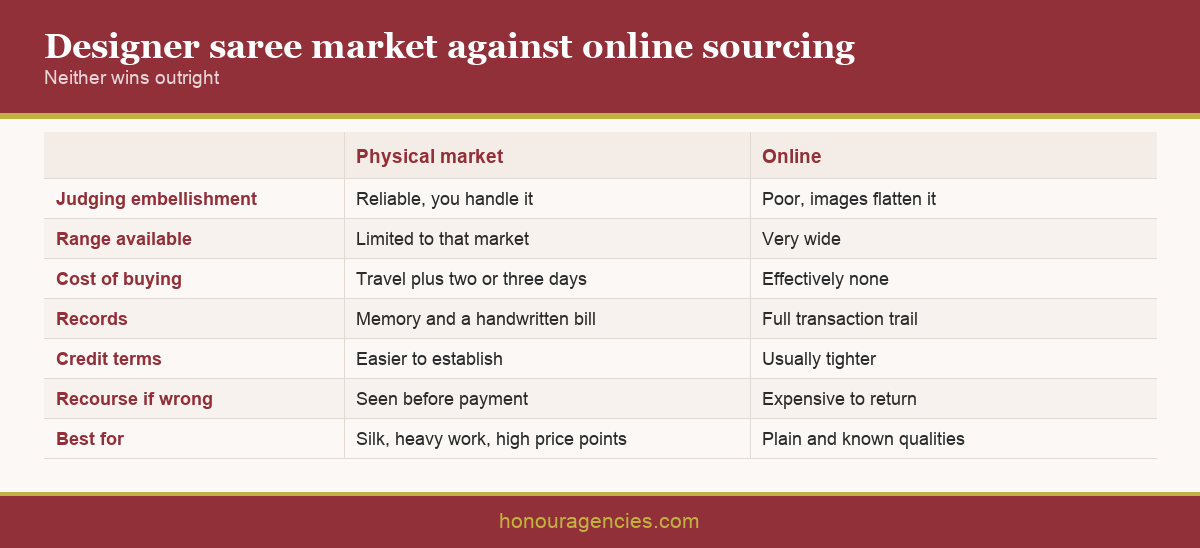
Markets fail on time and reach. They consume working days, they limit you to whoever trades in that market, and they force buying decisions under time pressure at the end of a trip, which is when poor choices happen.
They also encourage over buying. A buyer who has travelled feels obliged to fill the trip, and stock bought to justify a journey is rarely stock chosen against a plan. That tendency is worth guarding against deliberately.
Online fails on judgement for embellished goods. Colour reproduces unreliably across screens, embellishment density is impossible to assess from an image, and the reverse of a saree, where finish quality actually shows, is almost never photographed.
Payment terms are usually tighter online as well. Established market relationships often carry credit that a first time remote order will not, and for a retailer managing cash flow across a season that difference can outweigh a better headline rate.
Online also fails on recourse when something is wrong. Returning heavy embellished goods is expensive, disputes over subjective quality are hard to resolve remotely, and a seller with no ongoing relationship has limited incentive to accommodate you.
Visit to select, order to repeat. Use a market trip to handle new ranges, judge quality, agree terms and build the relationship, then place repeat orders remotely against products you have already assessed physically.
Reserve the physical visit for the categories that need it. Heavily embellished sarees, silk, anything sold on finish and anything at a high price point justify handling. Plain and lightly worked stock in known qualities can be ordered remotely with far less risk.
Ask for a physical sample before a first remote order in any new range. A single piece sent ahead costs little and settles every question an image leaves open. Sellers who refuse this on a substantial order are telling you something useful.
Build the relationship deliberately, whichever channel dominates. A supplier who knows your business, your price points and your customers gives better advice and better priority than one processing an anonymous order, and that holds true online as much as in a market.
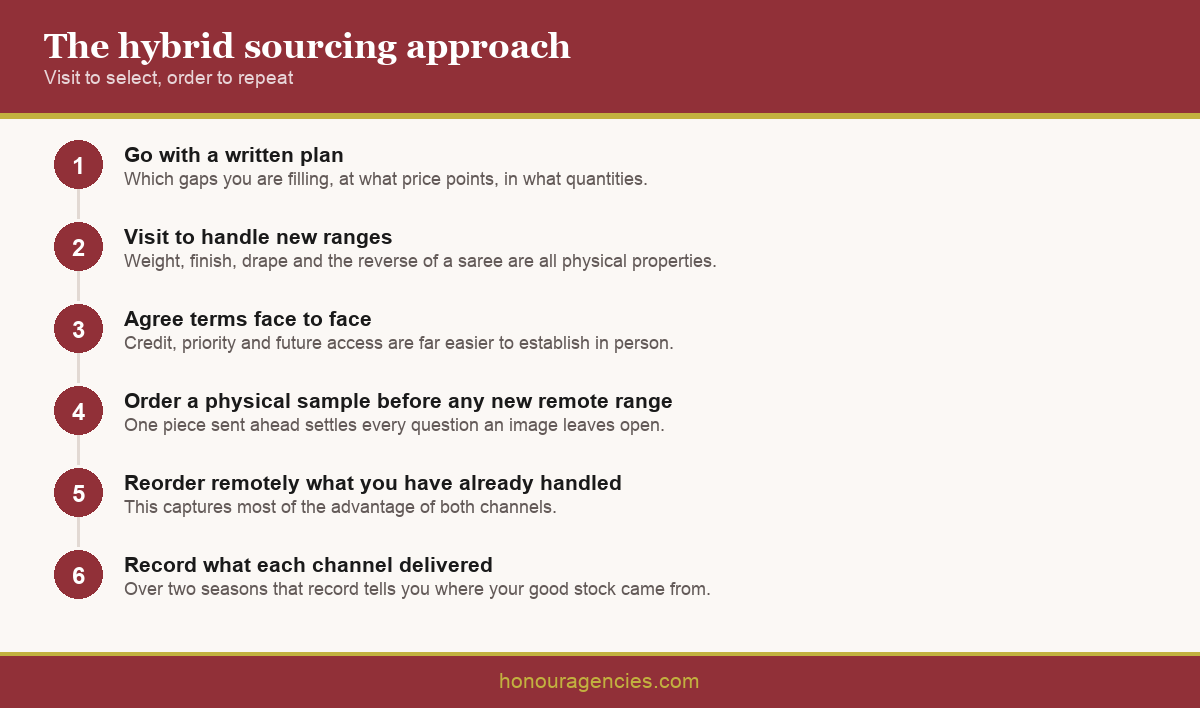
Go with a written plan. Whether visiting or browsing, decide in advance which gaps in your range you are filling, at what price points, in what quantities. Buyers without a plan buy what appeals rather than what sells.
Time the buying to the season rather than to convenience. Ranges land at predictable points in the year, and arriving early gives you the pick of a collection while arriving late leaves whatever did not sell. This applies equally to a market visit and to an online order.
Ask the same questions in both channels. Fabric composition, type of work, whether embellishment is machine or hand applied, whether the design can be repeated, and what the minimum quantity is. The channel changes, the questions do not.
Check colour fastness and embellishment security regardless of where you bought. Rub a damp white cloth across deep colours, tug gently at embellishment, and look at the reverse for loose threads and heavy backing. These take two minutes on arrival and prevent returns later.
Keep a simple record of what each channel actually delivered. Over a couple of seasons that record tells you where your good stock came from and where the problems originated, which is a better basis for the next decision than any general argument about markets and websites. Buyers stocking fancy occasion ranges tend to keep exactly that kind of note.
The designer saree wholesale market wins on judgement, negotiation and relationship, while online sourcing wins on range, time and record keeping. Neither is universally better, and the buyers who do best use a market visit to select and assess, then order remotely to repeat what they have already handled. Apply the same questions and the same arrival checks in both channels, and the risk in either drops considerably. Honour Agencies has supplied wholesale sarees from Ernakulam for 35 years. To discuss a designer range, contact our team.
Q: Is it better to buy designer sarees at a market or online? A: Markets are better for judging embellished goods, since weight, finish and drape are physical properties. Online is better for range, speed and records. Most experienced buyers use both.
Q: Why are designer sarees hard to buy online? A: Their value sits in embellishment density, finish and drape, none of which photographs reliably. Colour also reproduces inconsistently across screens, and the reverse of a saree is almost never shown.
Q: What does a market visit really cost? A: Travel, accommodation and two or three working days. For a small retailer placing modest orders, that cost can exceed the margin the trip generates, which is worth calculating before booking.
Q: How can I reduce risk when ordering remotely? A: Ask for a physical sample before a first order in any new range. One piece sent ahead settles every question an image leaves open, and a seller who refuses on a substantial order is telling you something.
Q: What is the hybrid approach? A: Visit to select and order to repeat. Use a market trip to handle new ranges, judge quality and agree terms, then place repeat orders remotely for products you have already assessed physically.
Q: Which categories should always be handled physically? A: Heavily embellished sarees, silk, anything sold on finish and anything at a high price point. Plain and lightly worked stock in known qualities carries much less remote buying risk.
Q: Why do buyers over purchase at markets? A: Because a trip creates a sense of obligation to fill it. Stock bought to justify a journey is rarely chosen against a plan, so go with written gaps, price points and quantities decided in advance.
Q: Are online prices genuinely comparable? A: Only when the specification is. Designer saree listings are often vague about fabric, work type and finish, so two rates can describe very different products despite looking directly comparable.
Q: What checks should be run on arrival? A: Rub a damp white cloth across deep colours to test for bleeding, tug gently at embellishment to check security, and inspect the reverse for loose threads and heavy backing.
Q: Does the buying channel affect credit terms? A: Usually. Terms, credit and future priority are easier to establish face to face. Our note on choosing the right wholesale dealers covers negotiating them.


Or login with