
Women danim jacket
$249.00

Red formal dress
$129.00

Man winter blazer
$149.00$99.00
Subtotal$477

 General
Retailers sourcing wholesale saree online stock now choose between three very different channels: large B2B marketplaces, social catalogues run over WhatsApp and Instagram, and a direct relationship with an established dealer. Each one changes what you pay, how much you can verify before you commit and who carries the risk when a consignment disappoints. This comparison sets out how the three actually differ so a boutique owner can pick the right channel for each type of order.
Large business to business marketplaces built on standard wholesaling economics put hundreds of saree suppliers in one searchable place, which makes them genuinely useful for discovery. A retailer can scan price ranges, compare minimum order quantities across regions and shortlist candidates in an afternoon without travelling anywhere.
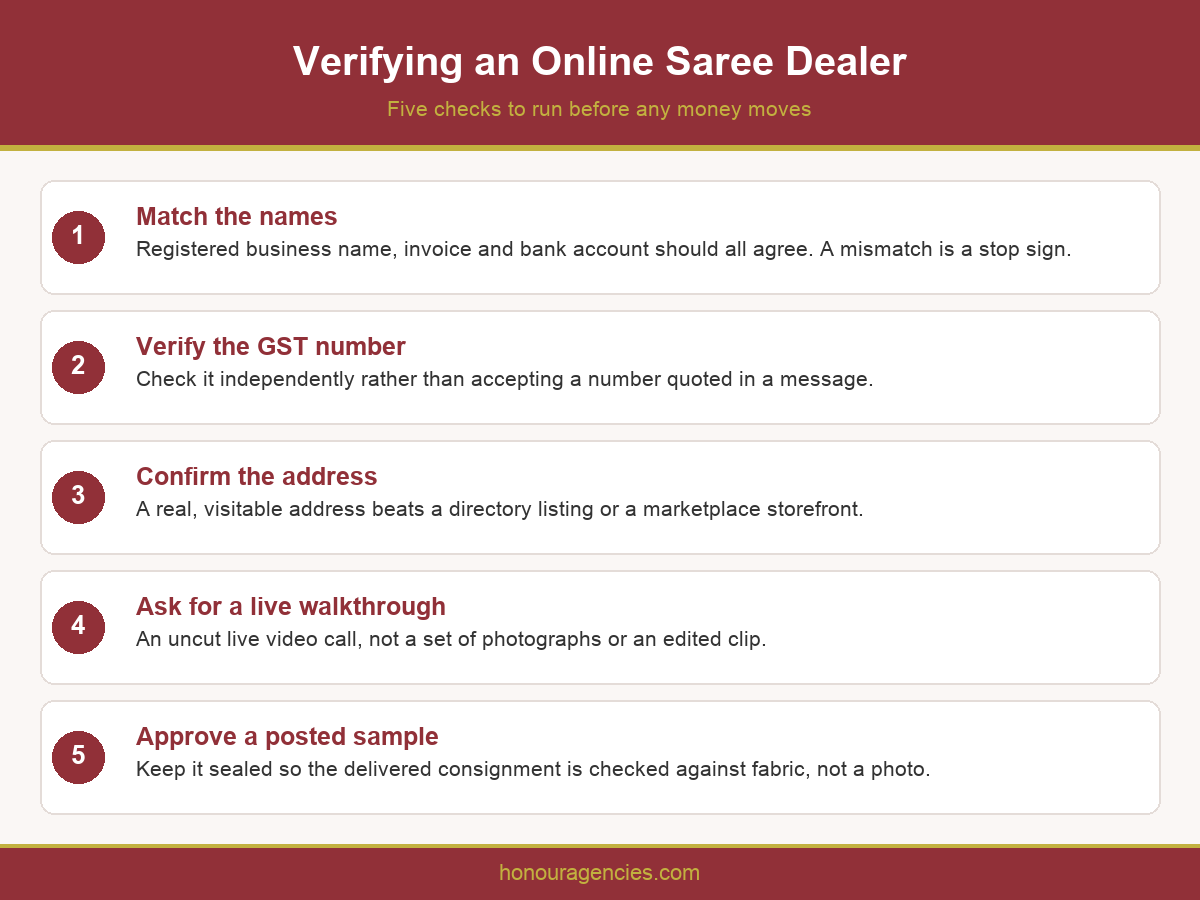
The tradeoff is verification. Listings are self reported, product photography is frequently reused across sellers, and the platform's rating system measures transaction completion rather than fabric quality or shade consistency across repeat orders. Recourse exists but is slow, and it rarely covers the commercial damage of a season's stock arriving wrong. Marketplaces are best treated as a way to find candidates, not as a substitute for checking them. Treat a marketplace shortlist as a starting point that still has to survive the verification checks below.
Social selling has become a serious part of the saree trade. Dealers post new arrivals to Instagram, share stock lists over WhatsApp and confirm orders in a chat thread. For a boutique that needs to top up a fast selling design before the weekend, nothing else moves as quickly.
Speed is exactly where the risk sits. A chat thread is a poor commercial record, prices quoted in a message are easy to revise, and a video shot in good light flatters fabric that will not look the same on your shelf. The discipline that makes this channel safe is simple: get the specification, price, quantity and delivery date restated in writing before paying, and treat the first order with any new social seller as a trial. Our checklist on ensuring quality when buying wholesale sarees online applies directly here.
There is a second risk that is easy to miss. Stock shown in a social catalogue is often not held by the seller at all, and a dealer forwarding another wholesaler's photographs may not be able to fulfil at the price quoted once you commit. Ask whether the pieces are in hand and ready to dispatch, and treat a vague answer as a no.
It works best with a dealer you already know. Once a supplier relationship exists offline, a WhatsApp catalogue becomes a fast, low friction ordering channel rather than an unverified one. The risk is not the medium. It is buying from a stranger through it.
Buying direct from an established wholesale dealer means a named business, a verifiable address, a GST invoice and someone who answers the phone when a delivery runs late. It is the slowest channel to set up and the least visible from a search box, which is why newer buyers often overlook it entirely.
Pricing behaves differently here. Because a dealer quotes against your actual volumes rather than publishing a public rate, the number improves as your order history builds, and it can be negotiated across a category rather than a single design. That flexibility is invisible on a marketplace listing, where the posted price is the same for a first time buyer and a longstanding account.
The real advantage is repeatability. A direct dealer can reproduce a bestselling design in eight weeks with the same shade and finish, hold stock for a known buyer, and flag a new range before it reaches a marketplace. That is worth considerably more across a full season than a marginally lower rate on a single order. Honour Agencies has run exactly this kind of relationship from Ernakulam for 35 years, and our product video catalogue lets remote buyers see drape and detail before committing. A local, visitable supplier also shortens the loop when something needs correcting mid order.
Payment structure varies more across these three channels than most retailers expect, and it is where a bad order becomes an expensive one. Marketplaces typically route payment through the platform, which offers a defined dispute process but ties any remedy to the platform's own rules and timelines. Those rules usually address non delivery well and quality disputes poorly.
Social selling is the least protected of the three. Payment is normally a direct transfer against a message, there is no intermediary holding funds, and a dispute becomes a private negotiation with whatever written record the chat happens to contain. That is workable with a known supplier and genuinely risky with a new one.
A direct dealer relationship sits in between on formality and ahead on practical recourse. Payment is usually an advance against a confirmed order with the balance on or before dispatch, supported by a GST invoice and a named business you can hold to account. There is no platform arbitration, but there is a commercial relationship the dealer wants to keep, which in practice resolves quality issues faster than a formal dispute process. Whichever channel you use, keep the approved sample sealed so a delivered consignment can be checked against it rather than against a photograph.
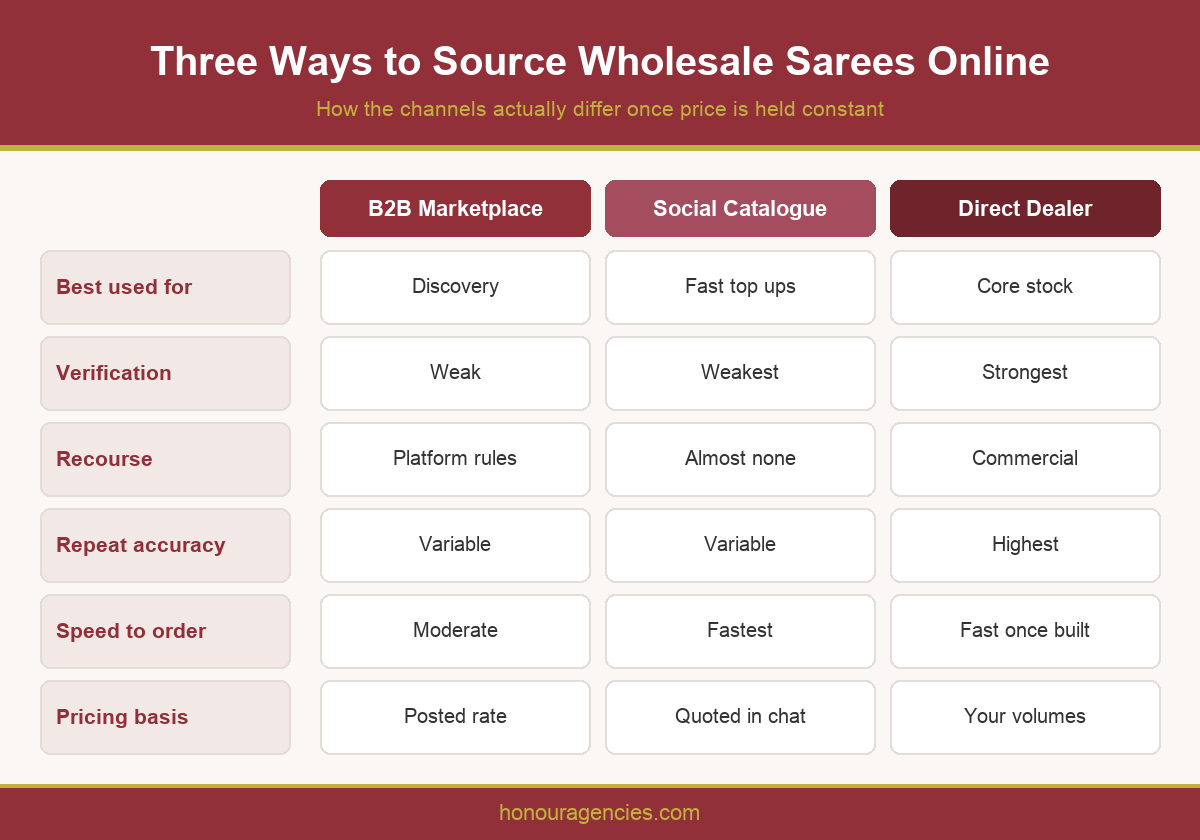
Judged on headline price alone the three channels look similar, because a marketplace listing and a dealer quotation often land within a few rupees of each other. The difference appears in everything around the price.
Verification is weakest on marketplaces and social catalogues, where you are assessing a supplier through their own material, and strongest with a direct dealer you can visit or call. Recourse follows the same pattern. Repeat accuracy, which decides whether you can restock a design that is selling, is where direct relationships pull clearly ahead, because the dealer has your specification on record and a reason to protect the account.
Speed runs the other way. Social catalogues are fastest, marketplaces are next, and a direct relationship takes the longest to establish even though it is quickest to use once built. That is why the sensible answer for most retailers is not one channel but a deliberate mix: a direct dealer for core stock, a marketplace for discovering new categories, and a social catalogue for fast seasonal top ups. The full sourcing framework sits in our complete wholesale saree buying guide.
One practical rule holds across all three channels. Whatever you are buying and wherever you found the supplier, the order should be traceable to a named business with a verifiable address and a proper invoice. A marketplace listing, a chat thread and a dealer quotation can all satisfy that test, and any of them that cannot should be treated as a trial at most. The channel is a matter of convenience. Accountability is not negotiable.
There is no single best way to buy wholesale saree online stock. Marketplaces are strong at discovery, social catalogues at speed, and direct dealers at consistency and recourse, which is what a retail business actually runs on. Match the channel to the order rather than the other way round, and keep your core stock with a supplier you have verified properly. Honour Agencies supplies boutiques, institutional buyers and resellers across India and overseas. To discuss a first order, get in touch or ask for current stock and pricing tiers.





Or login with