
Women danim jacket
$249.00

Red formal dress
$129.00

Man winter blazer
$149.00$99.00
Subtotal$477

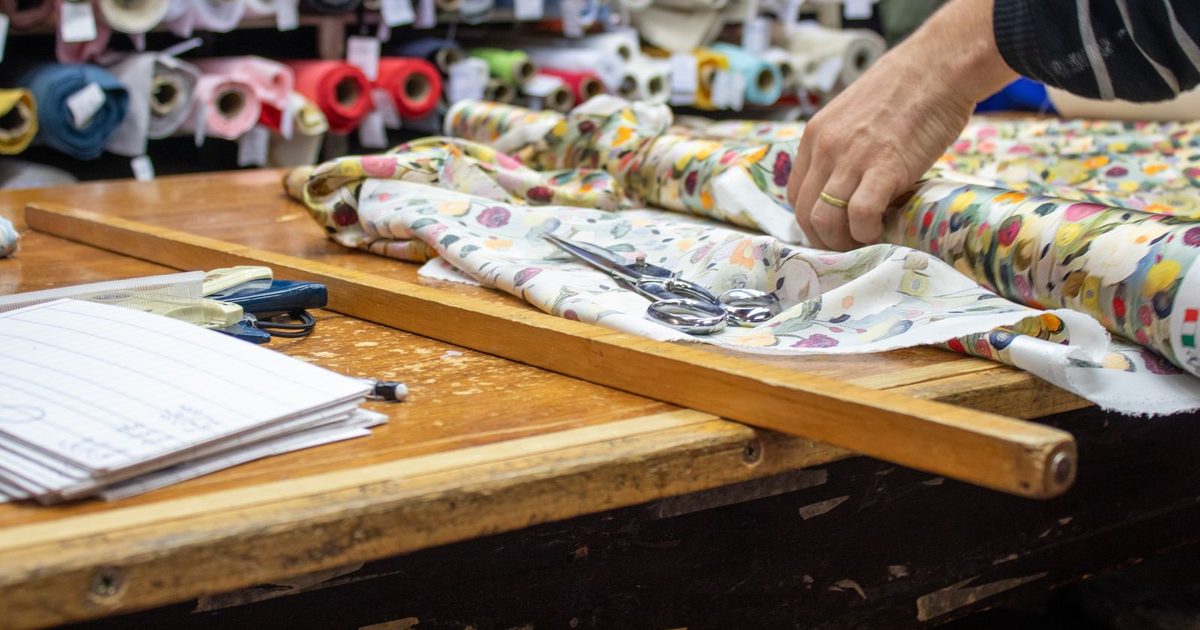 Running Material
Most fabric disputes are not caused by dishonest suppliers. They are caused by buyers who accept goods on paperwork, discover a problem after cutting, and then have no record of what was agreed or what arrived. Wholesale fabric quality control is the routine that closes that gap. It is not laboratory work and it does not need equipment beyond a tape, a scale and good light. This guide sets out the full inspection sequence, the defects worth knowing by name, and the records that make a supplier relationship work over years.
Fabric is the largest single input cost in most garment and retail businesses, and it is the only one that arrives in a form where problems can still be sent back. Once cloth is cut, every fault becomes yours, regardless of who caused it.
The economics are straightforward. A roll rejected on arrival costs a phone call. The same roll discovered at the cutting table costs the cloth, the labour already spent, the delay to the order, and often the customer. The gap between those two outcomes is what an inspection routine buys.
Timing is what makes the difference. Most supply arrangements allow a limited window in which goods can be questioned, and a claim raised three weeks after delivery is far weaker than one raised the same day, whatever the merits. An inspection routine that happens as goods arrive keeps you inside that window without anyone having to remember the rule.
There is a second benefit that buyers underrate. Suppliers behave differently towards customers who inspect. A buyer known to check width, weigh a sample and compare shade against a filed swatch receives more careful attention than one who signs whatever arrives, and that difference shows up in every subsequent delivery.
It is worth being realistic about what inspection can and cannot do. It will catch measurement errors, visible defects and shade departures reliably. It will not tell you how a cloth performs after a year of wear, and it will not substitute for choosing a supplier carefully in the first place. Inspection verifies a relationship rather than replacing one.
Inspection also protects the honest supplier. Faults occur in normal production, and a buyer with no record cannot distinguish an unlucky roll from a pattern of poor quality. With records, both parties can see what is actually happening and deal with it proportionately.
None of this requires a formal system. The discipline of quality control is simply checking a defined sample against a defined standard and recording the result, and it scales down to a small business perfectly well.
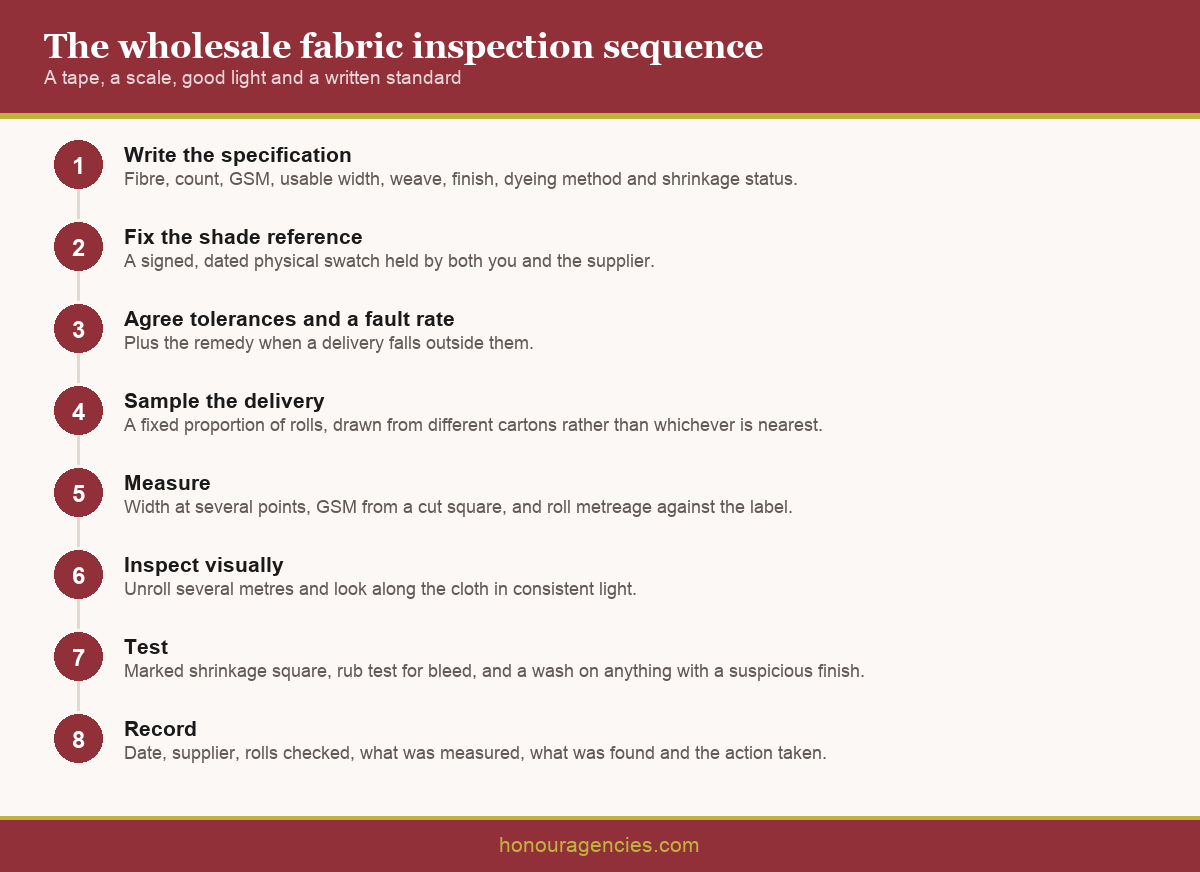
You cannot inspect against a standard that does not exist. Before an order is placed, the specification should name the fibre, the yarn count where relevant, the weight in grams per square metre, the usable width, the weave, the finish, the dyeing method and the shrinkage status.
Be specific about the end use as well. A supplier who knows the cloth is for institutional uniforms laundered twice a week will flag a finish that will not survive, while the same supplier quoting against a bare specification has no reason to raise it. Context turns a quotation into advice.
Our note on what retailers should check before choosing a supplier covers agreeing these points before an order is placed.
Add the shade reference. A signed and dated physical swatch, cut from the production cloth, held by both you and the supplier against your account, is the only reliable colour standard. A colour name or a screen image will not do the job.
State the acceptable variation for each measurable. Weight within a stated percentage, width within a stated tolerance, residual shrinkage below a stated figure. Without numbers, every conversation about a marginal delivery becomes an argument about opinion.
Cloth is a natural product and a small number of faults per hundred metres is normal rather than negligent. Agreeing an acceptable rate in advance prevents both parties from arguing about whether a particular defect is ordinary or unacceptable after the goods have been cut.
Put the standard where both sides can see it. A single page attached to the purchase order, listing the measurables, the tolerances and the fault rate, does more to prevent disputes than any amount of discussion afterwards. Suppliers who receive that page know exactly what will be checked, and deliveries improve accordingly.
Agree the remedy too. Whether an out of tolerance roll is replaced, discounted or returned, deciding in advance turns a dispute into an administrative step. Suppliers respect a stated standard far more than an unspoken expectation.
You do not need a dedicated department, but you do need a place where inspection can actually happen. A table long enough to unroll several metres, positioned under strong even light, is the whole of the requirement for most businesses.
Light is the part most often got wrong. Colour and fine defects both need consistent illumination, and a corner lit by a single warm bulb will hide barré, shade variation and light stains that are obvious under a neutral white light. Fix one light source and always judge shade there, so comparisons across months mean something.
Keep the tools together and in one place. A steel tape, a small digital scale, a pair of scissors, a white cotton rag for rub testing, a marker and the swatch file cover every check in this guide. Inspection that requires hunting for equipment quietly stops happening.
Decide who does it and when. Inspection performed by whoever is free, at whatever point in the week, produces inconsistent results and no accountability. Naming one person and one point in the receiving process is worth more than any amount of technical knowledge.
Train more than one person. Businesses that rely on a single individual to judge cloth lose that capability the moment they are unavailable, which is invariably the week a difficult delivery arrives. Two people applying the same simple checks beat one person applying sophisticated ones.
Checking every metre of every roll is neither practical nor necessary. The principle is to check a fixed proportion, chosen so that the sample represents the delivery rather than whatever is nearest the door.
A workable rule for a small operation is to inspect ten percent of rolls, with a minimum of two, drawn from different cartons or lots. If the sample fails, widen the inspection rather than accepting the rest on hope.
Note the lot numbers as you sample. Rolls usually carry a lot or batch identifier, and recording which lots are present in a delivery is what later allows you to trace a problem to a specific production run rather than to the supplier in general. It costs nothing at the time and is impossible to reconstruct afterwards.
Draw across the delivery, not from one place. Rolls loaded together often come from the same production run, so taking all your samples from one carton tells you about that run and nothing about the others.
Record which rolls you inspected, not just the outcome, and note the date the delivery actually arrived rather than the date on the invoice. Six months later, a note that says three rolls checked out of thirty is far more useful than one that says delivery fine, because it tells you how much confidence the result deserved.
Measure the width at several points along the roll, not once at the end. Width can vary along a piece, and a narrowing in the middle breaks a cutting plan without ever appearing on a delivery note.
Confirm whether you are measuring full width or usable width inside the selvedge. Suppliers quote both conventions, and the difference of an inch or two matters when panels are laid out tightly.
Weigh a cut sample rather than trusting the stated figure. Cut a ten centimetre square, weigh it in grams and multiply by one hundred to get grams per square metre directly. It takes a minute and immediately confirms whether the cloth you paid for is the cloth that arrived.
Weigh more than one sample where the delivery is large. Cloth weight can vary along a roll as well as between rolls, so a single square from the outer layer is a weak sample. Two or three cuttings from different points give a much better picture for very little extra effort.
Weight discrepancies are quietly expensive. A cloth delivered ten percent lighter than specified contains ten percent less fibre, wears accordingly, and was almost certainly priced as the heavier version.
Measure the length of at least one roll against its stated metreage. Short metreage is one of the most common and least discussed discrepancies in the trade, and it is invisible unless someone actually measures.
Check how the metreage was measured as well. Cloth measured under tension reads longer than the same cloth relaxed, and a roll that measures correctly on a powered machine can fall short when laid flat on a table. Where this becomes a recurring issue, agree with the supplier which method is definitive.
Do the arithmetic on the whole delivery when you find a shortfall. A two percent shortage across a large order is a meaningful sum, and it is entirely recoverable when documented at the point of delivery.
Our guide to spotting high quality Kerala sarees covers how these faults present in finished pieces.
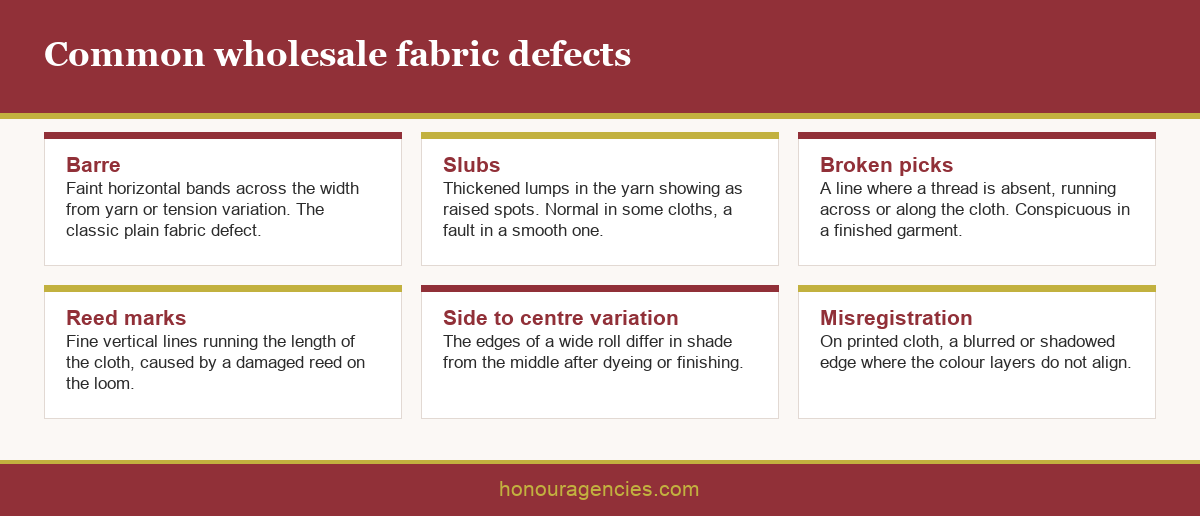
Barré appears as faint horizontal bands across the width, caused by variation in yarn or tension. It is the classic plain fabric defect, almost invisible under a print and obvious on a plain mid tone once a garment is worn.
Slubs are thickened lumps in the yarn that show as raised spots on the surface of the cloth. A few are normal in some cloths and characteristic in others, but a concentration of them in a smooth cloth is a fault.
Broken picks and missing ends appear as a line where a thread is absent, running across or along the cloth. They are conspicuous in a finished garment and easy to spot on an unrolled length.
Holes and cuts are the most obvious faults and the most commonly hidden. Cloth wound over a hole conceals it until the roll reaches the cutting table, which is precisely why inspection means unrolling several metres rather than examining the outer layer. Any fault found should be measured from the roll end so it can be avoided during cutting.
Reed marks show as fine vertical lines running the length of the cloth, caused by a damaged reed on the loom, while oil marks and stains from machinery show as discoloured patches that may or may not wash out. Test one before assuming.
Side to centre variation means the edges of a wide roll differ in shade from the middle, because dyeing and finishing machinery does not always treat the full width identically. It is best found by unrolling a length and looking across it in good light.
End to end variation means the shade shifts along the roll. Compare the beginning and end of a piece rather than assuming consistency, particularly on long rolls.
Misregistration on printed cloth shows as a blurred or shadowed edge where the separate colour layers of the design do not align correctly with one another. Look at a full repeat rather than a single motif, and look along a length for the join line where a rotary screen completes its rotation.
Shrinkage is the most valuable test and the simplest. Cut a square, mark it precisely in both directions, wash and dry it exactly as the finished garment will be treated, then measure again. Test both directions, because cloth usually moves more along the length than across the width.
Test the combination that will actually occur. A dark border against a pale body, a printed motif against a cream ground, or a saree stored folded against its own blouse piece are the situations where bleeding causes real damage. Washing a plain sample in isolation misses exactly the failure that generates returns.
Colour bleed is the second. Rub a damp white cloth firmly across the fabric, particularly on deep reds, blues and blacks, and look for transfer. Then wash a sample with a white swatch alongside and check whether colour has migrated.
Crease recovery matters wherever appearance through a working day is part of the value. Crush a section firmly for a slow count of ten, release it and watch. Good cloth relaxes back within a minute or two, poor cloth holds a sharp line.
The relevant fibre behaviour is documented for both cotton and silk, and knowing both makes the test unambiguous.
Fibre verification takes a few threads and a flame. Cotton and other cellulosics burn fast with a paper smell, silk and wool burn slowly with a hair smell and leave a crushable bead, and polyester melts, shrinks from the flame and leaves a hard plastic bead. Pull threads from both directions, since a cloth can be blended by direction.
Pilling resistance is worth a quick check on anything that will be worn and washed repeatedly. Rub the fabric against itself firmly for a few seconds and look for small fibre balls forming on the surface. Cloth that pills within seconds of hand rubbing will look tired within a season of real use.
Finish permanence is worth checking on anything that feels better than expected for its price. Wash a sample and handle it again, because softeners and calendered finishes flatter a sample and can disappear entirely after two washes.
Raise problems immediately and in writing, with the roll number, what you measured, what the specification said and what you found. A factual note is far more effective than a complaint, and it gives the supplier something they can act on with their mill.
Separate the disputed goods physically. Rolls that are being questioned should be set aside, labelled and left uncut, because cutting into a roll almost always ends the discussion in the supplier's favour. It sounds obvious and it is the mistake most often made under production pressure.
Keep the evidence. A cutting of the offending cloth, alongside your filed swatch, settles most colour disputes in a minute. Photographs help for visible defects but rarely settle shade questions, because cameras and screens both distort colour.
Distinguish between a fault and a preference. A cloth that is within specification but not what you hoped for is a buying error rather than a supplier failure, and treating the two the same way damages the relationship without improving anything. Reserve the formal process for measurable departures from what was agreed.
Be proportionate. A single faulty roll in a large delivery is normal production variation and usually best handled with a replacement. A pattern across deliveries is a different conversation, and having records is what lets you tell the two apart.
Give the supplier a chance to fix it before changing supplier. Switching restarts every approval from the shade card, because a new dyer on a new base cloth will not reproduce another supplier's shade from a swatch alone. The cost of switching is rarely just the price difference on the quotation. Buyers who have built long relationships with a wholesale fabric supplier generally find that a documented problem gets resolved quickly.
Retailers applying this to finished goods will find our comprehensive boutique buying guide a useful companion.
Keep an inspection log in a consistent format. Date, supplier, order reference, roll numbers inspected, what was measured, what was found and what action followed. It takes minutes per delivery and becomes genuinely valuable within a year.
Retire references deliberately rather than letting them accumulate. A swatch file with three superseded versions of the same shade is worse than useless, because it invites a comparison against the wrong reference. Mark superseded swatches clearly and keep only the current one in the working file.
Keep the swatch file alongside it. Each approved shade, signed and dated, labelled with the fabric, the department or product it belongs to, and the supplier's lot reference. Unlabelled swatches in a drawer answer no questions.
Our note on ensuring quality when buying wholesale covers the same checks applied to remote purchases.
Protect what you have accepted. Store rolls horizontally on racks rather than standing them upright, keep them off the floor and away from external walls, protect pale cloth from daylight, and rotate stock by age with a first in first out rule. Poor storage undoes good inspection.
Share what you find with the supplier, not only when something is wrong. A short note saying that the last four deliveries measured correctly is unusual enough that it changes how a supplier regards the account, and it makes the occasional complaint land as information rather than as a grievance.
Review the log periodically. Patterns emerge that no single delivery reveals, such as one supplier consistently running light on weight or one shade drifting steadily across the year. Those patterns are what turn inspection from a defensive routine into a purchasing advantage. Our note on identifying quality in wholesale goods covers applying the same discipline to finished pieces.
Wholesale fabric quality control needs a tape, a scale, good light and a written standard. Specify before you order, inspect a defined proportion on arrival, measure width, weight and metreage rather than trusting the note, test shrinkage and bleed yourself, and keep a log that outlives whoever placed the order. That routine costs very little and prevents almost every expensive surprise the fabric trade produces. Honour Agencies has supplied wholesale fabrics and sarees from Ernakulam for 35 years. To discuss a fabric requirement, contact our team.
Q: How much of a fabric delivery should be inspected? A: A fixed proportion rather than everything. Ten percent of rolls with a minimum of two, drawn from different cartons, works for most small operations. If the sample fails, widen the inspection.
Q: What is barré in fabric? A: Faint horizontal bands across the width caused by yarn or tension variation. It is the classic plain fabric defect, hidden by prints and clearly visible on plain mid tones once a garment is worn.
Q: How do I check fabric weight without laboratory equipment? A: Cut a ten centimetre square, weigh it in grams and multiply by one hundred. That gives grams per square metre directly and confirms whether the cloth delivered matches the cloth specified.
Q: Why measure roll metreage? A: Short metreage is common and rarely discussed, and it is invisible unless someone measures. A two percent shortfall across a large order is a meaningful sum and recoverable when documented on arrival.
Q: How do I test fabric shrinkage? A: Cut a square, mark it precisely in both directions, wash and dry it exactly as the garment will be treated, then measure again. Test both directions, since cloth usually moves more along the length.
Q: What is side to centre shade variation? A: A difference in shade between the edges and the middle of a wide roll, caused by uneven dyeing or finishing across the width. Unroll a length and look across the full width in good light.
Q: How do I verify what fibre a fabric is? A: Burn a few threads. Cotton burns fast with a paper smell, silk and wool burn slowly with a hair smell leaving a crushable bead, and polyester melts leaving a hard bead. Test both directions.
Q: What should be recorded in an inspection log? A: Date, supplier, order reference, which rolls were inspected, what was measured, what was found and what action followed. Recording which rolls you checked matters as much as the outcome.
Q: How should a faulty delivery be raised? A: Immediately and in writing, with roll numbers, what you measured, what the specification said and what you found. Keep a cutting of the cloth, since photographs rarely settle shade questions.
Q: Does inspection change how suppliers treat you? A: Noticeably. A buyer known to check width, weigh samples and compare shade against a filed swatch gets more careful attention. Our supplier selection guide covers choosing well in the first place.




Or login with