
Women danim jacket
$249.00

Red formal dress
$129.00

Man winter blazer
$149.00$99.00
Subtotal$477

 General
Most institutions treat uniform buying as a purchasing decision and discover, one delivery too late, that it was really an approval process. The colour drifts, the length is wrong, the blouse piece is short, and nobody can point to a document that says otherwise. A structured uniform saree design approval sequence prevents all of that. It moves an order through a written brief, a shade card, a lab dip, a pre production sample and a stated tolerance before a single metre of bulk cloth is woven. This guide sets out that sequence in full, and explains what each stage is actually proving.
An institution buying uniform sarees is not buying a product off a shelf. It is commissioning a production run against a description, and the gap between the description and the result is where every problem lives. Two people can agree on the phrase mid blue cotton and picture entirely different cloth.
The financial exposure is larger than it appears. A uniform order is bought per head, worn for years and reordered continuously, so a specification error is not a single loss. It repeats every time the order repeats, and it usually gets worse, because each new lot drifts a little further from an original nobody wrote down.
There is an operational cost too. A uniform that fits badly or feels uncomfortable is quietly modified by the people wearing it. Sleeves get rolled, pallus get retucked, and the visual consistency the institution paid for disappears within a month. That failure traces directly back to an approval stage that never happened.
Approval stages also protect the supplier. A manufacturer working to a signed sample and a stated tolerance knows exactly what will be accepted, which produces better pricing and fewer disputes than an arrangement built on goodwill. Buyers sometimes read a formal approval process as distrust. In practice it is the opposite, and experienced Ernakulam suppliers generally welcome it.
It is worth being clear about who carries which risk. The supplier carries manufacturing risk, that the cloth can be woven and dyed to the agreed standard. The institution carries specification risk, that the standard described is actually the one the job needs. Approval stages exist to transfer as little as possible of the second onto chance. When an order goes wrong without a documented approval trail, the argument is unwinnable in both directions, because neither side can show what was agreed.
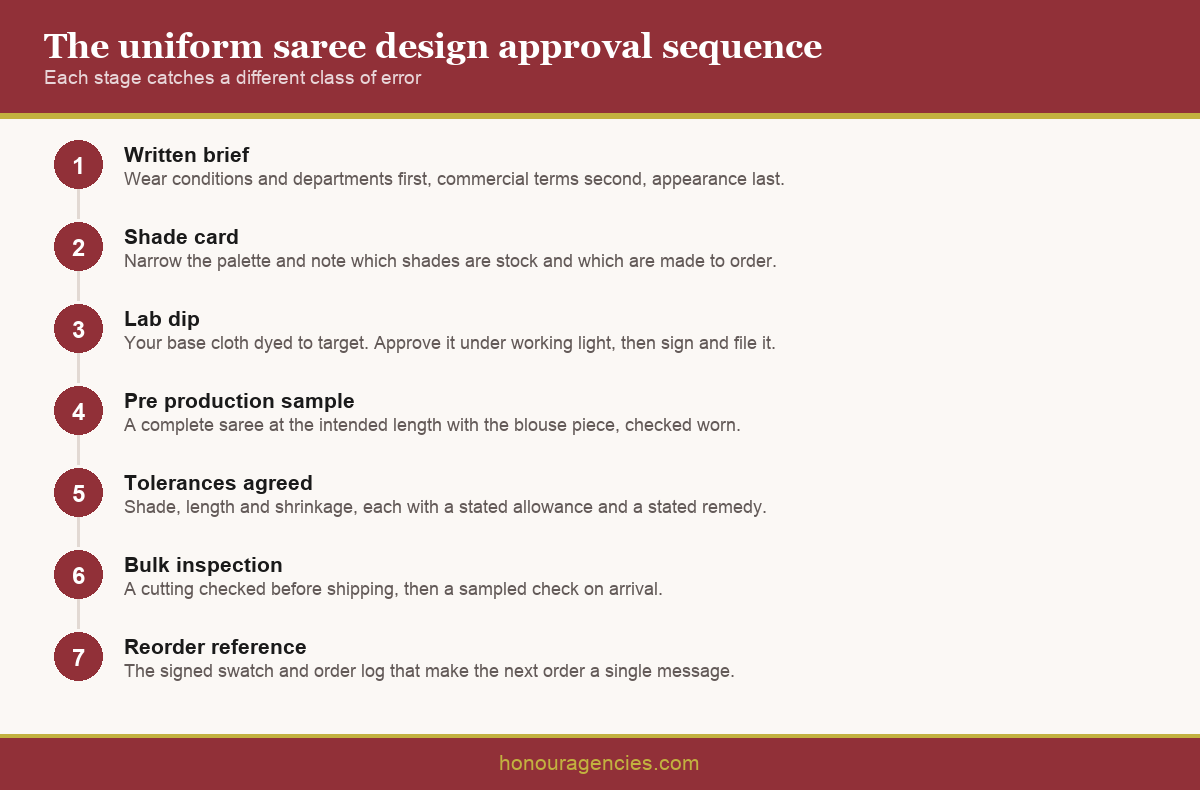
The sequence that follows is not bureaucratic for its own sake. Each stage catches a different class of error, and skipping one simply moves that error further down the line where it costs more to fix.
Start by describing the job, not the garment. Write down the shift length, the working temperature, whether the role is physical, how often the uniform is washed and by whom, and whether staff pin or tuck the pallu. Those facts drive almost every fabric recommendation a supplier will make.
Quantify wherever you can. Two hundred staff on a three shift rotation with twice weekly laundering is a specification. A large hospital that needs uniforms is not. The more precisely the brief states numbers, the more precisely a supplier can recommend a weight, a blend and a replacement interval rather than offering a general purpose cloth that suits nobody exactly.
Departments matter here. A brief that treats a hospital or a hotel as one uniform requirement forces a single fabric onto very different roles. Separating the brief by department while keeping the palette unified gives you a uniform that looks like one institution and works for each team.
State the laundry method explicitly. Domestic washing, in house industrial laundry and contracted laundry produce very different fabric lives, and the fabric that suits one may fail under another. This is the single most commonly omitted line in an institutional brief.
Name the quantities, the expected reorder pattern and the timeline. Suppliers price and plan very differently for a one time order than for an account that will repeat quarterly for five years, and the second usually attracts better terms.
Set out the approval stages you intend to run, and who signs each one. Naming the decision maker at the outset avoids the common delay where a lab dip sits unapproved for three weeks because nobody is sure whose call it is.
Say what you will supply and what you expect. If the institution is providing an existing garment as a reference, send it rather than describing it. If a brand colour has a defined reference, provide it, but expect the supplier to translate it onto cloth rather than match it exactly, because a colour defined for print or screen does not transfer directly to dyed fabric.
Include the awkward questions early. How long will the shade reference be held, what is the minimum repeat quantity, and what happens if a yarn or dyestuff is discontinued. Getting those answers before the first order is far easier than negotiating them after a mismatch.
A shade card is a supplier's physical range of available colours, and it is the first honest conversation about what is actually achievable. Screens and printed charts both lie, in different directions, and neither should be used to select an institutional colour.
Read a shade card for more than the colour. Note which shades are standard stock and which are made to order, because the two behave completely differently on reorder. A stock shade can often be repeated in small quantities at short notice, while a made to order shade may carry a large minimum and a long lead time.
Look at the card in a good light and at arm's length rather than close up. Institutional colour is experienced across a room, and shades that look distinct when two swatches are touching can merge at conversational distance. Where possible, view candidate shades pinned to a board a few metres away, which is much closer to how staff and visitors will actually see the uniform.
Ask what base cloth each shade is presented on. The same dye recipe reads differently on cotton, on a cotton rich blend and on polyester, so a shade approved on one base is not automatically available on another. This trips up institutions that pick a colour for the front desk and then want the same colour in a heavier cotton for housekeeping.
Our note on collection ideas for schools and offices shows how institutions structure a palette across departments.
Resist choosing too many shades. Every additional colour multiplies the stock a supplier must hold against your account, and the slow moving shades are the first to go out of stock when you need them. Four or five clearly separable colours serve most institutions better than eight subtle ones.
Check separation under working light rather than at the counter. Shades that look distinct beside a window can collapse into one another under the warm fluorescent lighting used in many corridors and wards. Our note on choosing a colour that works for your brand covers how to build a palette that survives that test.
A lab dip is a small piece of your actual base fabric dyed to your target shade. It is the first point at which colour stops being a selection and becomes a manufactured result, and it is the most important single checkpoint in the sequence.
What a lab dip proves is narrow but vital. It shows that the dyer can hit the target on your cloth, and it gives you a physical object to approve, sign and file. It does not prove anything about weave quality, drape or finished garment behaviour, which is why a sample stage still follows.
Expect more than one round. A first lab dip landing slightly off target is normal rather than a sign of a poor supplier, and two or three submissions to reach an exact match is a reasonable expectation on a difficult shade. Build that time into the schedule at the start. Institutions that leave no room for a second submission are the ones that end up accepting a near enough colour under deadline pressure, which is precisely the compromise the process exists to avoid.
Approve or reject clearly. A lab dip that is close but not right should be rejected with a direction, such as slightly deeper or less towards green. Vague responses produce a second submission no better than the first and waste a fortnight.
Take the lab dip into the space where the uniform will be worn. Warm indoor lighting pulls blues towards green and deepens pinks towards peach, while cool daylight reveals a different tone entirely. A shade approved at a shop counter is approved under conditions nobody will ever work in.
Look at it beside the other approved departmental shades, not in isolation. The question is not only whether the colour is right but whether it separates from its neighbours at a glance down a corridor.
Record the approval properly. Sign and date the lab dip, note the base fabric, the department and the supplier's lot reference, keep one copy and require the supplier to hold the twin against your account. That signed piece is the reference every future order is measured against. The underlying property you are protecting is colour fastness, which governs how the approved shade will hold through washing, light and rubbing.
The pre production sample is a complete saree, made on the intended cloth in the approved shade, with the intended border and blouse piece. It is the last chance to catch anything before bulk production commits the full quantity.
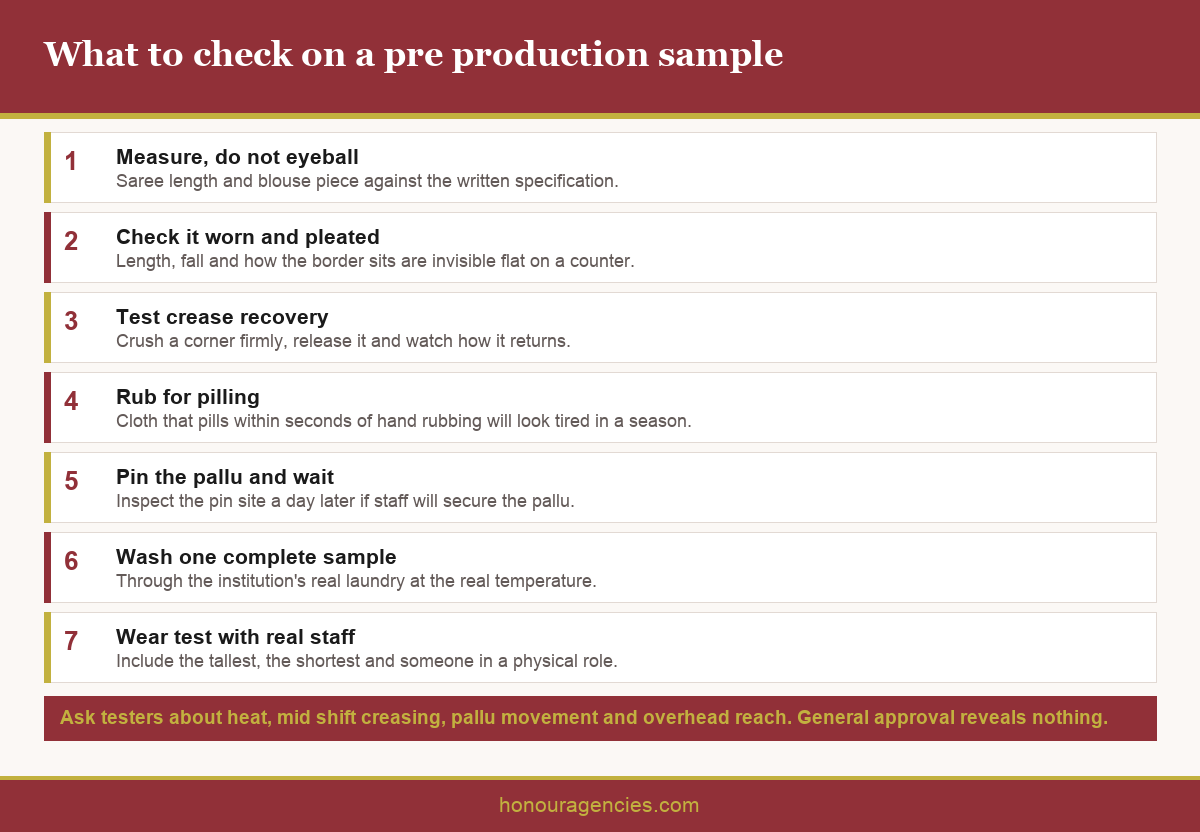
Check it as a garment, not as fabric. Have someone wear it, pleat it, move in it and reach overhead. A great many faults, in length, in fall, in how a border sits when pleated, are invisible on a counter and obvious on a person within a minute.
Measure the saree length and the blouse piece against the written specification rather than eyeballing them. Confirm the border alignment, the selvedge finish and whether the pallu design sits where it should when the garment is draped rather than laid flat.
Wash one sample before you approve anything. Send a complete sample through the laundry process the institution actually uses, at the temperature and detergent strength that will be applied in service, then measure it again and compare the colour against the unwashed piece. A single wash test tells you more about real garment life than any amount of counter inspection, and it is the stage most often skipped.
Test the fabric the way the job will. Crush a corner in the hand and release it to judge crease recovery. Rub it against itself to check for pilling, and note that shrinkage will only show after the wash test. If staff will pin the pallu, pin the sample and leave it a day, then look at the pin site.
Choose the testers deliberately. Include the tallest and shortest staff in the department, and include someone whose role is physically demanding. A sample that works for an average build in a seated role proves very little about how the garment behaves at the edges of the size range, and the edges are where complaints begin.
Where the order is large, put two or three samples into real use for a week with volunteers from the department. A short wear test surfaces comfort problems that no inspection catches, and comfort determines whether the uniform is worn as intended.
Ask the wearers specific questions. Was it hot, did it crease by mid shift, did the pallu stay put, was overhead reach restricted. General approval from a wear test tells you nothing. Our list of mistakes to avoid when ordering covers the faults that most often reach delivery.
No two production runs are identical, and a specification that pretends otherwise creates arguments rather than preventing them. The mature approach is to state a tolerance and hold the supplier to it.
A tolerance is not a licence to deliver poor work. It is a statement of the variation that normal production produces, agreed in advance so that both parties know where the line sits. Without one, every small variation becomes a negotiation, and the institution loses either way, by accepting drift it did not intend or by rejecting cloth that was always going to vary slightly.
Cover the three that matter. Shade should be matched to the filed swatch within an agreed visual tolerance under a named light source. Length should carry a stated allowance in centimetres. Shrinkage should be stated as a percentage after a defined wash, rather than assumed to be zero.
Write down what happens when a delivery falls outside tolerance. Whether the remedy is replacement, a discount or rejection, agreeing it in advance turns a dispute into an administrative step. Suppliers respect a stated standard far more than an unspoken expectation.
Assemble one file and keep it current. It should hold the signed lab dip, the approved pre production sample or a cutting of it, the written specification, the tolerance agreement, the care instruction and a log of every order with dates, quantities and lot references.
This file is the real output of the approval process. Institutions that keep it can reorder in a single message years later. Institutions that do not end up rebuilding the specification from scratch each time a coordinator changes job. Buyers who manage institutional supply chains well are usually just the ones maintaining better records.
Ask for a cutting from the bulk lot before the full quantity ships. Comparing it against the filed swatch takes minutes and catches a mismatch while it remains the supplier's problem rather than yours.
Agree in advance how the goods will be presented. Cartons marked by shade, size and department, with a packing list that matches, make inspection quick and issue straightforward. Unmarked cartons of mixed stock turn a one hour check into a day of sorting, and that cost falls entirely on the institution.
Inspect on arrival rather than on issue. Check a sample of pieces against the specification for shade, length, blouse dimensions and visible faults, and record what you checked. Faults found at issue, weeks later and mixed through a department, are far harder to resolve.
Use a consistent method. Even a simple approach, pulling a fixed proportion of pieces from different cartons and checking each against the same list, gives you a defensible position and a record of quality over time. Formal quality control practice in textiles is built on exactly this principle of sampling against a standard.
Institutions comparing fabrics at this stage will find our guide to best fabrics for Kerala climate useful for local conditions.
Store the balance properly. Reserve stock in a damp store will mildew, and pieces folded in one position for a year develop permanent lines that no pressing removes. Keep it dry, off the floor and refolded periodically.
The value of the whole process appears at the second order. Anyone can match a shade once. Matching it eighteen months later, on a partial quantity, from a different yarn delivery, is the promise worth testing before you commit.
Keep the relationship with one supplier where the arrangement is working. Every change of supplier restarts the approval sequence from the shade card, because a new dyer on a new base cloth will not reproduce another supplier's shade from a swatch alone. The cost of switching is rarely just the price difference on the quotation.
Ask directly how long the supplier holds a shade reference, what notice a repeat run needs, and what the minimum repeat quantity is. Place repeats away from peak festival production where you can, since mills running at capacity give both longer lead times and less careful matching.
Watch for silent changes on the supplier side as well. A mill switching yarn source, a dyehouse changing process, or a supplier moving production to a different unit can all shift the result without any change to the recipe on paper. An annual comparison against the filed reference is the only practical way to catch that early.
Review once a year. Compare a worn saree against the filed swatch and a fresh piece from stock. That single comparison tells you whether the fabric is performing, whether the laundry has changed something, and whether the shade has moved, while each is still a conversation rather than a replacement programme.
Replace in cohorts rather than individually. Uniforms fade together within a batch, so swapping whole groups keeps a department consistent while replacing single garments creates a patchwork. Our guidance on caring for and maintaining institutional wear covers the routine that extends the interval between those cycles.
Uniform saree design approval is a sequence of physical checkpoints, and each one exists to catch an error while it is still cheap. Write a brief that describes the job before the garment, read the shade card for stock availability as well as colour, approve a lab dip under working light, wear test a pre production sample, state your tolerances, and keep one approval file that outlives whoever placed the order. Institutions that follow that sequence reorder in a single message years later. Honour Agencies has supplied wholesale and institutional sarees from Ernakulam for 35 years. To discuss an institutional requirement, contact our team.
Q: What is a lab dip in uniform saree ordering? A: A small piece of your actual base fabric dyed to the target shade. It proves the dyer can hit the colour on your cloth and gives you a physical object to sign, date and file as the reference.
Q: Why is a shade card not enough on its own? A: A shade card shows what a supplier can offer, usually on one base fabric. Your cloth may take dye differently, so the card narrows the choice while the lab dip confirms the actual result.
Q: What should a pre production sample include? A: A complete saree in the approved shade on the intended cloth, with the intended border and blouse piece. Check it worn and pleated on a person, since length and border faults are invisible flat on a counter.
Q: What tolerances should be agreed with the supplier? A: Shade matched to the filed swatch within a stated visual tolerance under a named light, length within a stated centimetre allowance, and shrinkage as a percentage after a defined wash rather than assumed to be zero.
Q: Who should sign each approval stage? A: Name the decision maker in the brief before work starts. Most delays happen when a lab dip waits weeks for approval because nobody is certain whose responsibility the sign off actually is.
Q: How long do suppliers hold a shade reference? A: It varies, so ask directly and get the answer in writing before the first order. Also confirm the minimum repeat quantity and what happens if a yarn or dyestuff is discontinued.
Q: Should uniforms be wear tested before bulk production? A: For large orders, yes. Put two or three samples into real use for a week and ask specific questions about heat, creasing, pallu movement and overhead reach. General approval from a wear test reveals nothing useful.
Q: When should delivered stock be inspected? A: On arrival, not on issue. Check a fixed proportion of pieces from different cartons against the specification and record what you checked. Faults found weeks later across a department are far harder to resolve.
Q: What documents make up the approval file? A: The signed lab dip, a cutting of the approved sample, the written specification, the tolerance agreement, the care instruction and a log of orders with dates, quantities and lot references.
Q: How often should the specification be reviewed? A: Annually. Compare a worn saree against the filed swatch and fresh stock. Our guide to choosing a design for your institution covers revisiting the design itself.




Or login with