
Women danim jacket
$249.00

Red formal dress
$129.00

Man winter blazer
$149.00$99.00
Subtotal$477

 Running Material
Two suppliers quote running material for the same garment. One rate is lower. Most buyers stop there, and most buyers are wrong, because a fabric specification is a set of numbers and the rate is only meaningful beside them. GSM tells you what the cloth is, width tells you what it will yield, and together they decide your real cost far more than the quoted rate does. This guide explains how to read running material GSM and width, and how to check both yourself in a couple of minutes.
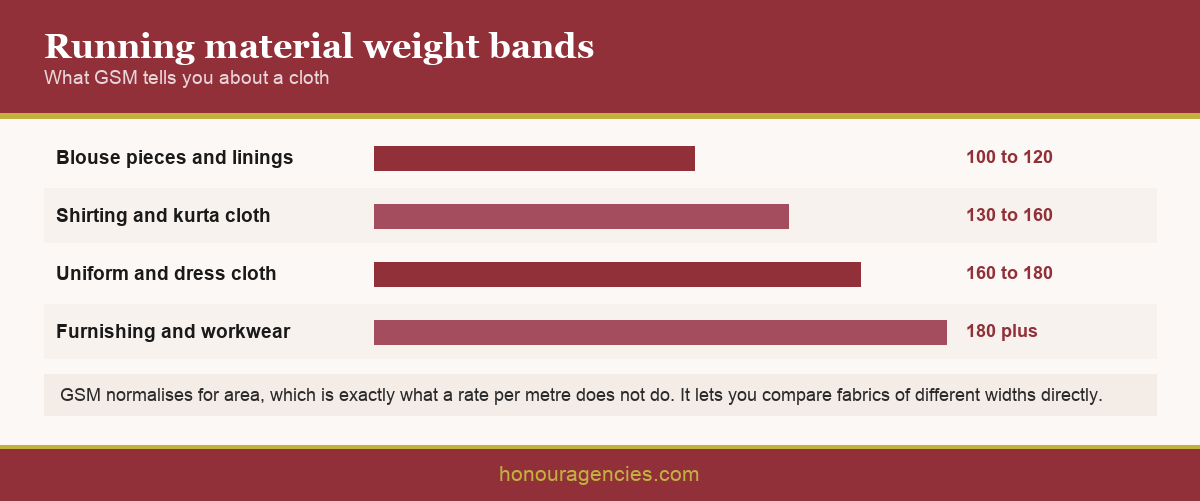
GSM stands for grams per square metre and describes the weight of a standard area of cloth. Because it normalises for area, it lets you compare fabrics of different widths directly, which is exactly what a rate per metre does not do. The underlying measure is grammage.
The number maps roughly onto use. Light running material around 100 to 120 GSM suits blouse pieces, linings and summer garments. Mid weights between 130 and 160 GSM cover most shirting, kurta and uniform applications. Above 180 GSM the cloth moves towards furnishing and workwear.
Weight is also the honest driver of cost. A heavier cloth contains more fibre per metre, so a lower rate on a lighter fabric is not a saving. Comparing rates without comparing GSM flatters the wrong supplier in almost every case.
GSM also predicts how a cloth will behave in a garment beyond simple durability. A light fabric drapes and gathers softly but shows every underlying seam and needs lining more often, while a heavier cloth holds a structured line and resists creasing at the cost of warmth. Deciding the weight band before looking at any samples usually produces a better result than choosing by feel from whatever is on the counter.
Be careful comparing GSM across different fibres. The same weight in cotton, polyester and viscose feels quite different because the fibres have different densities and handles. Within a single fibre the comparison is reliable, which is what makes it so useful when assessing several quotes for the same cloth.
Width is the usable measurement across the roll, and it varies far more than buyers expect, commonly between 36 and 60 inches. That range changes everything downstream, because garments are cut from area rather than from length.
A cloth at 58 inches yields substantially more pieces per metre than the same cloth at 44 inches. If a wider fabric costs fifteen percent more per metre but produces thirty percent more garments from that metre, it is cheaper in the only sense that matters.
Wastage is not linear either. A roll width that divides neatly into your panel width wastes almost nothing, while one leaving an unusable strip wastes it on every metre for the life of the order. Work this out once for your main products and keep the answer.
Confirm which width you are being quoted. Some suppliers state the full width of the roll and others the usable width inside the selvedge, and the difference of an inch or two breaks a tight cutting plan. Ask explicitly, because both conventions are in common use. Our guide to choosing the right running material covers matching cloth to end use.
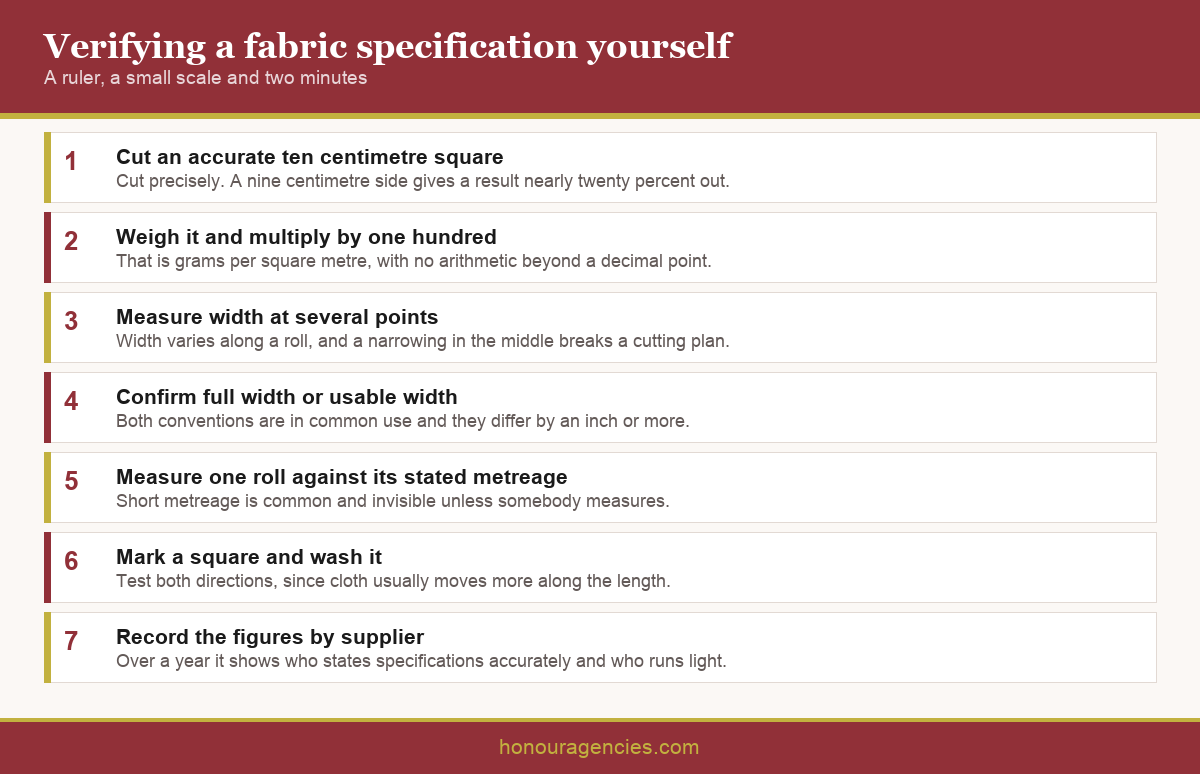
Checking GSM takes a minute. Cut a ten centimetre square from the sample, weigh it in grams on a small digital scale, and multiply by one hundred. That gives grams per square metre directly, with no arithmetic beyond moving a decimal point.
Cut the square accurately, because the method depends on the area being right. A square that is nine centimetres on one side gives a result nearly twenty percent off, which is worse than not testing at all.
Check width at several points along the roll rather than once at the end. Width can vary along a piece, and a narrowing in the middle breaks a cutting plan without ever appearing on a delivery note.
Watch how the cloth was measured as well. Fabric measured under tension reads longer than the same fabric relaxed, so a roll that measures correctly on a powered machine can fall short laid flat on a table. Where this recurs with a supplier, agree which method is definitive rather than arguing each time.
Measure roll metreage on at least one roll too. Short metreage is common in the trade and invisible unless somebody measures, and a two percent shortfall across a large order is a meaningful sum that is fully recoverable when documented on arrival.
Yarn count describes the fineness of the thread, and it runs counter to intuition. A higher count means finer yarn, so 60s is finer and softer than 40s, while 20s is coarser and gives more body. Finer counts cost more and suit finer garments.
Reed and pick describe how densely the threads are packed. A densely woven cloth uses more yarn at the same count and wears longer, which is why two fabrics at the same GSM can perform differently if one achieves its weight through density and the other through coarser yarn.
Shrinkage status should appear as a percentage after a defined wash rather than as a yes or no. All cotton moves, and a stated figure is what lets you cut with an allowance instead of discovering the problem after the first laundering.
Finish is the last variable and the least visible. Softeners and calendered finishes flatter a sample and can wash away entirely, so if a cloth feels noticeably better than expected for its count and price, ask what has been applied and whether it survives laundering.
Insist that every quotation carries the same figures. Fibre, count, GSM, usable width, weave density, finish, dyeing method and shrinkage status. A supplier unwilling to state them is quoting a different cloth from the one you are comparing it against.
Convert everything to a common basis before deciding anything. Cost per square metre is the minimum useful comparison, and cost per finished garment against your own cutting plan is better. This single step reorders most quotation comparisons.
Share the record selectively. Telling a supplier that their last four deliveries measured within specification is unusual enough to change how they regard your account, and it makes an occasional complaint land as information rather than as a grievance.
Keep a record of verified figures by supplier. Over a year that record shows which suppliers state their specifications accurately and which run consistently light, and that is worth more than any single negotiation.
Use the numbers in the conversation. A buyer who says the sample measured 138 GSM against a stated 150 is having a completely different discussion from one who says the cloth feels thin, and suppliers respond accordingly. Buyers sourcing running material wholesale regularly find this changes the whole relationship.
Running material GSM and width are the two numbers that decide what a cloth is and what it will cost you. Read them together with count, density, shrinkage and finish, verify GSM with a measured square and a scale, check width at several points, and convert every quotation to cost per finished garment. That habit consistently buys better cloth for less money than negotiating on the rate ever will. Honour Agencies has supplied wholesale fabrics from Ernakulam for 35 years. To discuss a running material requirement, contact our team.
Q: What does GSM mean? A: Grams per square metre, the weight of a standard area of cloth. Because it normalises for area, it allows fabrics of different widths to be compared directly in a way rate per metre cannot.
Q: What GSM should I choose? A: Around 100 to 120 for blouse pieces and linings, 130 to 160 for shirting, kurta and uniform use, and above 180 for furnishing and workwear. Match the band to the end product.
Q: How do I check GSM myself? A: Cut an accurate ten centimetre square, weigh it in grams and multiply by one hundred. Cut precisely, because an inaccurate square produces a result worse than not testing at all.
Q: Why does fabric width matter so much? A: Garments are cut from area, not length. A wider roll yields more pieces per metre, so a cheaper narrow cloth can easily cost more per finished garment than a dearer wide one.
Q: Should I measure width more than once? A: Yes, at several points along the roll. Width can vary along a piece, and a narrowing in the middle breaks a cutting plan without appearing anywhere on the delivery note.
Q: What is the difference between full width and usable width? A: Full width includes the selvedge, usable width excludes it. The difference is often an inch or two, which matters when panels are laid out tightly, so ask which convention is being quoted.
Q: Does a higher yarn count mean better cloth? A: It means finer yarn, not automatically better. Higher counts give softer, lighter cloth for fine garments, while coarser counts give body and durability suited to uniforms and heavier use.
Q: Can two fabrics at the same GSM be different? A: Yes. One may reach that weight through dense weaving of fine yarn and the other through coarse yarn loosely woven. The denser cloth generally wears longer, so check reed and pick too.
Q: How should shrinkage appear on a specification? A: As a residual percentage after a defined wash, not as a yes or no. A stated figure lets you cut with an allowance rather than discovering the problem after the first laundering.
Q: Does verifying specifications change supplier behaviour? A: Noticeably. A buyer quoting measured figures gets a different response from one saying the cloth feels thin. Our fabric sourcing guide covers building that discipline.


Or login with