
Women danim jacket
$249.00

Red formal dress
$129.00

Man winter blazer
$149.00$99.00
Subtotal$477

 General
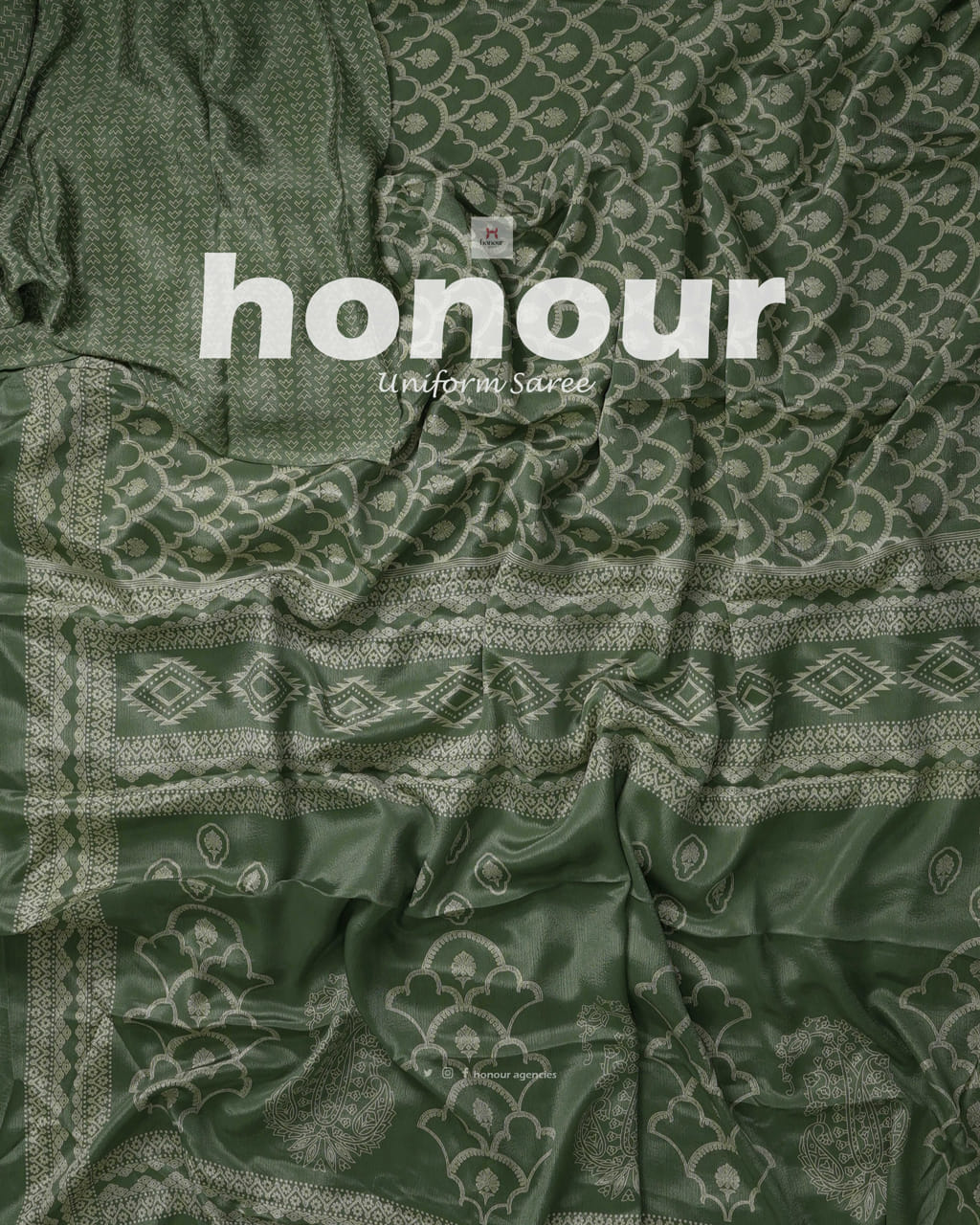
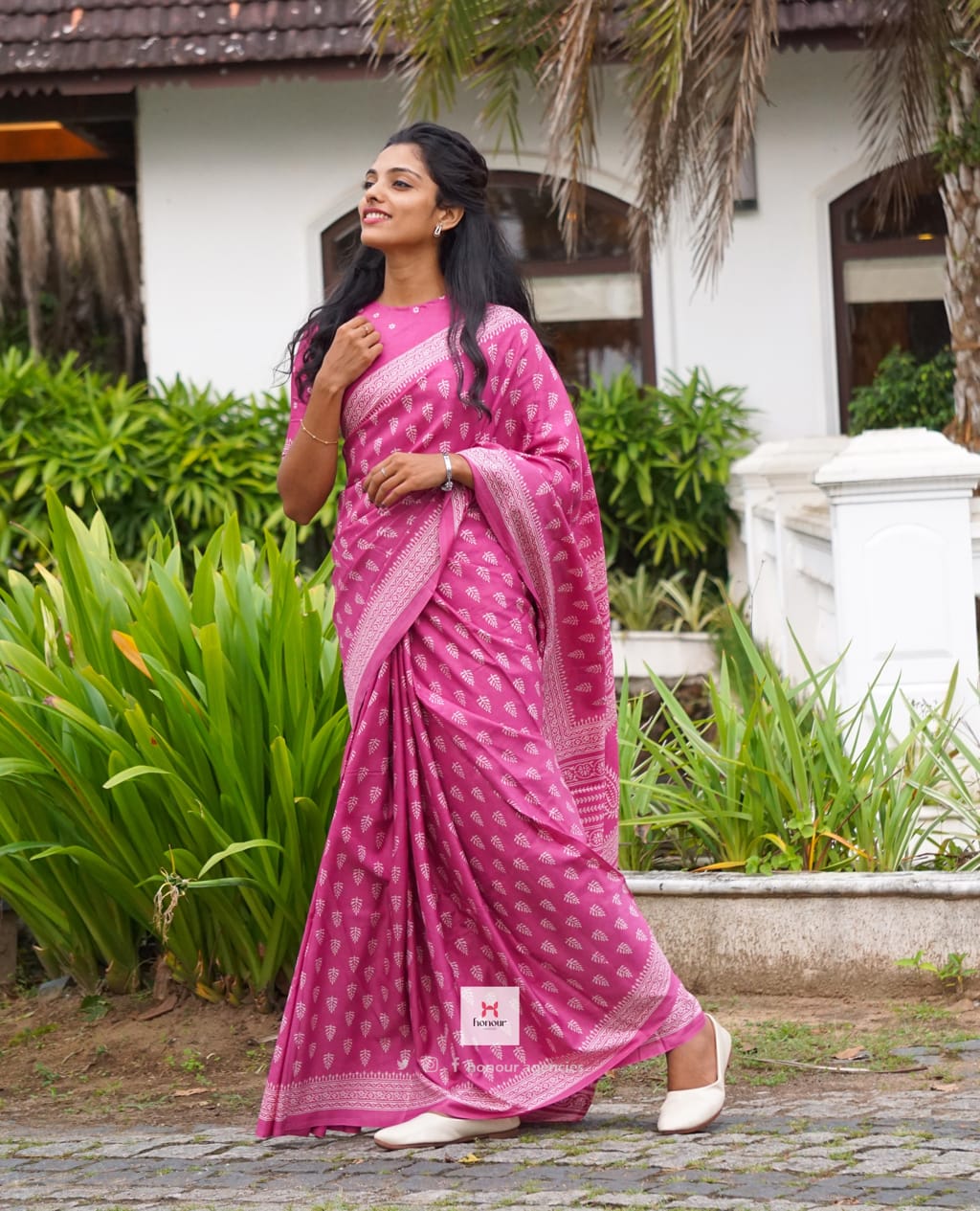
Plain uniform sarees look like the simplest thing an institution can buy. There is no print to match, no border to align and no design to approve, so buyers often skip straight to price. That is precisely why plain orders go wrong more often than patterned ones. With no design to hide behind, every fault in shade, weave and finish is fully visible. This guide covers how to buy plain uniform sarees in bulk so the department ends up in one colour, one length and one standard.
A print distracts the eye. Small variations in weave density, slight colour differences between panels and minor finishing marks all disappear under a pattern, which is why printed institutional fabric tolerates a wider quality band.
Plain cloth offers nowhere to hide. Barré lines, which are faint horizontal bands caused by yarn variation, are almost invisible on a print and obvious on a plain mid tone. The same is true of uneven dye pickup along a roll and of pressing marks from finishing.
Shade differences between lots are similarly exposed. Two printed sarees a half tone apart pass as a pair. Two plain sarees a half tone apart, worn side by side at a reception desk, read immediately as a mistake. That single fact should shape how a plain order is placed.
None of this makes plain a poor choice. Plain reads as more formal, ages more gracefully and suits institutional identity better than most prints. It simply needs a tighter specification, and buyers who understand that get consistently better results. Our note on printed designs for schools and corporates covers the alternative where a pattern is wanted.
Name the fibre, the weight and the weave, not just the colour. Cotton, cotton rich blend and polyester blend behave very differently in comfort, crease resistance and wash life, and a quotation that says plain uniform saree without those details cannot be compared against another.
State the working conditions. Shift length, temperature, whether the role is physical and how the garment will be laundered drive every sensible fabric recommendation. Suppliers give far better advice when they know the job rather than only the colour and the quantity.
Specify saree length in centimetres. This is the most commonly omitted line in an institutional order and the most common source of complaints after delivery. Length faults are invisible on a folded piece and obvious the moment a garment is pleated on a person.
Specify the blouse piece separately. Give its dimensions, confirm whether it is attached, and state whether it is expected in matching cloth. Institutions that leave the blouse to the supplier's discretion frequently receive pieces too short for the sizes on their team.
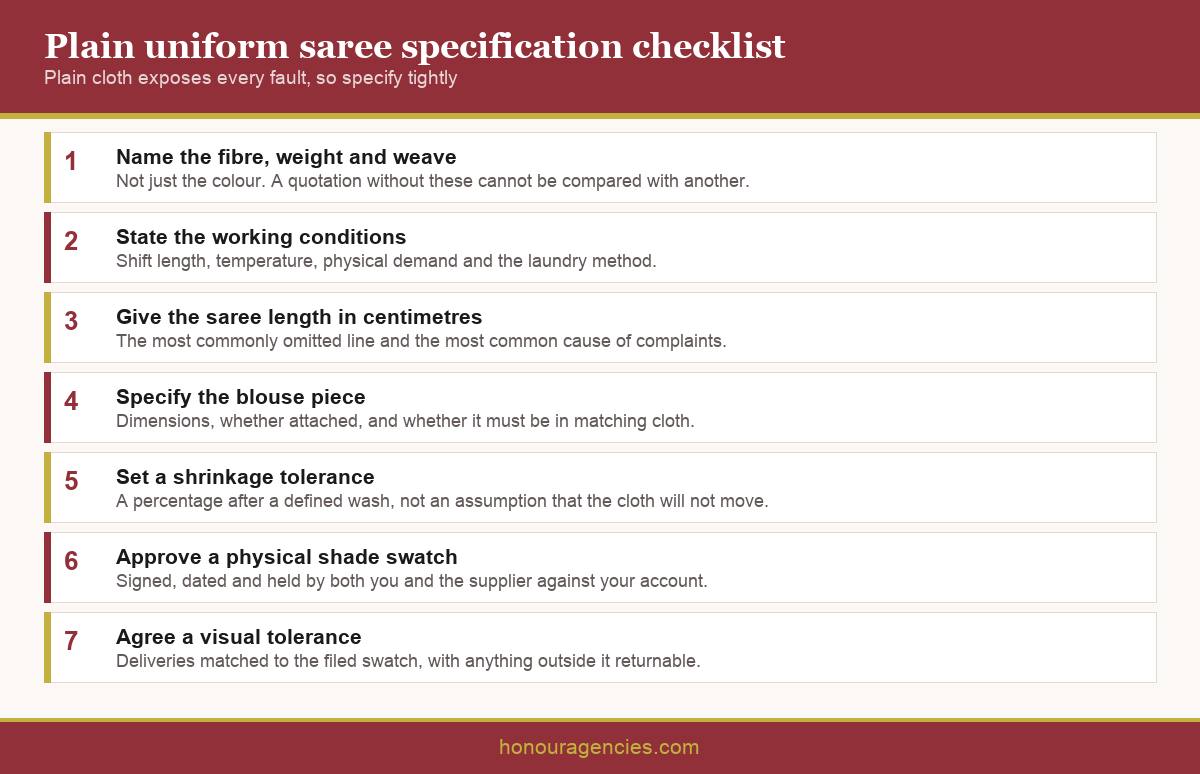
Finally, state a shrinkage tolerance as a percentage after a defined wash rather than assuming it will be zero. All natural fibre cloth moves, and an agreed figure prevents an argument later. Our guide to choosing the right fabric for institutional wear covers the fibre comparison in more detail.
Approve cloth rather than a colour name. Ask for a physical swatch cut from the production fabric, sign and date it, keep a copy on site and require the supplier you buy from to hold the matching piece against your account.
Label the reference so it is still useful in two years. It should record the fibre, the weight, the department, the approval date and the supplier's own lot identifier. An unlabelled swatch in a drawer answers no questions when a reorder arrives.
Buy the whole department from one lot wherever budget allows. A single lot is the cleanest possible baseline, and every additional lot introduces a small step that plain cloth displays clearly. Cover current staff plus a reserve in the first order rather than returning in three months.
State a tolerance rather than hoping for an exact match. No two runs are identical, so agree in writing that deliveries will be matched against the filed swatch under a named light source, and that anything outside the agreed visual tolerance can be returned. A stated standard is treated seriously in a way that an unspoken expectation never is.
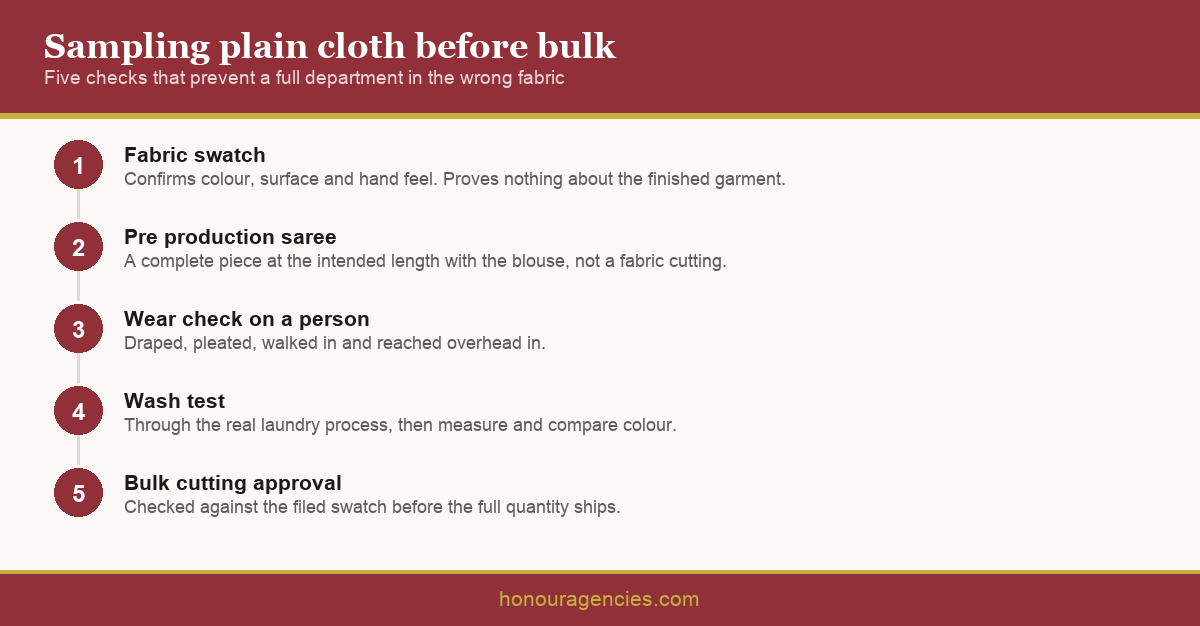
Request a cutting from every new lot before the full quantity ships. Comparing it against the filed swatch takes minutes and catches a mismatch while it is still the supplier's problem. This single habit prevents most reorder disputes on plain fabric.
Ask for a complete pre production sample rather than a fabric swatch alone. A finished saree in the intended cloth, at the intended length, with the blouse piece, is the only way to check the things that matter once the garment is worn.
Check it on a person. Have someone drape and pleat it, walk in it and reach overhead. Length, fall and how the selvedge behaves at the pleat line are invisible flat on a counter and obvious within a minute on a wearer.
Wash one sample through the institution's real laundry process, at the actual temperature and detergent strength. Then measure it again and compare its colour against the unwashed piece. This is the stage most often skipped and the one that predicts real garment life best.
Ask how the fabric was finished. Calendering and other finishing processes can make a cloth feel smoother and look better on the counter than it will after two washes, which is why a wash tested sample tells a different story from a fresh one. If a sample feels noticeably crisper than expected for its fibre, ask what finish has been applied and whether it survives laundering.
Inspect the cloth itself in good light. Hold a length up and look along it for barré lines, uneven dye pickup and slubs. On plain fabric these are the faults that will be visible on every wearer, so it is worth a careful look before bulk production rather than after.
Agree how the goods will arrive. Cartons marked by shade, size and department with a matching packing list turn inspection into a short task, while unmarked mixed cartons turn it into a day of sorting at the institution's cost.
Inspect on arrival rather than on issue. Pull a fixed proportion of pieces from different cartons and check each against the specification for shade, length, blouse dimensions and visible faults. Record what you checked, because faults found weeks later across a department are far harder to resolve.
Store the balance properly. Reserve stock in a damp store will mildew, and pieces folded in one position for a year develop permanent lines that pressing will not remove. Keep spares dry, off the floor and refolded periodically so the reserve is usable when an intake arrives.
Plan repeat orders around production seasons. Mills run hard before festival periods, and a repeat placed into that window competes for capacity with much larger orders. Quieter months usually deliver both a better lead time and a more careful match. Institutions that handle large repeat orders smoothly are usually just the ones planning further ahead.
Plain uniform sarees are unforgiving, and that is exactly why they reward a tight specification. Name the fibre, weight and weave, give the length and blouse dimensions in centimetres, approve a physical swatch and hold its twin with the supplier, wash test before bulk, and inspect on arrival. Do that and a plain order is the most consistent uniform an institution can buy. Honour Agencies has supplied wholesale and institutional sarees from Ernakulam for 35 years. To discuss a bulk requirement, contact our team.
Q: Why are plain uniform sarees harder to buy than printed ones? A: A print hides weave variation, slight colour differences and finishing marks. Plain cloth exposes all of them, so shade consistency, weave evenness and finish need a tighter specification than a patterned order.
Q: What are barré lines? A: Faint horizontal bands caused by yarn variation across the width of the cloth. They are almost invisible on a print and clearly visible on a plain mid tone, which makes them worth checking before bulk production.
Q: What should a plain uniform saree specification include? A: Fibre, fabric weight, weave, an approved physical shade reference, saree length in centimetres, blouse piece dimensions and a stated shrinkage tolerance after a defined wash.
Q: Why does saree length cause so many complaints? A: Because it is usually left unstated. Length faults are invisible on a folded piece and obvious once the garment is pleated on a person, so agree a figure in centimetres and check the first delivery worn.
Q: Should the blouse piece be specified separately? A: Yes. Give its dimensions, confirm whether it is attached and state whether it must match the saree cloth. Institutions that leave this to the supplier often receive pieces too short for their size range.
Q: How do we avoid shade differences across a department? A: Buy the whole department from one lot where budget allows, covering current staff plus a reserve. Then check a cutting from every later lot against your filed swatch before the full quantity ships.
Q: Is a fabric swatch enough before bulk production? A: No. Ask for a complete pre production saree at the intended length with the blouse piece. Many faults only appear when the garment is draped, pleated and worn rather than inspected flat.
Q: Should uniform fabric be wash tested? A: Always, through the institution's real laundry process at the actual temperature and detergent strength. Measure and compare the colour afterwards. It predicts garment life better than any counter inspection.
Q: When should delivered stock be inspected? A: On arrival. Pull a fixed proportion from different cartons and check shade, length, blouse dimensions and visible faults against the specification, recording the results for future reference.
Q: When is the best time to place a repeat order? A: Away from peak festival production, when mills are less stretched and matching is more careful. Our institutional supply chain guide covers planning the cycle.


Or login with