
Women danim jacket
$249.00

Red formal dress
$129.00

Man winter blazer
$149.00$99.00
Subtotal$477

 General
Georgette is bought by feel and sold by name, which is where the trouble starts. Two rolls both described as plain georgette can differ in fibre, weight, opacity and drape to the point where they are not really the same product. For anyone buying plain georgette fabric wholesale, learning to separate the grades is the difference between a consistent product line and a run of returns. This guide covers what georgette actually is, how the grades differ, and what to specify before an order goes out.
Georgette is a lightweight crepe woven from highly twisted yarns in both directions. That twist is what gives the cloth its characteristic slightly grainy surface, its dull rather than shiny finish, and the springy handle that separates it from a plain chiffon. The construction is documented as georgette in textile references, and understanding it explains most of the fabric's behaviour.
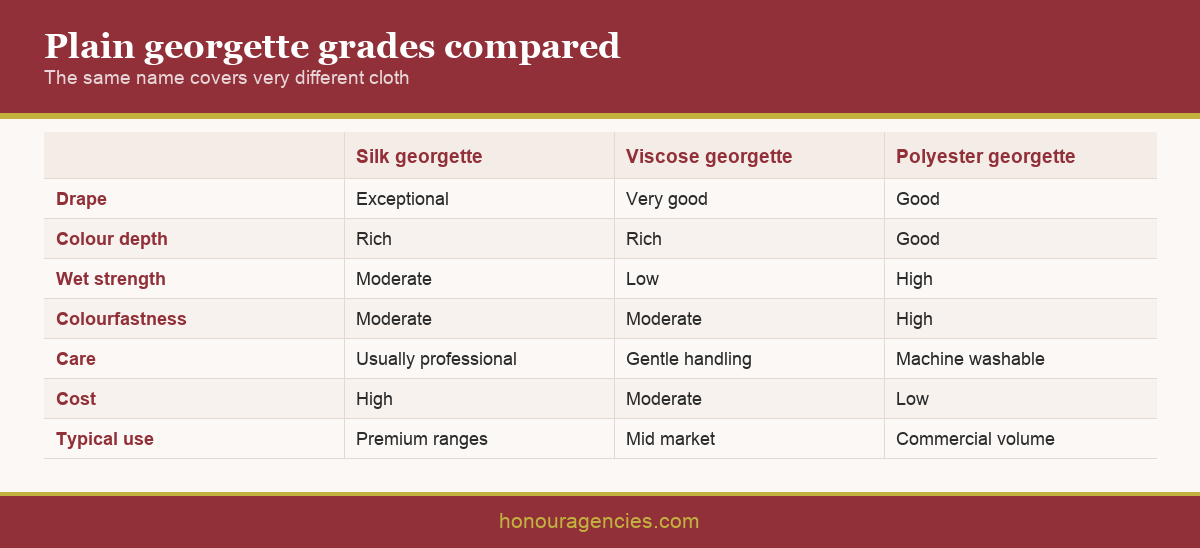
Because georgette describes a construction, the fibre underneath varies completely. Pure georgette is woven from silk and carries the price, the softness and the care requirements that implies. Faux georgette is woven from polyester or viscose filament and reproduces the surface at a fraction of the cost.
The two are not interchangeable and should never be quoted as though they were. Silk georgette drapes with a weight and a fluidity that synthetic versions approach but rarely match. Polyester georgette is stronger, cheaper, more colourfast and far easier to launder, which is why it dominates commercial volumes.
Viscose georgette sits between them. It handles closer to silk than polyester does, takes dye beautifully and costs considerably less than silk, at the price of lower wet strength and a shorter life under repeated washing. For many retailers it is the practical middle ground.
Weight is the primary grade indicator, quoted in grams per square metre or sometimes as a momme figure on silk. Lighter georgettes around 40 to 60 GSM are sheer and float, suiting dupattas, overlays and layered sarees. Mid weights around 60 to 90 GSM hold more structure and suit sarees intended to be worn without a heavy lining.
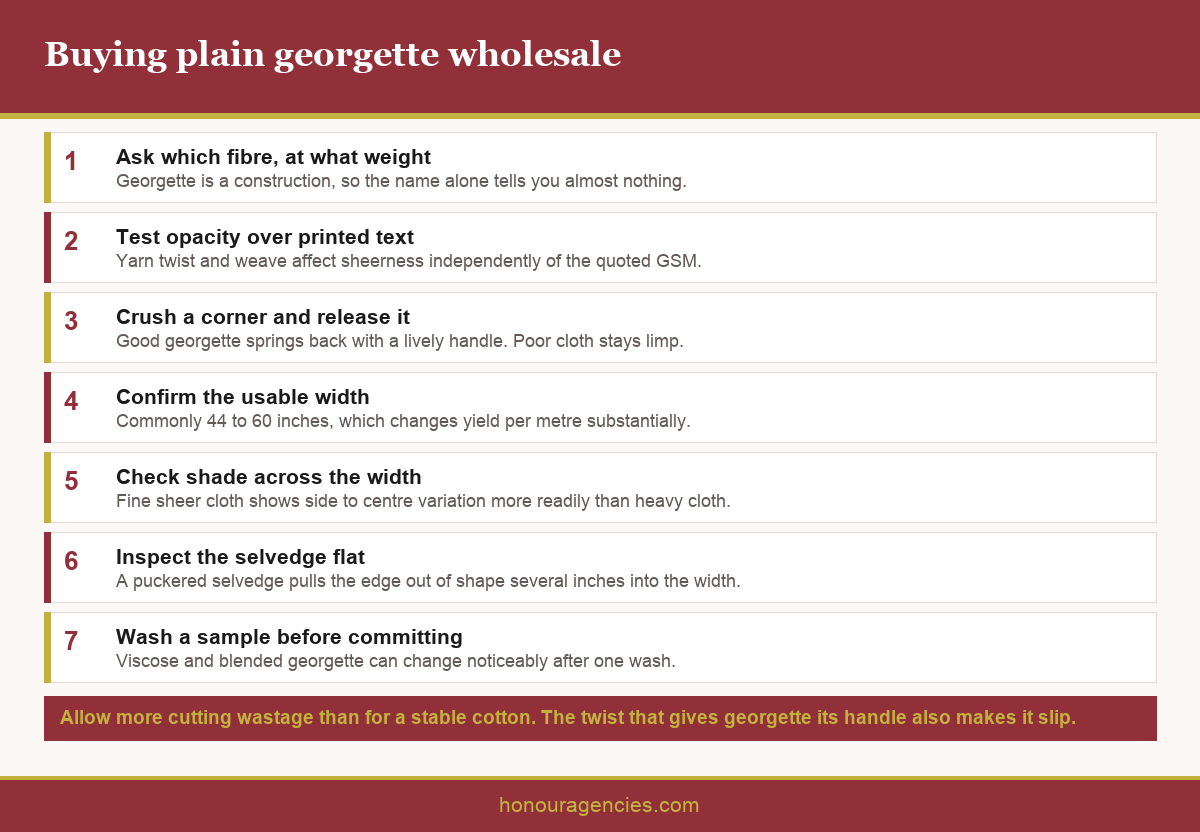
Opacity follows weight but not perfectly, because yarn twist and weave density affect it independently. Two cloths at the same GSM can differ noticeably in how much they show, so hold a sample over a printed page rather than judging by the quoted number alone.
Twist level separates good georgette from a flat imitation. A well made georgette has a lively, springy handle that recovers when crushed, while a poorly twisted cloth feels limp and creases badly. Crush a corner in your hand and release it, and the difference is immediate.
Finish is the last variable. Some georgettes carry a softening or a light calendered finish that flatters the sample and disappears after two washes. If a cloth feels noticeably better than expected for its price, ask what has been applied and whether it survives laundering.
Sheer light georgette belongs in dupattas, overlays, sleeves and layered panels where movement matters more than coverage. It is the wrong choice for a garment expected to be worn alone, because the transparency becomes a lining problem rather than a design feature.
Mid weight georgette is the workhorse of the saree trade. It drapes well, pleats cleanly, holds printed and embroidered decoration, and forgives a wide range of body shapes. Most commercial saree ranges in georgette sit in this band.
Heavier georgette, which shades towards a crepe, suits structured garments, kurtas and anything needing a defined line. It is less common in wholesale saree stock but valuable for boutiques producing stitched pieces from running cloth.
Think about what will be done to the cloth after it leaves you. Georgette destined for embroidery or heavy embellishment needs enough body to carry the weight without puckering, and a very light cloth that looks elegant plain will distort once a dense motif is worked onto it. Ask the question before the order rather than after the first sampled piece comes back.
Choose the grade against the end product and the price point together. A retailer selling a mid market saree range gains nothing from silk georgette that triples the cost, and a boutique building a premium line gains nothing from a polyester that reads as cheap in the hand. Our overview of specialist fabric merchants covers how to place a fabric within a range.
Georgette moves. The same twist that gives it life makes it slip under the scissors, distort on the table and stretch on the bias if it is handled carelessly. Anyone costing a garment from georgette should allow more cutting wastage than they would for a stable cotton.
Ask about width carefully. Georgette is commonly available between 44 and 60 inches, and the difference changes the yield per metre substantially. Convert every quotation to cost per finished garment against your own cutting plan rather than comparing rate per metre.
Check shade across the width as well as along the roll. Fine sheer cloth shows side to centre dye variation more readily than heavier fabric, and a garment cut from the selvedge side can differ visibly from one cut from the centre. Unroll a length and look across it in good light.
Watch the selvedge. On fine cloth a tight or puckered selvedge pulls the edge of the roll out of shape, and that distortion carries several inches into the usable width. It is easy to see if you unroll a length and lay it flat, and easy to miss entirely if you only handle a folded sample.
Approve a physical swatch and keep it. Sign and date a cutting from the production cloth, hold one copy and require the wholesale fabric supplier to keep the matching piece against your account, then check a cutting from every new lot before the full quantity ships.
Georgette creases in storage more readily than it does in wear, which surprises buyers who judge it only in the shop. Rolled stock holds its condition far better than folded stock, and a bolt folded for months develops lines along the folds that pressing does not fully remove.
Keep stock away from direct light. Fine cloth in pale shades yellows unevenly where daylight reaches it, so a roll stored near a window develops a visible band. Cover stock or store it away from windows, particularly for anything held across a season.
Give retail customers realistic care guidance. Polyester georgette launders easily, viscose georgette needs gentler handling and silk georgette generally needs professional care. Selling all three under one label and one care instruction produces complaints that were entirely avoidable.
Rotate by age rather than by convenience. The habit of using whatever is nearest leaves older cloth ageing at the back until it is unsaleable, and a simple date label with a first in first out rule prevents most of that loss. Retailers stocking glamorous occasion styles generally apply the same discipline to their georgette ranges.
Plain georgette fabric wholesale rewards buyers who ask which fibre, at what weight, at what width, with what finish, before they ask about the rate. Test opacity against a printed page, crush a corner to judge the twist, allow for extra cutting wastage, and keep a signed shade reference for reorders. Do that and georgette becomes one of the most reliable fabrics in a range rather than one of the most variable. Honour Agencies has supplied wholesale fabrics and sarees from Ernakulam for 35 years. To discuss a georgette requirement, contact our team.
Q: What is plain georgette fabric? A: A lightweight crepe woven from highly twisted yarns in both directions, giving a slightly grainy surface, a dull finish and a springy handle. It is a construction rather than a fibre, so the base material varies.
Q: What is the difference between pure and faux georgette? A: Pure georgette is woven from silk and carries silk's drape, price and care requirements. Faux georgette uses polyester or viscose filament to reproduce the surface far more cheaply and with easier laundering.
Q: Which georgette is best for sarees? A: Mid weight georgette around 60 to 90 GSM is the workhorse of the saree trade. It drapes and pleats cleanly, carries print and embroidery well, and suits a wide range of body shapes.
Q: How do I test georgette quality quickly? A: Crush a corner in your hand and release it. Well twisted georgette springs back with a lively handle, while a poorly made cloth feels limp and holds the crease. Then hold it over print to judge opacity.
Q: Does GSM alone tell me how sheer a georgette is? A: Not reliably. Yarn twist and weave density affect opacity independently of weight, so two cloths at the same GSM can differ visibly. Always test the actual sample over a printed page.
Q: Why does georgette need extra cutting allowance? A: The high yarn twist that gives georgette its handle also makes it slip under the scissors and stretch on the bias. Allow more wastage than for a stable cotton when costing a garment.
Q: How should georgette be stored? A: Rolled rather than folded, away from direct light. Folded bolts develop permanent lines along the folds, and pale shades yellow unevenly where daylight reaches them across a season.
Q: Does georgette shade vary across the roll? A: Fine sheer cloth shows side to centre variation more readily than heavier fabric. Unroll a length and check across the full width in good light rather than judging from a folded corner.
Q: How should georgette be laundered? A: It depends entirely on the fibre. Polyester georgette washes easily, viscose needs gentler handling and silk usually needs professional care. Give retail customers guidance matched to what they actually bought.
Q: What width does georgette usually come in? A: Commonly between 44 and 60 inches, which changes yield substantially. Our guide to sourcing premium fabrics covers converting quotations to cost per garment.


Or login with