
Women danim jacket
$249.00

Red formal dress
$129.00

Man winter blazer
$149.00$99.00
Subtotal$477

 General
Plain cotton is the most widely traded fabric in India and the easiest to buy badly. Two quotations can name the same cloth, quote very different rates, and both be honest, because plain cotton fabric wholesale pricing rests on counts, weight, width and finish that most enquiries never mention. Buyers who learn to read those four numbers stop comparing prices and start comparing cloth. This guide sets out what actually defines plain cotton, how to specify it, how to check it, and how to build a supply relationship that repeats.
Plain cotton describes a fabric woven in a simple over and under structure from cotton yarn, with no pattern in the weave and usually a single colour. The term is used loosely across the trade, and two suppliers using it in good faith may be offering cloth that differs in almost every measurable respect. That definition covers an enormous range, from fine voile at one end to heavy canvas at the other, which is why the word alone is not a specification.
Four numbers do most of the defining work. Yarn count describes the fineness of the thread, thread count or reed and pick describes how densely those threads are packed, weight describes the resulting cloth in grams per square metre, and width describes the usable cloth across the roll.
Combed and carded yarn is another distinction worth carrying into a conversation. Carded yarn is spun from cotton that has been cleaned but not combed, leaving shorter fibres in the mix, while combed yarn has those shorter fibres removed. Combed cloth is smoother, stronger and less prone to pilling, and it costs more for exactly those reasons.
Yarn count runs counter to intuition. A higher count means a finer yarn, so 60s cotton is finer and generally softer than 40s, and 20s is coarser and heavier again. Finer counts cost more per kilogram and produce a smoother, lighter cloth that suits blouses and fine garments. Coarser counts suit uniforms, curtains and anything needing body.
Fibre quality sits underneath all four. Cotton is graded partly by staple length, the average length of the individual fibres, and longer staple cotton produces smoother, stronger yarn with less pilling. That is why two cloths at the same count and weight can still feel and wear differently. A supplier who can tell you the staple grade is usually one who knows their mill.
The weave is the fourth variable and the one buyers most often assume. A plain weave is balanced and stable. A twill, even in a solid colour, drapes and wears differently. Confirm which you are being offered rather than assuming plain colour means plain weave. The underlying process is standard textile manufacturing, and suppliers answer these questions readily when they are asked directly.
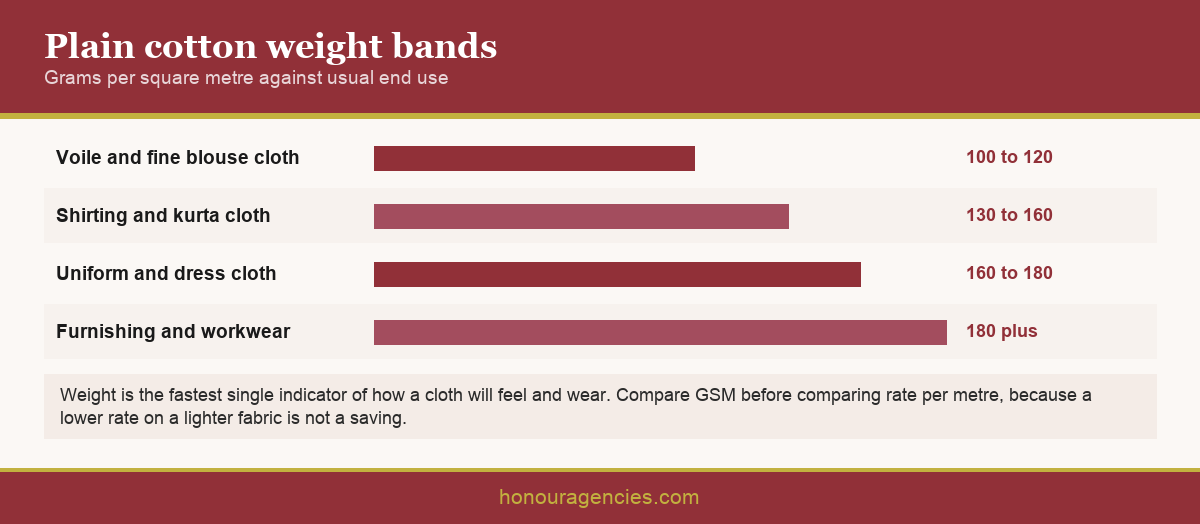
Fabric weight is quoted in grams per square metre, usually shortened to GSM. It is the fastest single indicator of what a cloth will feel like and how it will wear. Lightweight cotton around 100 to 120 GSM suits blouse material, linings and summer garments. Mid weights around 130 to 160 GSM cover most shirting, uniform and dress applications. Heavier cloth above 180 GSM moves towards furnishing and workwear.
Be careful comparing GSM across different fibres or blends, because the same weight feels very different depending on what it is made from. Within plain cotton the comparison is reliable, which is precisely why it is such a useful number when assessing quotations for the same cloth from several suppliers.
Our note on why cotton running fabrics sell well among Kerala tailors covers how weight choices play out in finished garments.
Weight also drives cost honestly. A heavier cloth uses more cotton per metre, so a lower rate on a lighter fabric is not automatically a better deal. Comparing rate per metre without comparing GSM is the single most common error in fabric buying, and it flatters the wrong supplier every time. Grammage is the standard on which this measure rests.
One practical shortcut is to carry a small digital scale and a ruler when assessing samples. Cut a ten centimetre square, weigh it in grams, and multiply by one hundred to get the GSM directly. It takes a minute and immediately tells you whether the quoted figure is honest, which changes the tone of every subsequent conversation with that supplier.
Width is quoted in inches or centimetres and varies far more than buyers expect, commonly from 36 inches to 60 inches. That range changes everything downstream, because a garment is cut from area, not from length.
A cloth at 44 inches quoted at a low rate can cost more per finished garment than a cloth at 58 inches quoted higher, simply because the wider roll yields more pieces per metre with less wastage. Always convert a quotation to cost per square metre, or better, to cost per garment against your own cutting plan, before deciding anything.
Width also interacts with the product you are making. Saree blouse pieces, kurta panels and uniform components each have a natural cutting width, and a roll that does not divide neatly into that width wastes cloth on every single garment. Work the arithmetic once for your main products and keep the answer, because it turns width from an afterthought into a purchasing criterion.
Confirm whether the quoted width is the full width or the usable width inside the selvedge. The difference is often an inch or two, which matters when a cutting plan is tight. Ask explicitly rather than assuming.
Greige cloth is fabric straight from the loom, unbleached and unfinished. It is the cheapest form and the starting point for everything else, but it will shrink, it carries natural impurities and its colour is not consistent. Buyers who want to dye to their own shade start here.
Bleached cotton has been cleaned and whitened, a process covered by standard textile bleaching practice. It provides a consistent white base for printing or dyeing and is what most buyers mean when they ask for plain white cloth.
Half bleached cloth sits between greige and fully bleached and is common in the trade. It is cleaner than greige and cheaper than full bleach, and it suits mid to dark dyeing where a perfectly white base is unnecessary. Buyers who only ask for bleached or unbleached sometimes pay for a whiteness their end use never needed.
Dyed cotton has been coloured to a specified shade, either as yarn before weaving or as piece goods after. Yarn dyed cloth generally holds colour better and costs more. Piece dyed cloth is more economical and covers most commercial requirements. Ask which you are being offered, because the difference shows over a garment's life.
Finishing covers everything applied after weaving and dyeing, from softening and calendering through to mercerising and pre shrinking. It changes how a cloth feels in the hand very significantly, and some finishes do not survive laundering.
That creates a trap. A calendered cotton feels smoother and looks crisper on the counter than it will after two washes, so a sample that feels noticeably better than expected for its count deserves a question about what has been applied. Ask what finish is on the cloth and whether it is permanent.
Ask about the hand feel deliberately. Softeners are the most common finish and the least permanent, and a cloth that arrives beautifully soft can feel noticeably harsher after three washes once the softener has gone. If softness is genuinely important to the end product, ask for a washed sample rather than judging the fresh one.
Retailers choosing between qualities will find our guide to choosing the right running material a useful companion here.
Mercerising is worth knowing about specifically. It strengthens cotton, improves lustre and makes dye uptake deeper and more even. Mercerised cotton costs more and generally justifies it in a garment that will be washed frequently.
Cotton shrinks. Any specification that assumes otherwise will produce a dispute, because the question is never whether the cloth moves but how much and whether that was agreed. Shrinkage is normal fibre behaviour rather than a defect.
Ask whether the cloth is pre shrunk, sometimes described as sanforised, and ask for the residual shrinkage figure as a percentage. Untreated cotton can move several percent in the first wash, which is enough to turn a correctly cut garment into a wrong one.
Test in both directions. Cotton usually shrinks more along the length, in the warp direction, than across the width, and a garment cut without allowing for that will change proportion rather than simply getting smaller. Mark a square rather than a line so you capture both axes in a single test.
Run your own test rather than relying on the answer alone. Cut a measured square, mark it precisely, wash it the way the finished garment will be washed, dry it the same way and measure again. The result tells you more about the cloth than any certificate.
Write the tolerance into the order. State the acceptable residual shrinkage percentage after a defined wash, and state what happens if a delivery exceeds it. Suppliers respond to a stated standard far more reliably than to an assumption, and the conversation is much easier before the cloth is cut.
Plain cloth exposes colour variation that a print would hide, which makes shade control a central concern rather than a refinement. Two rolls a half tone apart, cut into garments worn side by side, read immediately as a mistake.
Approve a physical swatch cut from the production cloth, sign and date it, keep one copy and require the wholesale fabric supplier to hold the matching piece against your account. A colour name, a screen image or a printed chart will not hold a shade.
Side to centre variation deserves particular attention on wide cloth. Dyeing and finishing machinery does not always treat the edges and the middle of a wide roll identically, and a garment cut from the selvedge side can end up marginally different from one cut from the centre. On a plain mid tone worn as a uniform, that difference is visible.
Watch for within roll and roll to roll variation. Agree which light source is definitive. Shade comparisons made under a shop tube light, under a north window and under warm evening light will not agree with each other, and disputes often come down to two people looking at the same cloth in different rooms. Naming a single reference light, even informally, removes an entire category of argument.
Ask for the cloth to be checked for side to centre and end to end shade variation, and inspect a length yourself across its full width in good light rather than looking at a folded corner.
Request a cutting from each new lot before the full quantity ships, and compare it against the filed swatch under a consistent light source. This takes minutes and catches a mismatch while it is still the supplier's problem to solve.
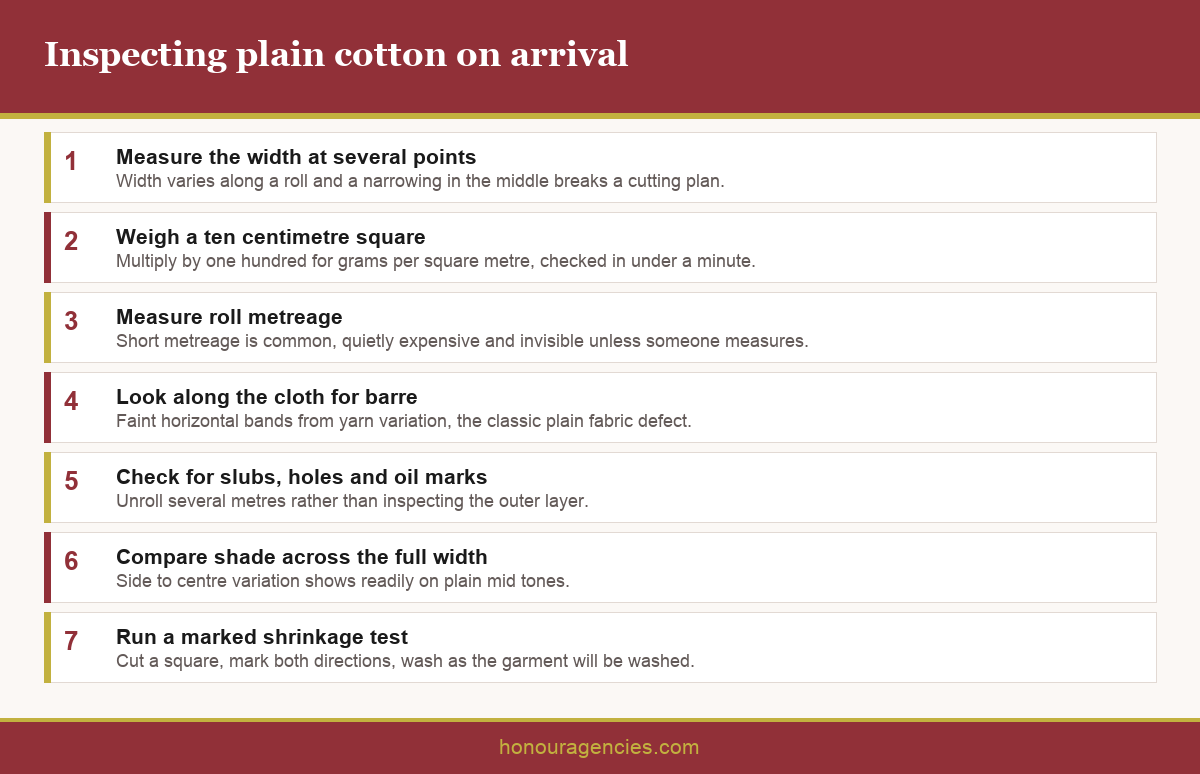
Inspect a proportion of rolls rather than accepting on documents alone. Even a light check, unrolling a few metres from several rolls and looking along the cloth in good light, catches most of what matters.
Adopt a consistent sampling rule rather than inspecting at random. Checking a fixed proportion of rolls, drawn from different cartons or lots rather than whichever is nearest the door, gives a result you can actually rely on. The principle is the same one used in formal fabric inspection systems, where faults are counted against a defined standard rather than judged by impression.
Look for the faults plain cotton actually shows. Barré lines are faint horizontal bands from yarn variation and are the classic plain fabric defect. Slubs are thickened spots in the yarn. Holes, oil marks from machinery and dye patches are all straightforward to spot once you are looking for them.
Check the roll for how it has been wound as well as what is on it. A loosely or unevenly wound roll can hide creasing, and cloth wound over a fault conceals it until the roll is opened on the cutting table. Unrolling a few metres rather than inspecting the outer layer takes very little time and reveals a great deal.
Measure rather than trusting the label. Check the width across several points, weigh a cut sample to confirm the GSM, and measure the length of at least one roll against its stated metreage. Short metreage is a common and quietly expensive discrepancy.
Decide in advance what you will do about minor faults. Cloth is a natural product and a small number of faults per hundred metres is normal rather than negligent. Agreeing an acceptable fault rate, and how a roll exceeding it will be handled, prevents both parties from arguing about whether a defect is ordinary or unacceptable after the cloth has been cut.
Record the results in a consistent format. A simple log of what was checked, on which rolls, against which specification, builds a picture of a supplier's reliability over time and gives you a defensible position when something is genuinely wrong. Our note on identifying quality in wholesale goods covers the same discipline applied to finished pieces.
Cotton is hygroscopic, which means it absorbs moisture from the air, and that single property governs most of what goes wrong in storage. Rolls held in a humid room take up moisture, and moisture in a tightly wound roll is what produces mildew, musty odour and permanent staining that no washing removes.
Keep stock off the floor and away from external walls. Floors are the coldest surface in most godowns and the first place condensation forms, and external walls carry damp through in monsoon conditions. Simple pallets or racking solve most of this at negligible cost.
Store rolls horizontally on racks rather than standing them on end. A roll standing upright compresses under its own weight, which flattens the lower section and creates a permanent crease line across the cloth. That flattened portion often has to be discarded, which is a quiet loss that nobody records.
Protect white and pale cloth from light. Prolonged exposure to daylight yellows unbleached and bleached cotton unevenly, so a roll stored near a window develops a visible band where the light reached it. Cover stock or store it away from windows, particularly anything held for more than a season.
Buyers stocking cotton blouse material alongside dress fabric usually apply one rotation rule across both.
Rotate stock by age rather than by convenience. The natural habit is to use whatever is nearest the door, which leaves older cloth at the back ageing quietly until it is unsaleable. A simple date label on each roll and a first in first out rule prevents almost all of that waste.
Finally, keep dyed lots together and labelled. A roll separated from its lot identifier becomes a shade matching problem the moment it is needed, because there is no way to tell which order it belonged to or what it was approved against.
Insist that every quotation carries the same figures. Count, GSM, width, weave, finish, dyeing method and shrinkage status should all appear. A supplier unwilling to state them is quoting a different cloth from the one you are comparing it against.
Convert everything to a common basis before deciding. Rate per metre is almost meaningless across different widths and weights, and cost per square metre or cost per finished garment is the only fair comparison. This single step reorders most quotation comparisons.
Understand where the price is actually coming from. Cotton is a commodity, and mill rates move with raw cotton prices, yarn availability and season. A supplier holding stock absorbs some of that movement, while one buying to order passes it straight through. Neither model is wrong, but they behave very differently when the market moves, and knowing which you are dealing with explains a lot about how quotations change month to month.
Ask about continuity directly. Whether the supplier holds regular stock in your shade, how long a repeat run takes, what the minimum repeat quantity is, and what happens when a yarn is discontinued. These answers matter more than the rate for anyone buying repeatedly.
Treat a fabric supplier as a technical relationship rather than a price source. A supplier who knows what you make, how you cut and how your customers launder can flag a cloth that will disappoint before you order it, and that advice is worth considerably more over a year than a small difference in rate. The buyers who get the best fabric are usually the ones who explain the end use rather than only issuing a specification.
Place repeat orders away from peak production. Mills run hard before festival seasons, and cloth ordered into that window competes for capacity with much larger buyers. Quieter months deliver better lead times and more careful matching, which is worth planning for. Buyers who source running material wholesale regularly tend to build their calendar around this.
Plain cotton fabric wholesale rewards buyers who ask four questions before they ask about price. What is the count, what is the GSM, what is the usable width, and what finish is on it. Add a wash test for shrinkage, a signed shade swatch held by both sides, and an inspection routine on arrival, and most of what goes wrong in fabric buying simply stops happening. Honour Agencies has supplied wholesale fabrics and sarees from Ernakulam for 35 years. To discuss a fabric requirement, contact our team.
Q: What does GSM mean in plain cotton fabric? A: Grams per square metre, the weight of the cloth. It is the fastest indicator of feel and durability. Light cotton around 100 to 120 GSM suits blouses, while 130 to 160 GSM covers most shirting and uniform use.
Q: Does a higher yarn count mean better fabric? A: It means finer yarn, not automatically better. Higher counts like 60s give a softer, lighter cloth suited to fine garments. Coarser counts like 20s give body and durability, which uniforms and furnishings need.
Q: Why does fabric width matter so much? A: Garments are cut from area, not length. A wider roll yields more pieces per metre with less wastage, so a cheaper rate on a narrow cloth can cost more per finished garment than a dearer wide one.
Q: What is greige fabric? A: Cloth straight from the loom, unbleached and unfinished. It is the cheapest form and the base for bleaching, dyeing and finishing, but it shrinks, carries natural impurities and is not colour consistent.
Q: How much does plain cotton shrink? A: Untreated cotton can move several percent in the first wash. Ask whether the cloth is pre shrunk and request the residual shrinkage percentage, then verify it yourself with a measured and marked wash test.
Q: What is mercerised cotton? A: Cotton treated to strengthen the fibre, improve lustre and deepen dye uptake. It costs more and usually justifies it in garments that will be laundered frequently, because colour and finish hold better.
Q: What are barré lines? A: Faint horizontal bands caused by yarn variation across the cloth. They are the classic plain fabric defect, almost invisible under a print and clearly visible on a plain mid tone once the garment is worn.
Q: How should plain cotton quotations be compared? A: Convert every quotation to cost per square metre, or cost per finished garment against your cutting plan. Rate per metre is close to meaningless when widths and weights differ between suppliers.
Q: How do we stop shade drifting between orders? A: Approve a physical swatch cut from production cloth, sign and date it, and require the supplier to hold the matching piece. Check a cutting from each new lot before the full quantity ships.
Q: What should be checked when fabric arrives? A: Width at several points, GSM by weighing a cut sample, roll metreage, and the cloth itself for barré, slubs, holes and dye patches. Our blouse material buying guide covers related checks.


Or login with