
Women danim jacket
$249.00

Red formal dress
$129.00

Man winter blazer
$149.00$99.00
Subtotal$477

 General
Housekeeping uniform sarees have the hardest working life of any institutional garment. They are worn by staff who bend, lift, stretch and climb for a full shift, in warm back of house areas, and they are washed more often and more aggressively than any other uniform in the building. Specifying them like front of house wear guarantees early failure. This guide covers the fabric, fit, seam and reorder decisions that decide how long housekeeping uniform sarees actually last.
Housekeeping work is physical in a way that other uniformed roles are not. Staff reach above shoulder height, kneel, carry linen and move between warm corridors and air conditioned rooms many times a day. Every one of those actions puts load on the garment in places a standing role never touches.
The consequence is that failure happens at predictable points. Pleats wear thin, the section over the shoulder abrades against carried linen, and seams on the blouse give way at the arm. A saree specified purely on how it looks folded on a counter will not have been tested against any of that.
Heat is the other constant. Back of house areas are rarely air conditioned to the standard of guest floors, and laundry and service corridors are warmer still. Fabric that traps heat produces staff who roll, tuck or loosen the garment to cope, which destroys the uniform appearance the institution was buying.
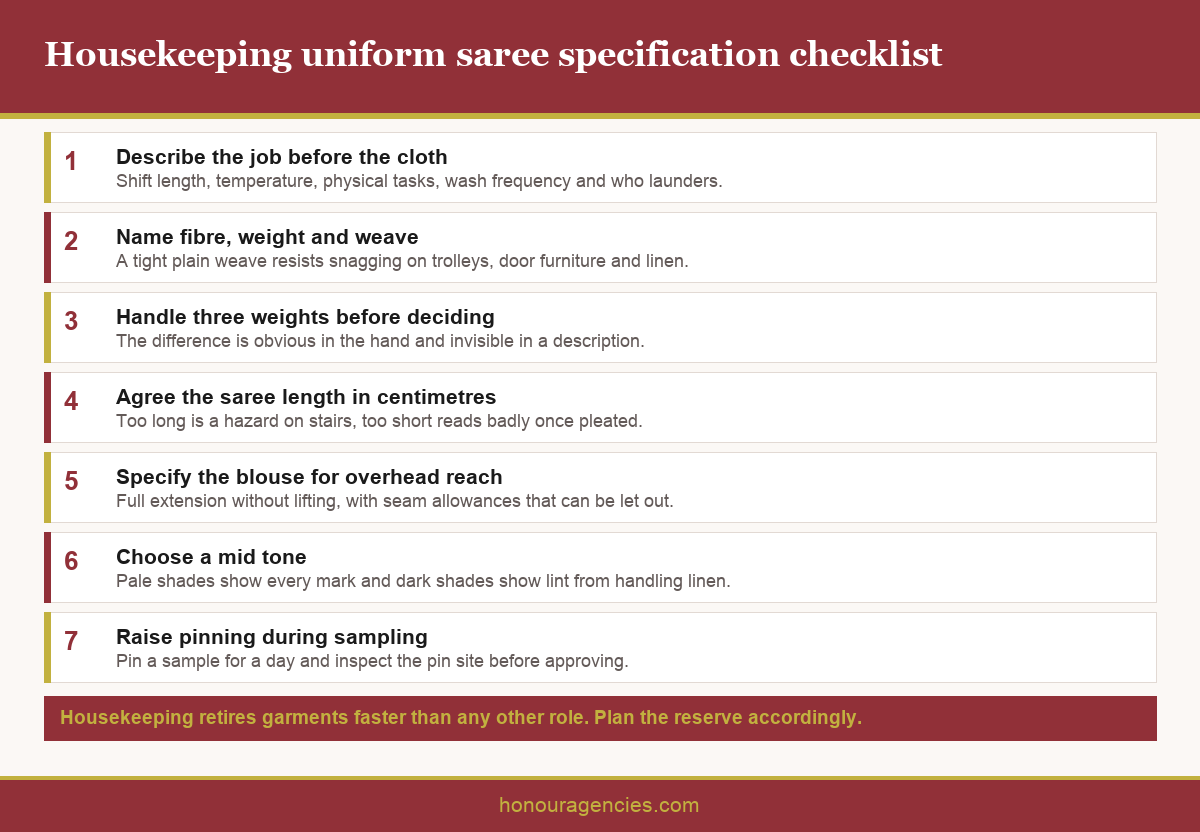
The practical starting point is to describe the job before describing the cloth. Write down the shift length, the temperature range, the physical tasks and the wash frequency, then choose fabric against that description. Suppliers give much better advice when they are told the conditions rather than a colour. A short written brief also protects you later, because it becomes the reference against which a disappointing delivery can be measured.
Cotton is the natural default because it breathes and tolerates hot washing, which is exactly what this role needs. Its weaknesses are creasing and shrinkage. Both are manageable when the fabric is pre shrunk and the specification allows a stated tolerance rather than pretending shrinkage will be zero.
Polyester cotton blends trade some breathability for crease resistance and better colour retention. For housekeeping the balance usually favours the higher cotton content, because comfort drives compliance. A blend around two thirds cotton is a common landing point for teams working in warm conditions. Understanding how cotton behaves as a fibre helps when comparing quotes that describe blends differently.
The weave matters as much as fibre. A tight plain weave resists snagging on trolleys, door furniture and linen, and holds its shape at the fold. A loose weave feels softer in the hand and fails earlier at exactly the points housekeeping stresses. Handle the cloth folded and rubbed, not just draped.
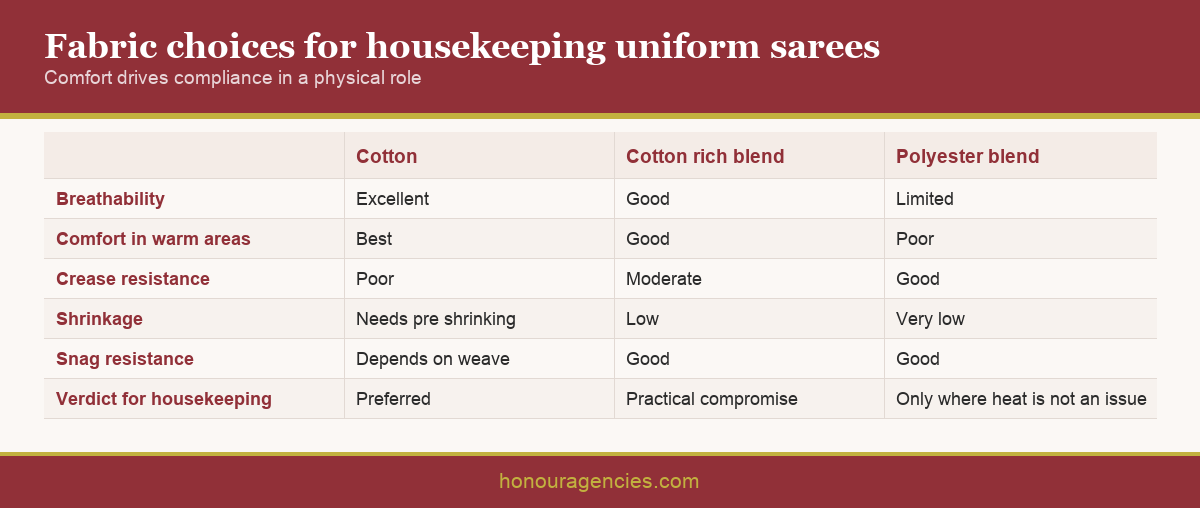
Weight is the third variable. Lighter cloth is more comfortable through a long shift but shows wear sooner. Heavier cloth lasts but reads as hot. Handle three weights from one supplier before deciding, because the difference is obvious in the hand and invisible in a description. Our guide to choosing the right fabric for institutional wear sets out the wider comparison.
Saree length is the specification most often left vague and most often regretted. Too short reads as ill fitting on taller staff once pleated, and too long is a trip hazard for someone carrying linen down a stairwell. Agree the length in centimetres and check the first delivery on a person rather than flat on a table.
The blouse carries most of the movement load, so specify it separately. Housekeeping staff need a sleeve and armhole that allow full overhead reach without the garment lifting, and seam allowances generous enough to be let out. Decide early whether the institution tailors centrally or staff arrange their own, because that choice changes what you buy.
Consider how the saree is secured during work. Many housekeeping teams tuck or pin the pallu for safety around trolleys and machinery. A fabric that creases permanently where it is pinned will look untidy within weeks, so raise pinning explicitly when you evaluate samples.
Sizing across a large team is easier when you standardise. Ordering one saree length with a generously cut blouse in a small range of sizes is usually more practical than trying to individualise, and it makes new joiners far simpler to equip. Our note on the top mistakes to avoid when ordering covers the traps that catch first time buyers.
Housekeeping sees more soiling than any other role, so colour choice is partly a maintenance decision. Very pale shades show every mark and drive a shorter replacement cycle. Very dark shades hide marks but show lint and dust, which is a real problem in a role that handles linen all day. Mid tones are the usual compromise.
If your institution uses colour to separate departments, keep housekeeping's shade clearly distinct from the shades worn in guest facing roles. The separation should survive a corridor glance under working light, not just a close inspection under daylight.
Shade drift between orders is a sourcing problem with a simple fix. Approve a physical swatch, sign it, keep a copy and require the supplier you buy from to hold the matching reference against your account. Every reorder is then checked against cloth rather than a colour name or a photograph.
Give the laundry the care specification directly. Housekeeping uniforms go through the most wash cycles in the building, and most premature fading traces back to a hot cycle with aggressive detergent that nobody adjusted. Our guidance on caring for and maintaining institutional wear covers the routine worth publishing.
Housekeeping teams turn over faster than most departments, so the order plan should assume continuous recruitment rather than a fixed headcount. A single large order sized to today's staff leaves the department mismatched within a few months as new joiners arrive in whatever was available.
Place a main order plus a held reserve against your shade reference. Size the reserve from your actual quarterly joiner and leaver numbers rather than a flat percentage, and add a damage allowance, because this role retires garments faster than any other through snags and stains.
Ask the supplier two direct questions before committing. How long will they hold your shade reference, and what is the minimum quantity for a repeat run. A shade that only runs economically at large volumes is the wrong choice for a department that needs ten sarees in a quiet month.
Keep the paperwork in one place. The signed swatch, the fabric specification, the saree length, the blouse detail, the care instruction and a log of past orders make every future order a short conversation. Buyers who manage institutional supply chains well treat that file as the real deliverable.
Housekeeping uniform sarees are bought for movement and laundry, not for display. Choose a breathable cotton or cotton rich cloth in a tight weave, specify length and blouse construction in writing, pick a mid tone that hides marks without showing lint, and plan reorders around turnover with a held shade reference. That combination keeps a large team looking consistent for years. Honour Agencies has supplied wholesale and institutional sarees from Ernakulam for 35 years. To discuss a housekeeping requirement, contact our team.
Q: What fabric is best for housekeeping uniform sarees? A: Cotton or a cotton rich blend around two thirds cotton. Housekeeping works in warm back of house areas, so breathability drives comfort and comfort drives whether staff wear the uniform correctly through a full shift.
Q: Why do housekeeping uniforms wear out faster than others? A: Wash frequency more than wear. Housekeeping garments are laundered more often and more aggressively than any other uniform in the building, so shrinkage control and colour fastness matter more than surface finish.
Q: What saree length should be specified for housekeeping? A: Agree a length in centimetres rather than assuming a standard, and check the first delivery on a person. Too short looks ill fitting once pleated, and too long is a hazard for staff carrying linen on stairs.
Q: Should the blouse be specified separately? A: Yes. The blouse carries the movement load. Specify a sleeve and armhole that allow full overhead reach, and ask for generous seam allowances so garments can be let out for new staff.
Q: What colour works best for housekeeping sarees? A: Mid tones usually. Pale shades show every mark and shorten the replacement cycle, while very dark shades show lint and dust, which is a real problem for staff handling linen all day.
Q: How do we stop the shade changing between orders? A: Approve a physical swatch, sign it, keep a copy and require your supplier to hold the matching reference on your account. Reorders are then checked against cloth instead of a colour name.
Q: How much reserve stock should we hold? A: Base it on your actual quarterly joiners and leavers rather than a flat percentage, and add a damage allowance. Housekeeping retires garments faster than any other role through snags and stains.
Q: Does pinning the pallu damage the fabric? A: It can. Fabrics that crease permanently where they are pinned look untidy within weeks. Raise pinning explicitly when you evaluate samples, since most housekeeping teams secure the pallu for safety.
Q: Who needs the wash care instructions? A: The laundry provider, not only the staff. Housekeeping uniforms see the most wash cycles in the building, and most early fading comes from a hot cycle and strong detergent that nobody adjusted.
Q: Can housekeeping sarees be ordered in small repeat quantities? A: Often yes, once an account and shade reference exist, though the first order is usually larger. Confirm the repeat minimum before choosing a shade. Our cost effective bulk buying guide covers how to structure it.


Or login with