
Women danim jacket
$249.00

Red formal dress
$129.00

Man winter blazer
$149.00$99.00
Subtotal$477

 General
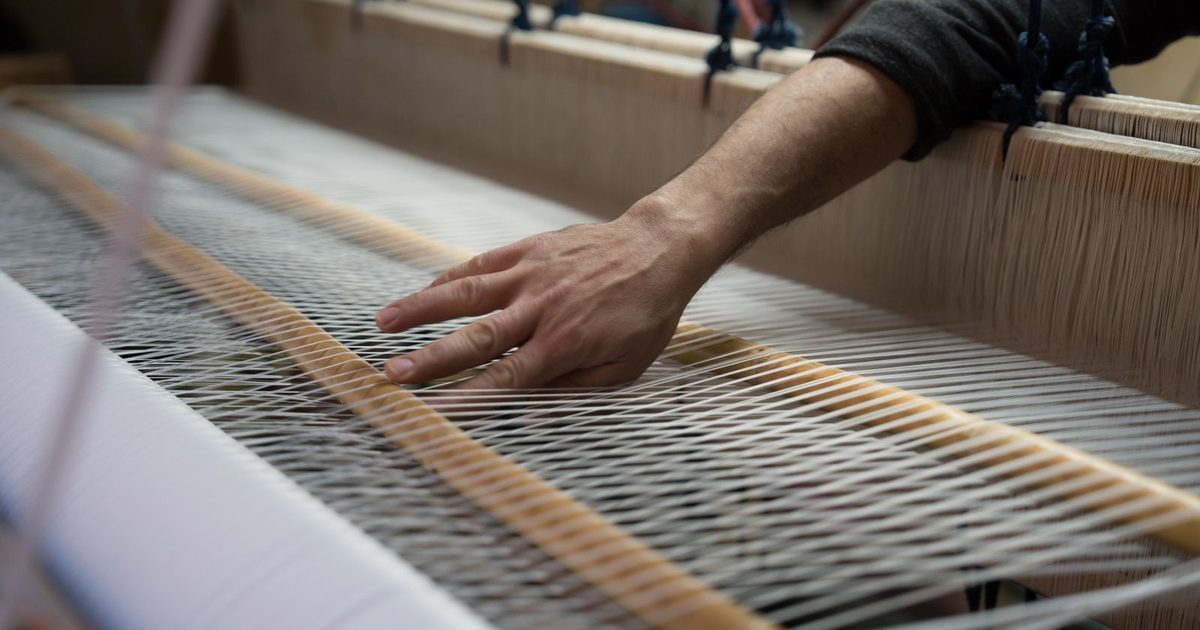
India counts 35.22 lakh handloom weavers and allied workers, and the National Handloom Day 2026 explainer from PIB says authenticity safeguards now carry their work to wider markets. For anyone who wants to buy sarees online India wide, that shift matters. The word "handloom" on a listing is turning from a sales adjective into a claim that can be checked.
If you stock sarees for a boutique or a store, talk to our wholesale team about weave details and documentation before your festive orders. This guide explains which labels prove a handloom claim, what online shoppers now expect, and how retailers can prepare for 2027.
Key Takeaways
Handloom used to be a word sellers could use loosely. Government data, new draft rules and shopper habits are all pushing it toward proof. Retailers who treat it as a checkable claim will protect their margins and their reputation.
The PIB explainer records 28.20 lakh looms in India, with nearly nine in ten in rural areas. Weaving is tied to place, which is why origin matters so much to buyers. Yet many saree listings still say "handloom" with no label, no weaver detail and no region. Shoppers have learned that a photo cannot show whether a saree came off a pit loom or a powerloom. So they look for marks, tags and seller answers instead. For anyone planning to buy sarees online India wide, a verifiable claim is quickly becoming the baseline, not a bonus. If you resell, our guide on checking quality in wholesale sarees for resale covers the physical checks that sit alongside labels.
The change also protects weavers. PIB notes that women make up more than 72% of the handloom workforce. When a powerloom copy is sold as handloom, it takes sales from those households. Shoppers who buy sarees online India wide increasingly see a verified label as a way to support real weavers.
Four marks do most of the work: the Handloom Mark, the India Handloom Brand, GI tags and the Silk Mark. Each answers a different question, so a strong listing names the ones that genuinely apply.
Handloom Mark. Launched in 2006, it assures buyers that a product is handwoven. PIB reports 29,402 Handloom Mark registrations as of 30 June 2026, and 815 retail outlets selling labelled products.
India Handloom Brand. Launched in 2015, it covers natural fibre products with fast colours, skin friendly dyes and social compliance. PIB counts 2,305 registrations across 184 categories by June 2026.
GI tags. A geographical indication links a product's quality or reputation to its place of origin. The Intellectual Property India GI overview explains how registration protects such names. PIB reports 106 handloom products registered.
Silk Mark. For pure silk sarees, the Silk Mark label confirms the fibre itself, which matters as much as the weave.
A simple five step check works for most orders. First, look for a stitched Handloom Mark label. Second, ask whether the line carries the India Handloom Brand. Third, confirm any regional name against its GI registration. Fourth, check the Silk Mark on pure silk. Fifth, ask the supplier for paperwork that links the piece to a weaver, society or loom. If you plan to buy sarees online India wide, sellers who pass these five checks are far easier to trust.
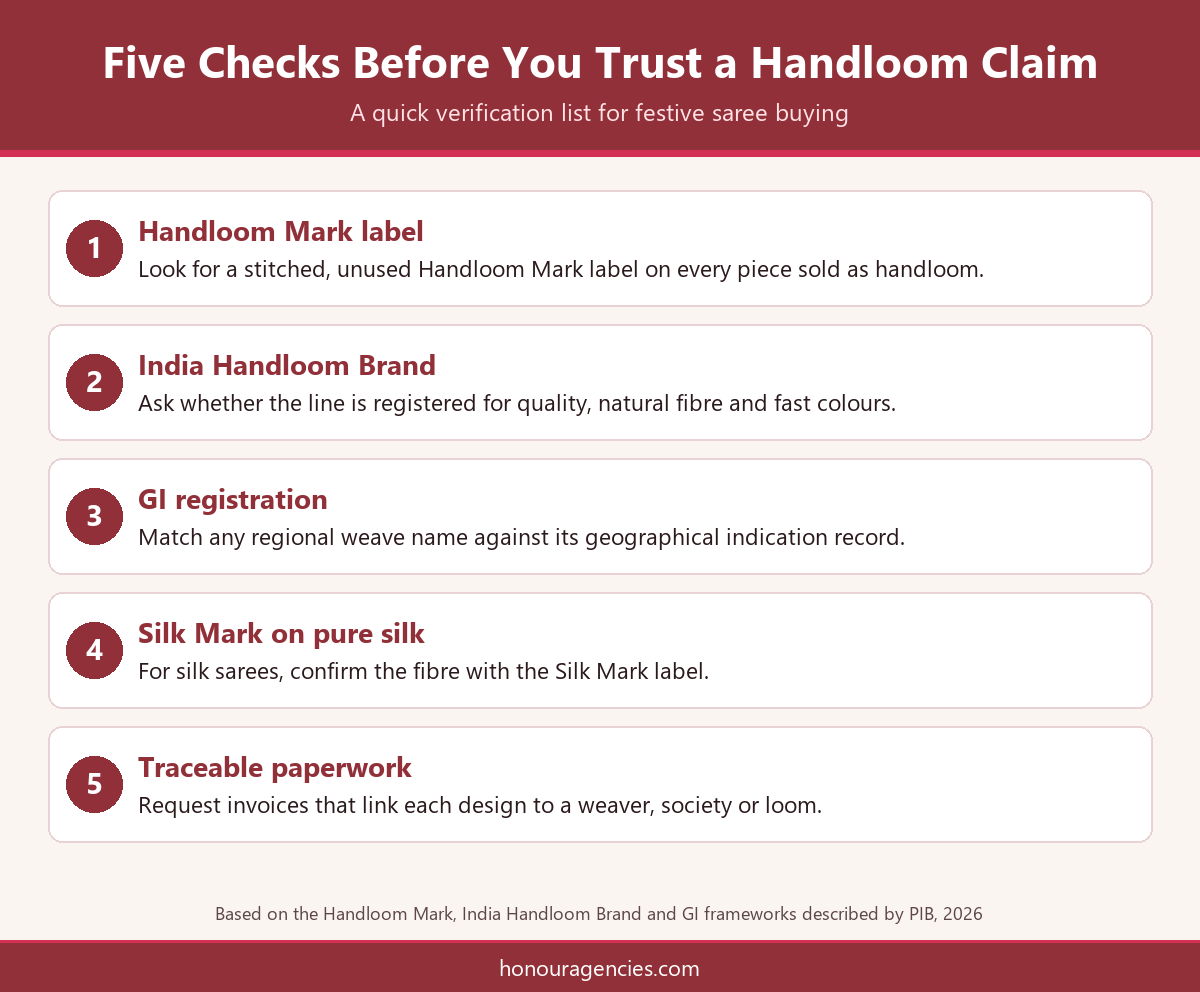
India has proposed making the Handloom Mark Label compulsory. If the rules are notified as drafted, selling an unlabelled product as "handloom" would be treated as misleading.
According to an ELP legal update on the new handloom marking rules, the Ministry of Textiles notified the draft Handloom Mark Standards (Labelling and Display) Regulations, 2025 to the WTO on 11 March 2026. The notification gave 1 October 2026 as the proposed date of entry into force. Under the draft, every product marketed as handloom must carry a valid label that cannot be reused or duplicated. Traders who are not registered must still ensure each handloom product they sell is labelled and traceable to its weaver or loom. Penalties can reach imprisonment under the Textiles Committee Act and the Trade Marks Act. Final dates depend on the Gazette notification, so confirm the current status before you relabel stock.
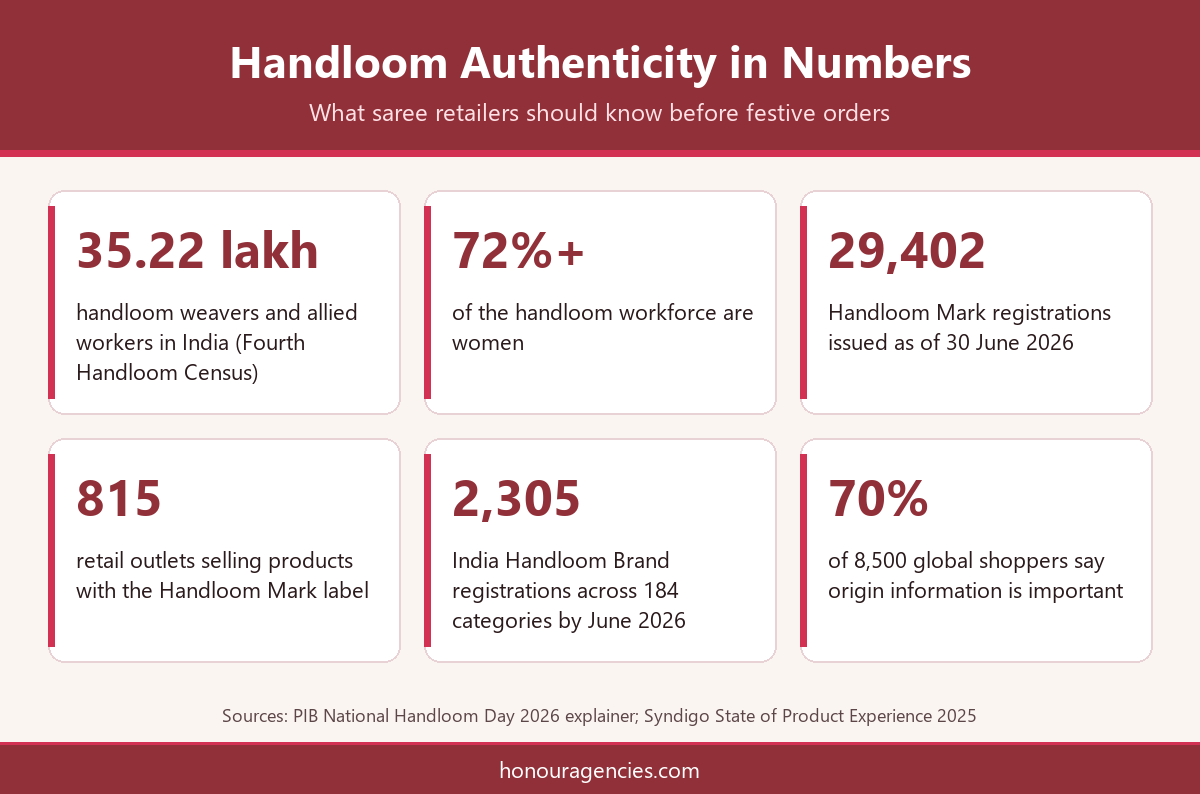
Shoppers want origin details they can see before they pay. Global research shows this is now a mainstream expectation rather than a niche concern.
Syndigo's State of Product Experience 2025 survey of 8,500 consumers found that 70% consider it somewhat or very important to find a product's country or region of origin. It also found 75% are more likely to return to brands that give easy access to product information. Saree buyers behave the same way. A search for designer sarees near me online shopping is often a search for a seller who can answer questions quickly. Someone looking for Diwali collection silk sarees online 2027 will compare listings for fibre, weave, region and label. Listings that skip these details lose the click to one that names them. Our comparison of online wholesale platforms versus direct dealers shows why direct dealers often answer these questions faster.
A complete listing usually answers six questions. What is the fibre? Was it woven on a handloom or a powerloom? Which region or cluster made it? Which labels does it carry? What is the length, including the blouse piece? How should it be washed and stored? Shoppers who buy sarees online India wide, from platforms that list thousands of designs, will choose the page that answers all six. Clear tag photos and label numbers also cut disputes after delivery, because the buyer knew exactly what was promised.
Kerala has strong weaving traditions and active state support, so local retailers are well placed to sell verified sarees. Preparation starts with sourcing records, not marketing copy.
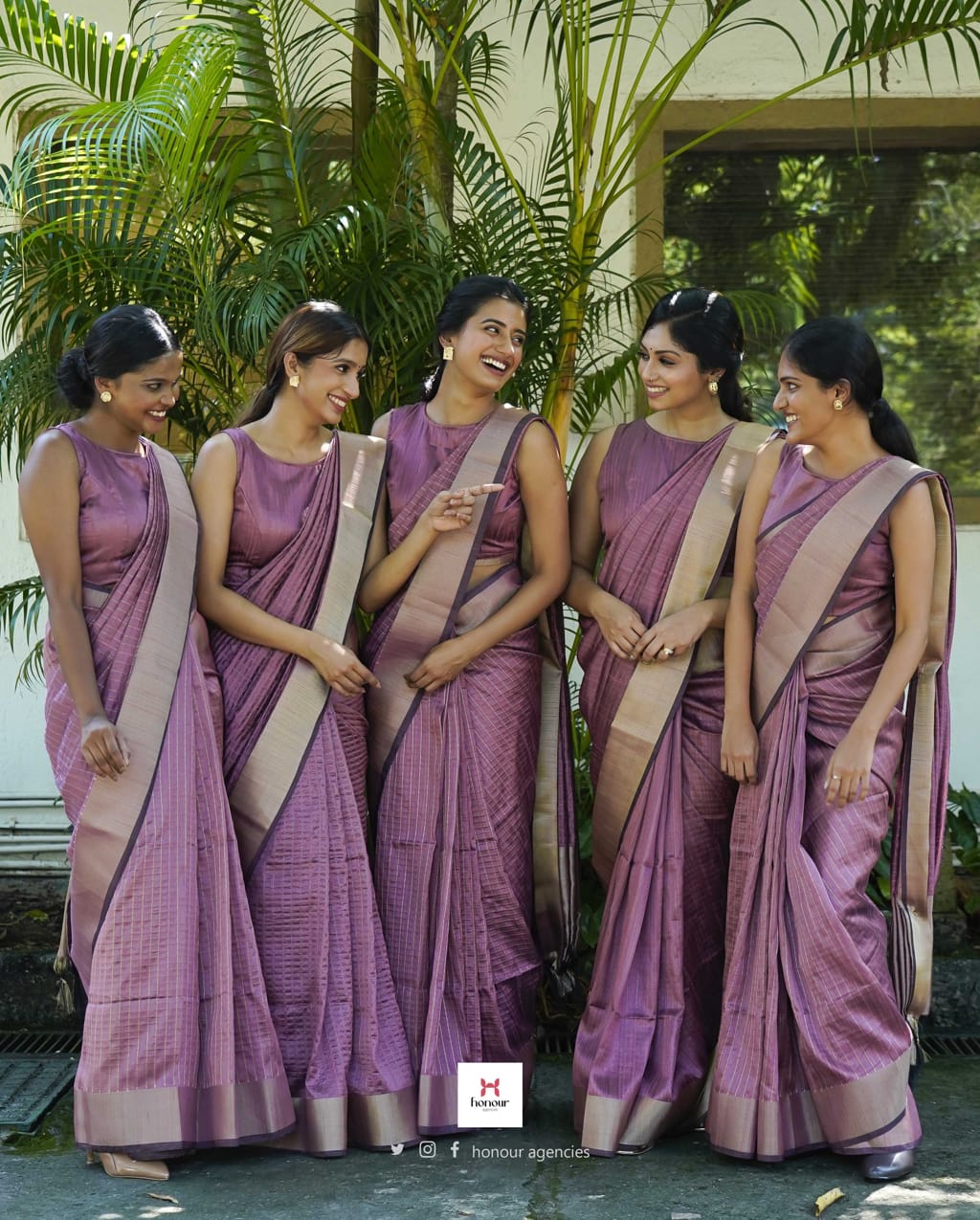
The Kerala Directorate of Handloom and Textiles runs schemes for marketing, export promotion and rebates through organisations such as Hantex and Hanveev. Retailers can use that ecosystem when they need certified handloom lines. For mixed stock, honesty works better than vague wording. Describe a powerloom saree as powerloom, and keep the word "handloom" for pieces with a label and paperwork. Store supplier invoices, label numbers and weave details with each design code. Then copy those facts into product pages, so customers who buy sarees online India wide can verify them. Our guide to spotting high quality Kerala sarees in wholesale markets explains what to inspect in person.
The outlook for 2027 points the same way. Handloom exports reached about Rs 1,330.96 crore in FY 2025-26, says PIB, with the UAE, the United States, France, the United Kingdom and Spain as leading markets. Wider audiences ask the same question: is it really handwoven? Looking ahead, expect shoppers to search with terms like "Handloom Mark", "GI tagged" or "Silk Mark" alongside fabric names. Product pages that carry label numbers, region names and clear photos of tags will match those searches. That is an outlook, not a forecast figure. It follows the direction the draft rules and shopper surveys already point to. Browse our Kerala saree collection and premium sarees to plan festive assortments with clear product details.
Handloom authenticity is moving from a story on a tag to a claim that buyers, platforms and regulators can check. The Handloom Mark, India Handloom Brand, GI tags and Silk Mark give retailers the tools to prove what they sell. Shoppers who buy sarees online India wide already expect origin details, and the draft labelling rules would make them compulsory for anything called handloom. Start by documenting every design you stock and describing each weave honestly. To plan your next order with a supplier backed by 35 years in the textile trade, contact Honour Agencies on Broadway, Ernakulam.


Or login with