
Women danim jacket
$249.00

Red formal dress
$129.00

Man winter blazer
$149.00$99.00
Subtotal$477

 General
An air hostess uniform saree is one of the most closely observed garments in service work. It is seen at close range by hundreds of passengers a day, photographed constantly, and worn in a pressurised cabin through shifts that cross climates and time zones. The garment has to look immaculate at hour nine and move safely in a narrow aisle. This guide covers how buyers specify, approve and resupply an air hostess uniform saree without the palette or the fit drifting.
Aircraft cabins are dry, and dry air changes how fabric behaves. Natural fibres lose some of their softness and can feel stiffer, while synthetics build static that makes a pallu cling and shift out of position. Both effects are invisible in a showroom and obvious at thirty thousand feet.
Duty periods are long and largely spent standing, walking and reaching. The garment is folded at the waist, pressed against seat backs and trolleys, and repeatedly pleated by movement. Creasing that would be unremarkable in an office becomes conspicuous when the wearer is standing at arm's length from a passenger for hours.
Temperature swings compound this. Crew move between an air conditioned cabin, a hot apron and a terminal that may be either. A cloth that performs in one of those conditions and fails in another produces a uniform that only looks correct part of the time.
The right specification therefore starts with behaviour, not appearance. Ask how the fabric drapes after four hours of movement, how it recovers from creasing, and whether it builds static in dry air. Those three questions separate a cabin appropriate cloth from a merely attractive one. Put them in writing at enquiry stage, because a supplier who has been told the working conditions will propose something far closer to the mark than one working from a colour and a quantity.
Crepe and crepe blends are the common answer, and for good reason. The crimped yarn structure of crepe gives a textured surface that disguises minor creasing and a fall that stays controlled through movement. That combination is exactly what a long duty period demands.
Georgette and fine polyester blends offer a lighter drape and strong crease recovery, at the cost of more static in dry cabin air. Silk and silk blends look exceptional at close range and photograph beautifully, but they demand careful laundering and a shorter replacement cycle, which makes them better suited to premium or ceremonial use than daily rostered flying.
Cotton is rarely the right answer here despite being excellent elsewhere. It creases readily, and a creased saree at close passenger range undermines the presentation the airline is paying for. Where breathability is a genuine concern, a cotton rich blend with good recovery is a better compromise than pure cotton.
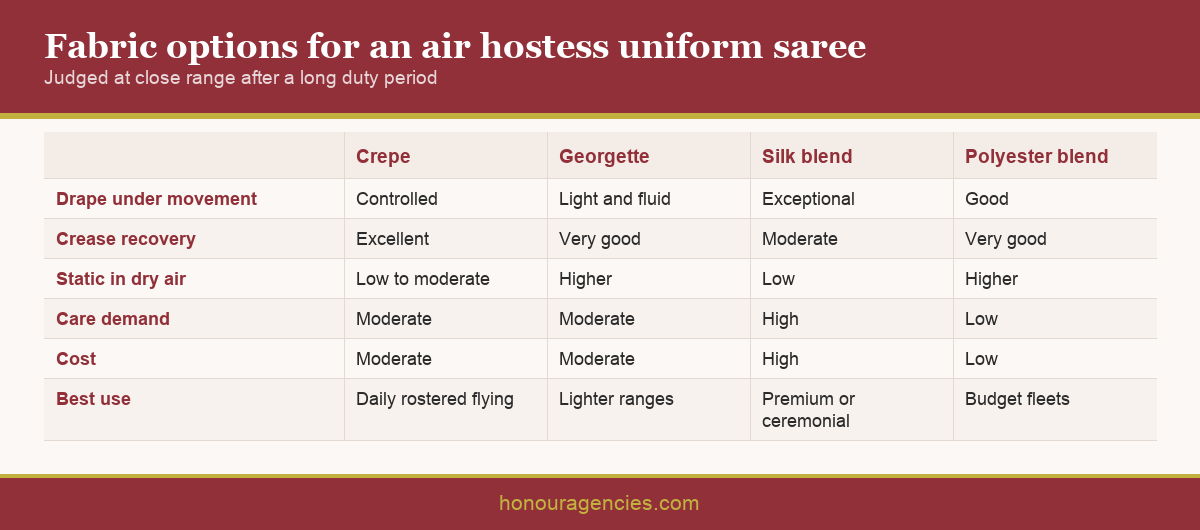
Whatever the fibre, handle the cloth crushed in the hand and then released before approving it. Recovery from that simple test predicts cabin performance better than any description on a quotation. Our overview of choosing the right fabric for institutional wear covers the wider fibre comparison.
Airline identity is tightly controlled, and the uniform is one of its most visible carriers. That usually means a specific brand shade rather than a shade family, and it makes matching a technical requirement rather than a preference. Approve against a physical swatch and treat the approved cloth as the reference for every subsequent run.
The lighting problem is acute in this setting. Cabin lighting is warm and low, terminal lighting is bright and cool, and daylight on an apron is different again. A shade approved under one of those can read noticeably differently under the others. Check the swatch under all three before signing.
Border and pallu treatment is where most airline branding actually lives, because a printed logo rarely survives repeated laundering well. A woven border stripe in brand colours, a contrast pallu or a coordinated blouse gives a durable identity that stays crisp. Our note on the role of staff dress in corporate branding sets out the options.
Guard against silent substitution. Yarns and shades are discontinued, and the useful supplier tells you and submits the nearest match for approval. Ask directly what happens when your shade becomes unavailable, and get the answer written into the arrangement rather than discovering it in a delivery.
Cabin work happens in confined space, and the garment has to allow it. Length matters more than usual, because a saree that sits low is a genuine hazard on aircraft steps and in a galley. Agree the length in centimetres and check the first delivery on a person, pleated and moving, rather than flat on a counter.
Securing the pallu is standard practice for safety, and it should inform the fabric decision. A cloth that holds a permanent crease where it is pinned will look untidy within weeks of rostered flying. Raise pinning explicitly during sample evaluation and inspect the sample after it has been pinned for a day.
The blouse takes the movement load, particularly overhead reach into lockers. Specify sleeve and armhole construction that allows full extension without lifting the garment, and ask for seam allowances that can be let out. Decide in advance whether tailoring is arranged centrally or by the crew member.
Comfort is not a courtesy here, it is compliance. Crew who find a uniform restrictive will adjust it, and a uniform that is adjusted is no longer uniform. Involving a few working crew in the sample assessment catches problems that a procurement review never will.
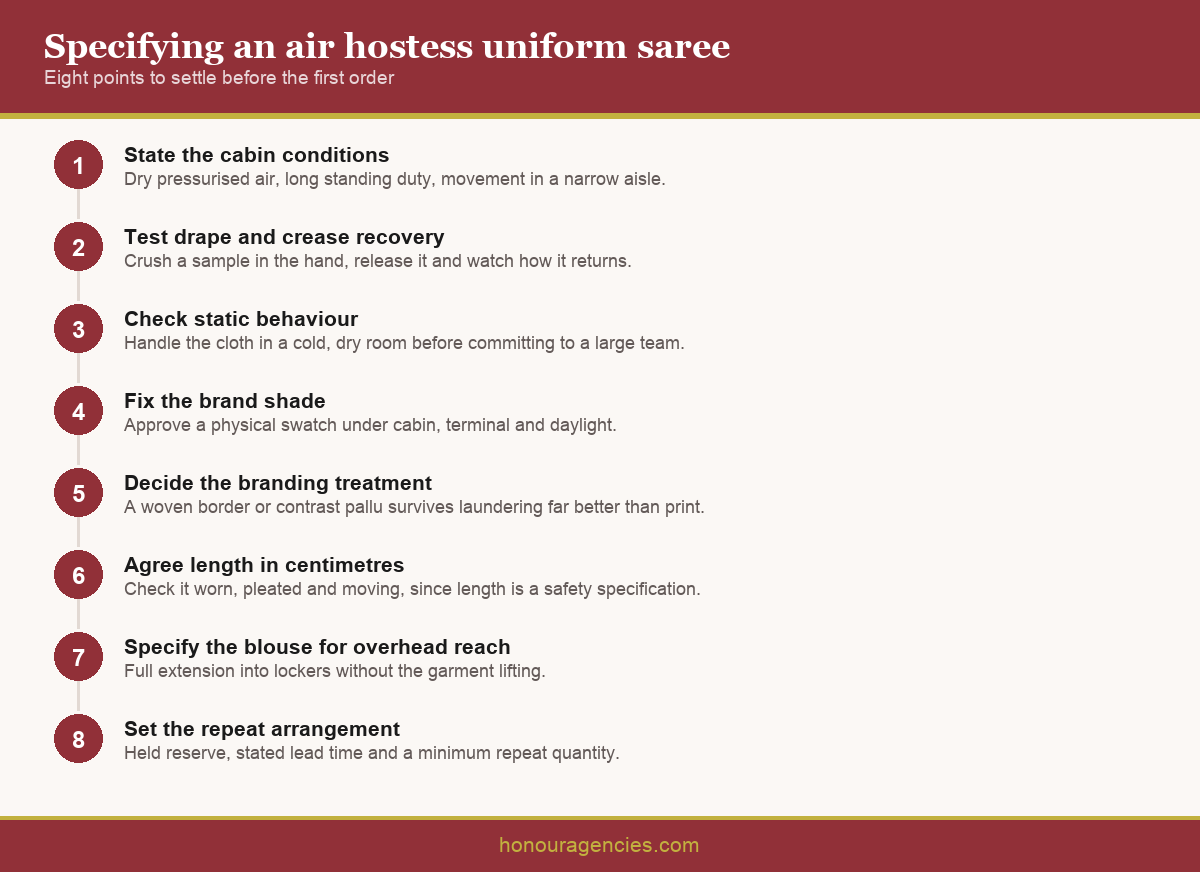
Airlines recruit and roster continuously, so uniform supply is a steady trickle rather than one large event. That reality should shape the commercial arrangement. Agree a main order, a held reserve and a stated lead time for partial repeat runs in your approved shade.
Confirm the reorder minimum before you approve a shade. A colour that only runs economically at large volumes is the wrong choice for an operation that needs fifteen sarees after a small intake. Suppliers can often hold yarn or greige stock against an account, which is worth asking about explicitly.
Keep a complete specification file. The signed swatch, the fabric detail, the length, the blouse construction, the care instruction and a log of orders make each repeat a short conversation rather than a fresh negotiation. Buyers who manage institutional supply chains well treat that file as the deliverable.
Build in an annual review. Compare a flown saree against the filed swatch and a fresh piece once a year. That single comparison tells you whether the fabric is performing as specified, whether laundering has changed, and whether the shade still matches, while each is still easy to correct. Working with an established Ernakulam supplier makes that continuity far easier to hold.
An air hostess uniform saree has to look immaculate at close range after a long duty period, and that is a fabric behaviour problem before it is a design one. Choose a crepe or blend with proven crease recovery, control the shade against a physical reference checked under cabin, terminal and daylight, specify length and blouse for safe movement, and structure supply around continuous small repeats. Honour Agencies has supplied wholesale and institutional sarees from Ernakulam for 35 years. To discuss a requirement, contact our team.
Q: What fabric suits an air hostess uniform saree best? A: Crepe and crepe blends usually. The crimped yarn structure disguises minor creasing and holds its fall through long duty periods, which is exactly what close range passenger contact and constant movement demand.
Q: Why is cotton rarely used for cabin crew sarees? A: Cotton creases readily, and creasing is highly visible at the close range crew work at. Where breathability matters, a cotton rich blend with good crease recovery is a better compromise than pure cotton.
Q: Does cabin air affect how a saree behaves? A: Yes. Cabin air is dry, which stiffens some natural fibres and builds static in synthetics, making a pallu cling and shift. Test fabric for static behaviour before approving it for rostered flying.
Q: How should airline brand colours be controlled? A: Approve a physical swatch and keep it as the reference for every run. Check the shade under cabin, terminal and daylight, because warm cabin lighting and bright terminal lighting read very differently.
Q: Can an airline logo be printed on the saree? A: Printed logos rarely survive repeated laundering well. A woven border stripe in brand colours, a contrast pallu or a coordinated blouse gives a more durable identity that stays crisp through the garment's life.
Q: What saree length is appropriate for cabin crew? A: Agree the length in centimetres and check it on a person, pleated and moving. A saree that sits too low is a genuine hazard on aircraft steps and in a galley, so length is a safety specification.
Q: Does pinning the pallu damage the fabric? A: It can. Some fabrics hold a permanent crease at the pin point and look untidy within weeks. Pin a sample for a day and inspect it before approving the cloth for rostered use.
Q: How should the blouse be specified? A: For overhead reach into lockers. Ask for a sleeve and armhole that allow full extension without the garment lifting, and generous seam allowances so pieces can be let out for new crew.
Q: How are repeat orders usually handled? A: As continuous small runs rather than one large order. Agree a held reserve, a stated lead time and a reorder minimum before approving a shade, since airlines recruit and roster continuously.
Q: How often should the uniform be reviewed? A: Once a year, comparing a flown saree against the filed swatch and fresh stock. Our guidance on caring for and maintaining institutional wear covers the routine between reviews.


Or login with