
Women danim jacket
$249.00

Red formal dress
$129.00

Man winter blazer
$149.00$99.00
Subtotal$477

 General
Buyers comparing plain cotton fabric wholesale price almost always compare the wrong number. Rate per metre is the figure on the quotation, and it is close to meaningless across cloths of different widths, weights and finishes. A cheaper metre can easily cost more per finished garment. This guide sets out what actually drives the rate, which variables move it most, and how to put two quotations on a footing where the comparison means something.
Yarn count is the first driver. Finer yarn costs more per kilogram to spin, so a 60s cotton will always sit above a 40s of similar construction. Buyers sometimes read a higher rate as a better margin for the supplier when it is simply a finer yarn.
Fabric weight is the second and the most direct, and it is measured as grammage in grams per square metre. A heavier cloth uses more cotton per metre, so a lower rate on a lighter fabric is not a saving. Comparing rate per metre without comparing grams per square metre flatters the wrong supplier in almost every case.
Construction sits alongside weight. A densely woven cloth uses more yarn than an open one at the same count, and it wears longer for exactly that reason. Reed and pick figures, which describe thread density, tell you whether you are being offered a substantial cloth or a thin one dressed up by finishing.
Wastage at the mill also feeds the rate. A narrower, more difficult cloth produces more off quality metreage during production, and that loss is priced into what you pay. It is one reason unusual widths and very fine counts carry a premium beyond the cost of the yarn itself.
Fibre quality underlies all of it. Cotton graded by staple length behaves differently at the same count, and longer staple gives smoother, stronger yarn with less pilling. Combed yarn, which has the shorter fibres removed, costs more than carded yarn and justifies it in anything washed frequently.
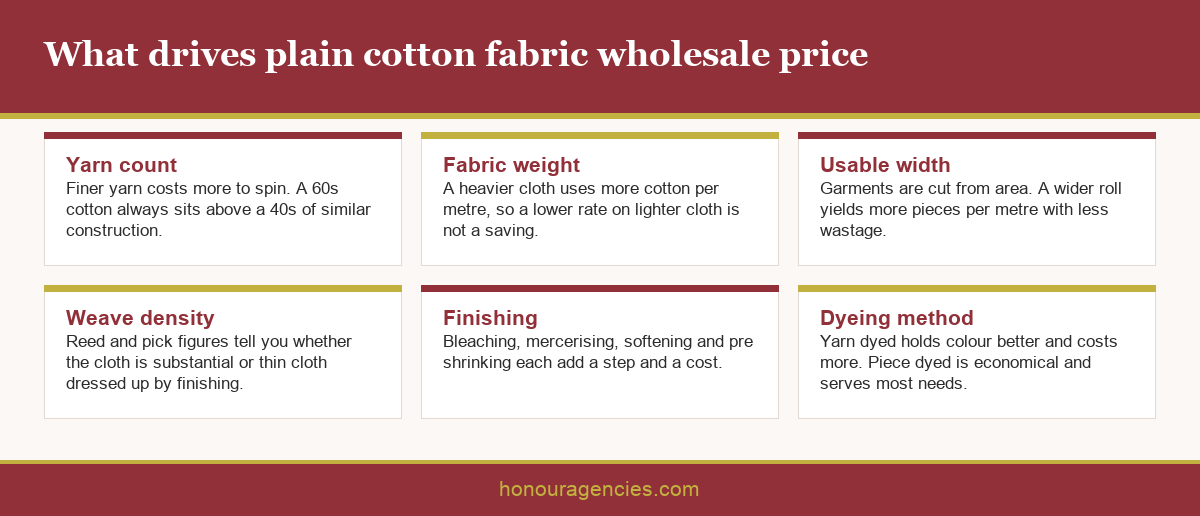
Width is the variable buyers most often ignore and the one that changes the true cost most. Garments are cut from area, not from length, so a cloth at 58 inches yields substantially more usable pieces per metre than the same cloth at 44 inches.
Work an example once and the point sticks. If a wider cloth costs fifteen percent more per metre but yields thirty percent more garments per metre, it is cheaper in the only sense that matters. Buyers who never do this arithmetic consistently choose the more expensive option while believing they are saving.
Remember that the wastage figure belongs to your product, not to the cloth. Two buyers purchasing the same roll can experience very different real costs because one cuts panels that nest neatly into the width and the other does not. This is why a supplier cannot tell you which cloth is cheapest for you, and why the arithmetic is worth doing once properly.
Cutting plans matter too, because wastage is not linear. A roll width that divides neatly into your panel width wastes almost nothing, while one that leaves an unusable strip wastes it on every metre for the life of the order. Work this out for your main products and keep the answer.
Confirm whether the quoted width is full width or usable width inside the selvedge. The difference is often an inch or two, which is enough to break a tight cutting plan. Ask directly rather than assuming, because both conventions are in common use.
Greige cloth, straight from the loom, is the cheapest form and the base for everything else. Every process applied afterwards adds cost, and understanding which processes have been applied explains most of the gap between two quotations.
Bleaching adds a step and a consistent white base. Half bleached cloth sits between greige and full bleach, costs less, and is perfectly adequate where the cloth will be dyed to a mid or dark shade. Buyers who only ever specify fully bleached sometimes pay for a whiteness the end product never needed.
Dyeing method is a real cost difference. Yarn dyed cloth, coloured before weaving, holds colour better and costs more. Piece dyed cloth, coloured after weaving, is more economical and serves most commercial requirements well. Ask which you are being quoted, because the difference shows across a garment's life.
Finishing covers softening, calendering, mercerising and pre shrinking, and each adds to the rate. Mercerising in particular costs more and generally earns it, since it strengthens the fibre and deepens dye uptake. Pre shrinking costs a little and prevents a great deal of trouble, so it is rarely worth declining. Our guide to buying blouse fabric in bulk covers how these processes show up in finished cloth.
Quantity moves the rate, but less dramatically than many buyers expect on standard cloth. Mills price in ranges rather than continuously, so moving from four hundred metres to six hundred may change nothing while crossing a threshold changes the rate meaningfully. Ask where the breaks sit rather than negotiating blind.
Stock cloth and made to order cloth price differently. A shade a supplier already holds can often be served in small quantities at a stable rate, while a made to order shade carries a minimum quantity and a lead time. Choosing a stock shade is frequently the largest saving available to a small buyer.
Season matters more in cotton than in most fabrics. Raw cotton prices move with the harvest and the market, and mills run at capacity before festival periods when demand peaks. Ordering into that window generally means a higher rate, a longer lead time and less careful matching.
Know which kind of supplier you are dealing with. One holding stock absorbs some market movement and quotes more stable rates. One buying to order passes movement straight through. Neither is wrong, but they behave very differently when cotton prices move, and it explains a great deal about why quotations change month to month.
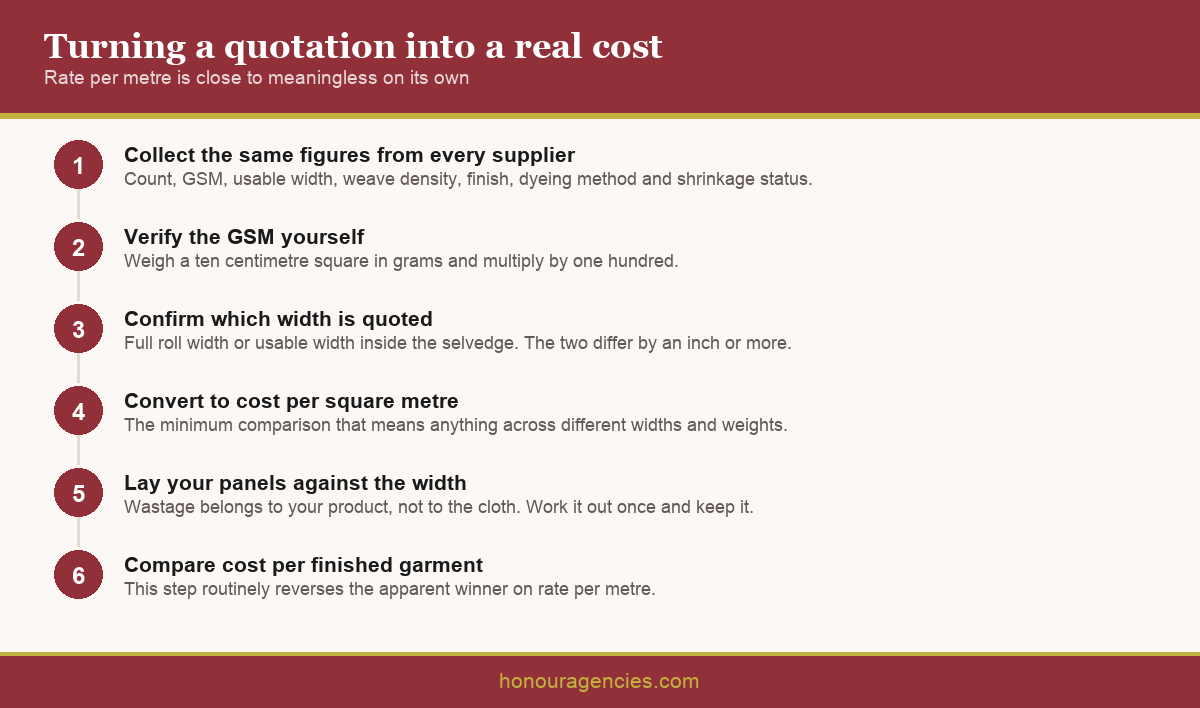
Insist that every quotation carries the same figures. Count, GSM, usable width, weave density, finish, dyeing method and shrinkage status should all appear. A supplier unwilling to state them is quoting a different cloth from the one you think you are comparing.
Convert everything to a common basis. Cost per square metre is the minimum useful comparison, and cost per finished garment against your own cutting plan is better still. This single step reorders most quotation comparisons and often reverses the apparent winner.
Ask for the terms alongside the rate. Payment period, whether the price includes taxes and freight, who bears the cost of a rejected roll and what the minimum order is all change the effective price. Two identical rates on different terms are not the same offer, and the difference often exceeds the negotiating room on the rate itself.
Verify rather than trusting the sheet. Weigh a ten centimetre square of the sample and multiply by one hundred to check the GSM directly. Measure the width across several points. These take a minute each and change the tone of every subsequent conversation with that supplier.
Factor in what happens after delivery. A cloth that shrinks unpredictably, arrives short on metreage or varies in shade between rolls carries costs that never appear on the quotation. A slightly dearer supplier who delivers consistently is usually the cheaper one over a year. Buyers sourcing running material wholesale regularly learn this quickly.
Plain cotton fabric wholesale price is a function of count, weight, width, construction, finishing and dyeing, and no rate means anything without those figures beside it. Convert every quotation to cost per finished garment, verify GSM and width yourself, choose stock shades where you can, and time repeat orders away from peak season. That approach consistently buys better cloth for less money than negotiating hard on a rate per metre. Honour Agencies has supplied wholesale fabrics from Ernakulam for 35 years. To discuss a fabric requirement, contact our team.
Q: Why do two plain cotton quotations differ so much? A: Usually because they describe different cloth. Yarn count, weight, width, weave density, finishing and dyeing method all move the rate, and a quotation without those figures cannot be compared with another.
Q: Is rate per metre a fair way to compare fabric prices? A: No. Garments are cut from area, so width and weight change the real cost substantially. Convert every quotation to cost per square metre, or better, cost per finished garment against your cutting plan.
Q: Does a higher GSM always cost more? A: Generally yes, because a heavier cloth uses more cotton per metre. That is why a lower rate on a lighter fabric is not a saving, and comparing rates without comparing GSM misleads almost every time.
Q: What is the difference between yarn dyed and piece dyed cotton? A: Yarn dyed cloth is coloured before weaving and holds colour better, at a higher cost. Piece dyed cloth is coloured after weaving, costs less and serves most commercial requirements perfectly well.
Q: Is pre shrunk fabric worth the extra cost? A: Almost always. Untreated cotton can move several percent in the first wash, which is enough to make a correctly cut garment wrong. The premium for pre shrinking is small against that risk.
Q: Does ordering more always reduce the rate? A: Not continuously. Mills price in ranges, so a small increase may change nothing while crossing a threshold changes the rate meaningfully. Ask the supplier where the quantity breaks sit rather than negotiating blind.
Q: When is the best time to buy plain cotton? A: Away from peak festival production. Mills run at capacity before those seasons, which means higher rates, longer lead times and less careful matching than in the quieter months.
Q: How can I check a supplier's stated GSM? A: Cut a ten centimetre square of the sample, weigh it in grams and multiply by one hundred. It takes a minute and immediately tells you whether the quoted figure is accurate.
Q: Why is width described in two different ways? A: Some suppliers quote the full width of the roll and others the usable width inside the selvedge. The difference is often an inch or two, which matters when a cutting plan is tight, so ask explicitly.
Q: Is the cheapest supplier usually the cheapest overall? A: Rarely. Short metreage, shade variation between rolls and unpredictable shrinkage all carry costs that never appear on a quotation. Our blouse material sourcing guide covers the hidden costs.




Or login with