
Women danim jacket
$249.00

Red formal dress
$129.00

Man winter blazer
$149.00$99.00
Subtotal$477

 General
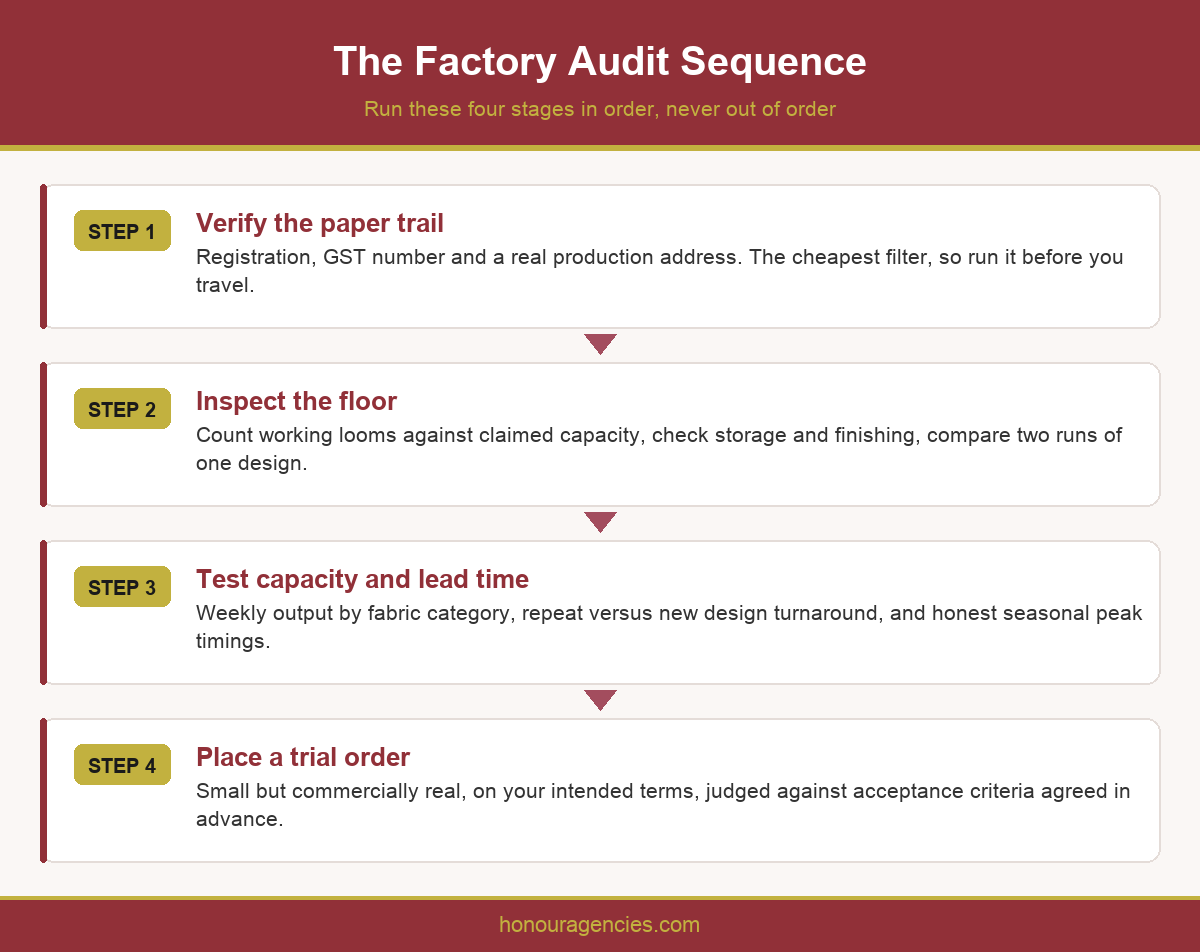
Placing a bulk order with a wholesale saree factory you have never inspected is the fastest way to lose a season's margin. Photographs prove nothing, catalogues are often borrowed, and a convincing quotation costs a supplier nothing to produce. This guide sets out a practical audit you can run before you commit: what to verify on paper, what to look at on the production floor, what a video walkthrough should show you, and how a trial order exposes problems while they are still cheap to fix.
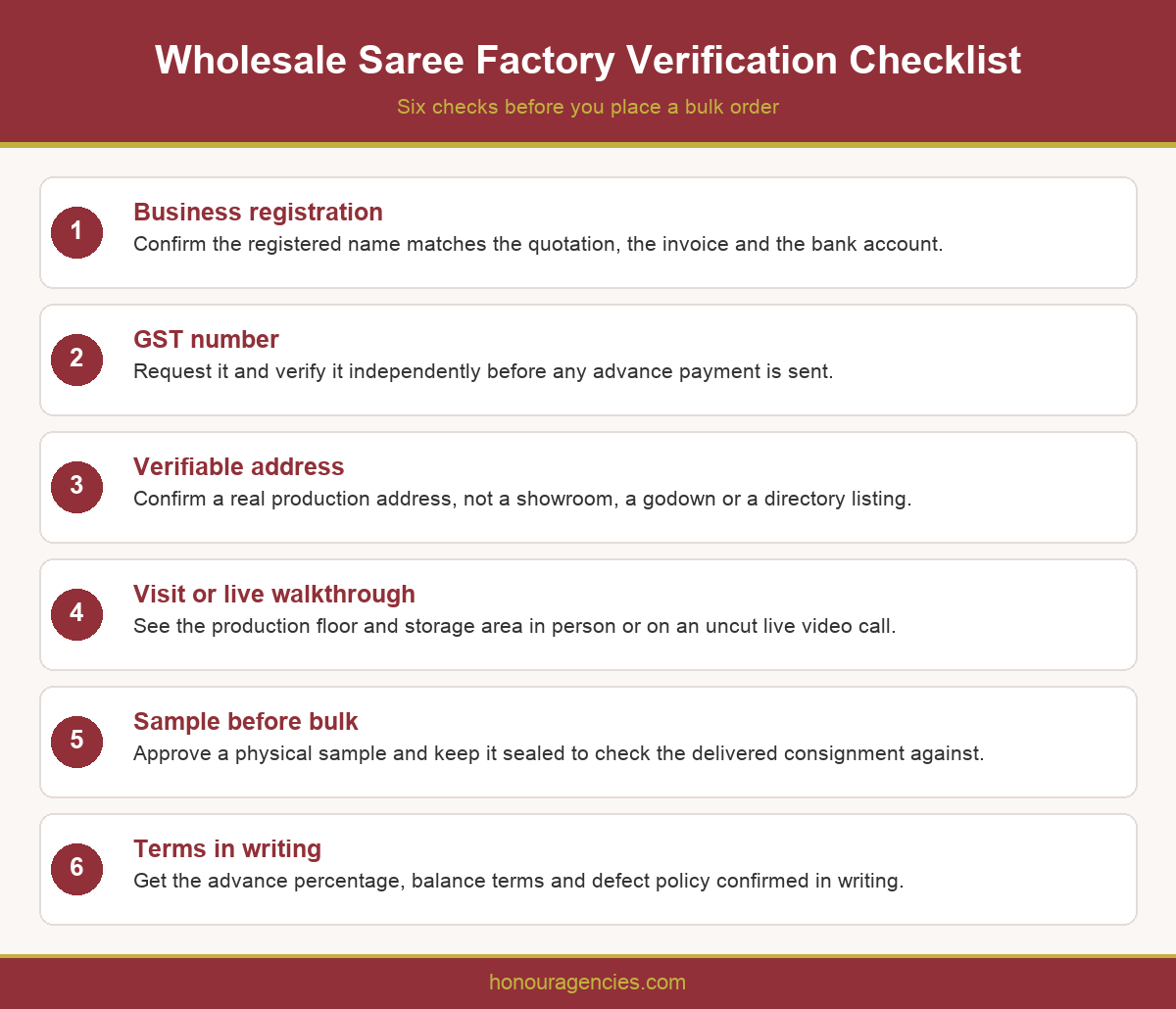
Documentation is the cheapest filter you have, and it removes most unsuitable suppliers before you spend a day travelling. Ask for the registered company name and confirm it matches the name on the quotation, the invoice and the bank account you are asked to pay into. A mismatch between any of those three is a serious warning sign.
Request the GST number and verify it independently before you send any advance. Confirm that the address given is a real production address rather than a showroom, a godown or a listing on a directory. A factory that is reluctant to put its registration details in writing has told you something important, and no sample quality will compensate for it. The commercial consequence of skipping this step is that you have no recourse at all if the goods never arrive.
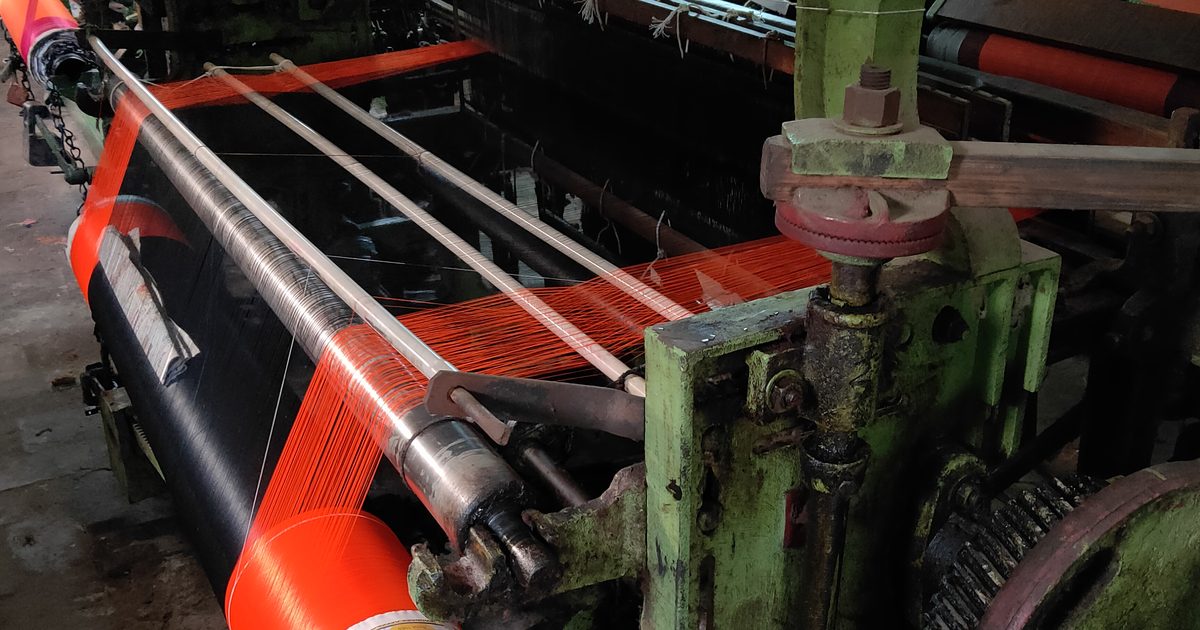
If you can visit, spend your time on the floor rather than in the office. Count working looms against the capacity the factory has claimed, because a unit that promises five hundred pieces a week from a handful of running machines is either subcontracting or overstating. Ask which orders are on the machines now and when they were started.
Look at how greige and finished stock is stored. Damp, uncovered or badly stacked fabric points to losses you will eventually pay for in rejected pieces. Check the finishing and packing area, since most quality complaints originate there rather than at the loom. Watch whether the power loom operators are working to a written specification or from memory, because that single detail predicts how consistent your second consignment will be. Our overview of fabrics and designs found in wholesale saree factories helps you interpret what you are seeing.
Pay attention to the people as well as the machines. A floor with experienced operators working steadily tells you the unit retains skilled labour, which is the single biggest driver of finishing quality in saree production. High turnover shows up later as inconsistent borders and uneven pallu work, and no amount of supervision fixes it inside one order cycle.
The most useful request during a visit costs nothing: ask to see a design the factory has produced more than once, and compare the two runs side by side. Shade variation between batches, border alignment and finishing consistency will tell you more about the unit than any capacity claim. Consistency across repeats is the single quality that separates a supplier you can build a business on from one you cannot.
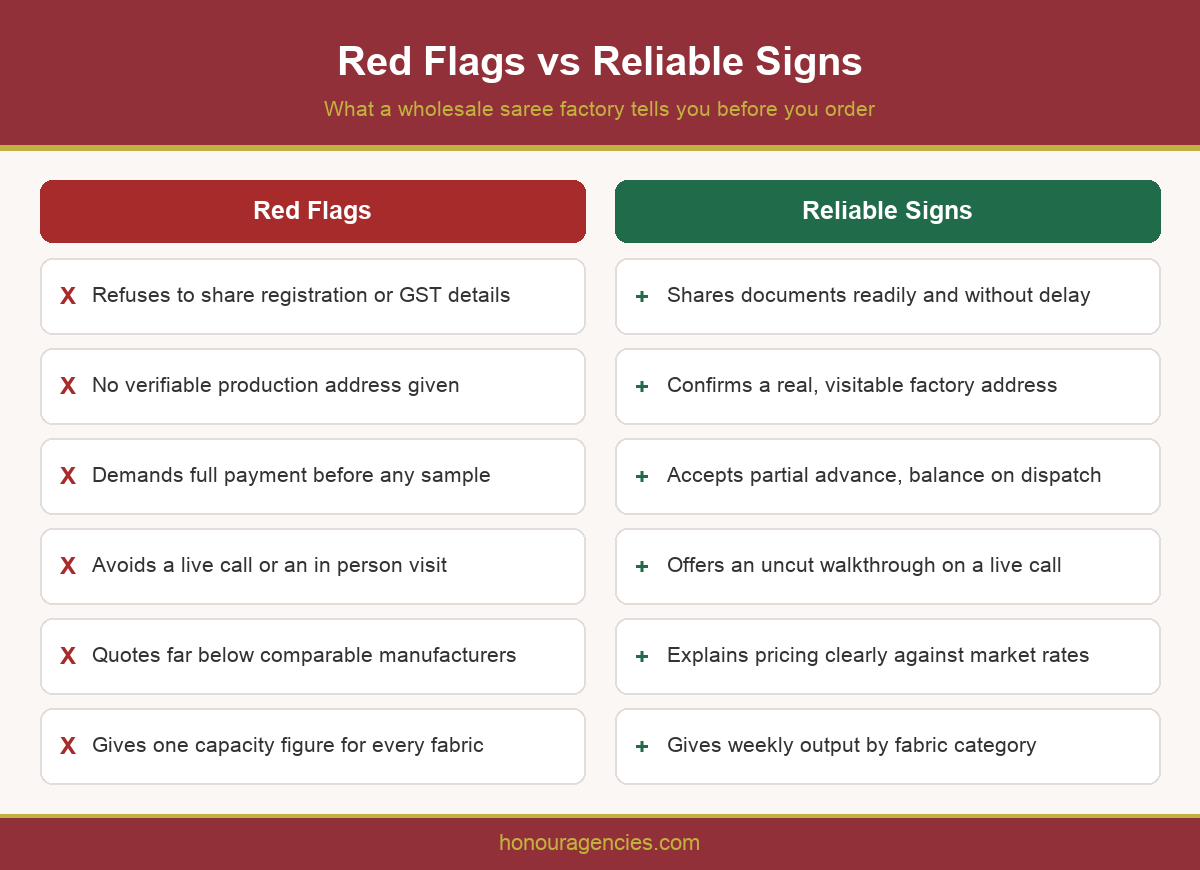
Most buyers cannot visit every factory, and a structured video walkthrough is a legitimate substitute when it is done properly. Insist on a live call rather than a recorded file, because a recording proves only that the footage exists somewhere, not that it shows this supplier today.
Ask the person holding the camera to walk continuously from the entrance through the production area to packing without cutting the feed. Ask them to stop at a running machine and hold the shot. Ask to see the storage area and the finishing table. A factory that agrees readily and moves through the building without hesitation is usually what it claims to be. One that offers only edited clips, still images or excuses about permissions is not worth a second call. The remote buying discipline is covered further in our guide to ensuring quality when buying wholesale sarees online.
Capacity claims are the easiest thing for a factory to overstate and the easiest for a buyer to check. Ask for weekly output by fabric category rather than a single headline number, then compare it against what you counted on the floor or saw on the call. A unit quoting one figure for cotton, silk and printed ranges alike has probably not measured any of them.
Lead time deserves the same scrutiny. Ask how long a repeat of an existing design takes against a new design requiring fresh setup, because the two are rarely close. Ask what happens to your delivery date if a larger order arrives after yours, and whether the factory subcontracts overflow to other units. Subcontracting is not automatically a problem, but a factory that does it without telling you cannot guarantee the consistency you are paying for.
Finally, ask how the unit handles seasonal peaks. Demand around Onam, Vishu and the wedding season compresses everyone's schedule, and a supplier who is honest about a longer lead time in those weeks is more reliable than one who promises the same turnaround year round. Buyers planning a seasonal range should build that reality into their own ordering calendar rather than discovering it late.
No amount of inspection substitutes for a small paid order. A trial order tests the things a visit cannot: whether the factory hits the agreed delivery date, whether the pieces match the approved sample, whether packing survives transport, and how the unit responds when you raise a defect.
Set the acceptance criteria before you place it. Write down the shade tolerance you will accept, the finishing standard, the packing specification and the delivery date, and share that with the factory in advance. A trial order judged against expectations you never stated is not a test, because any dispute becomes a matter of opinion rather than a matter of record.
Keep the trial deliberately small but commercially real, and place it on the same terms you intend to use later. Approve a physical sample first, confirm the advance and balance split in writing, and record the agreed lead time. When the consignment lands, check it against the sample rather than against the photographs. If the factory handles a complaint on a small order poorly, it will handle one on a large order worse. Buyers comparing several units at this stage will find our roundup of top saree manufacturers for resellers a useful reference.
Treat the trial as the start of the record rather than a one off test. Keep the approved sample sealed, file the acceptance criteria alongside it, and note how the factory actually performed against each one. That file becomes the reference for every repeat order afterwards, and it is what lets you hold a supplier to the standard you originally agreed instead of renegotiating it each season.
Vetting a wholesale saree factory is not complicated, but it has to be done in order: verify the paperwork, inspect the floor or run a proper live video walkthrough, then prove the relationship with a small trial order before you scale. Buyers who follow that sequence rarely lose money on a bulk commitment, and the ones who skip it usually find out why within a season. Honour Agencies has supplied wholesale sarees and fabrics from Ernakulam for 35 years, and welcomes every check described here. To arrange a walkthrough or request a sample, contact our team.





Or login with