
Women danim jacket
$249.00

Red formal dress
$129.00

Man winter blazer
$149.00$99.00
Subtotal$477

 Wholesale Sarees
Crepe silk sits in an awkward commercial position. It is expensive enough that customers expect real quality and similar enough to good synthetics that many buyers cannot tell the difference on a shelf. That gap is where mis selling happens, sometimes deliberately and often through simple ignorance. Anyone buying crepe silk sarees wholesale needs a small set of physical checks that settle the question. This guide sets out the ones that actually work.
Crepe is a construction produced by highly twisted yarns, a specific weave, or a finishing process, and it gives the characteristic finely pebbled surface and matt appearance. Applied to silk, it produces a cloth with real weight, a fluid controlled drape and a subtle rather than flashy lustre.
Genuine crepe silk has a distinctive handle. It falls in soft heavy folds, feels cool then quickly warms to the hand, and recovers well from crushing. A synthetic imitation is usually lighter for its bulk, stays cool, and either creases more readily or springs back too aggressively.
The matt surface matters. Real crepe silk has a quiet depth of colour rather than a bright surface shine, and a saree that gleams under a shop light is more likely to be a polyester crepe than a silk one.
Price is a weak signal on its own but a useful cross check. Silk carries a raw material cost that no amount of efficient manufacturing removes, so a crepe silk saree offered well below the range for comparable stock is worth a second look rather than a quick order. That does not make it fraudulent, but it does mean something in the specification differs from what you assumed.
None of this makes polyester crepe a poor product. It is durable, economical and entirely appropriate for many ranges. The problem is only ever description, and the checks below exist so that what you buy and what you sell match. Our overview of fancy occasion ranges covers where each fabric belongs in a range.
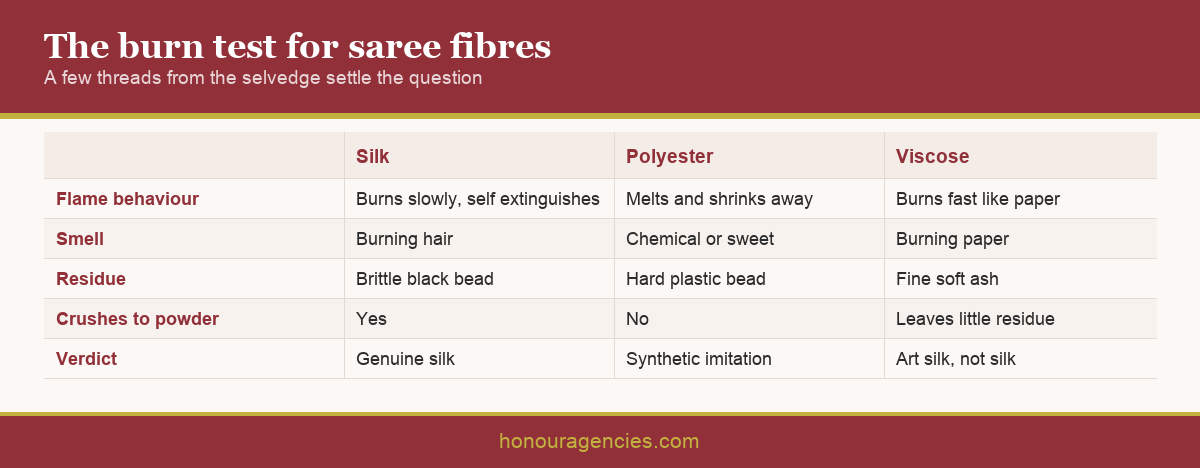
The burn test remains the most reliable field method, and it needs only a few threads pulled from the selvedge. Silk burns slowly, smells of burning hair, self extinguishes when the flame is removed and leaves a brittle black bead that crushes to powder.
Polyester behaves completely differently. It melts rather than burns, shrinks away from the flame, smells chemical or sweet, and leaves a hard plastic bead that will not crush. The difference is unmistakable once you have seen both.
Viscose, which is often sold alongside as art silk, burns fast like paper with little residue and no hair smell. It is a legitimate fabric with a legitimate place, but it is not silk and should not be bought or sold as such.
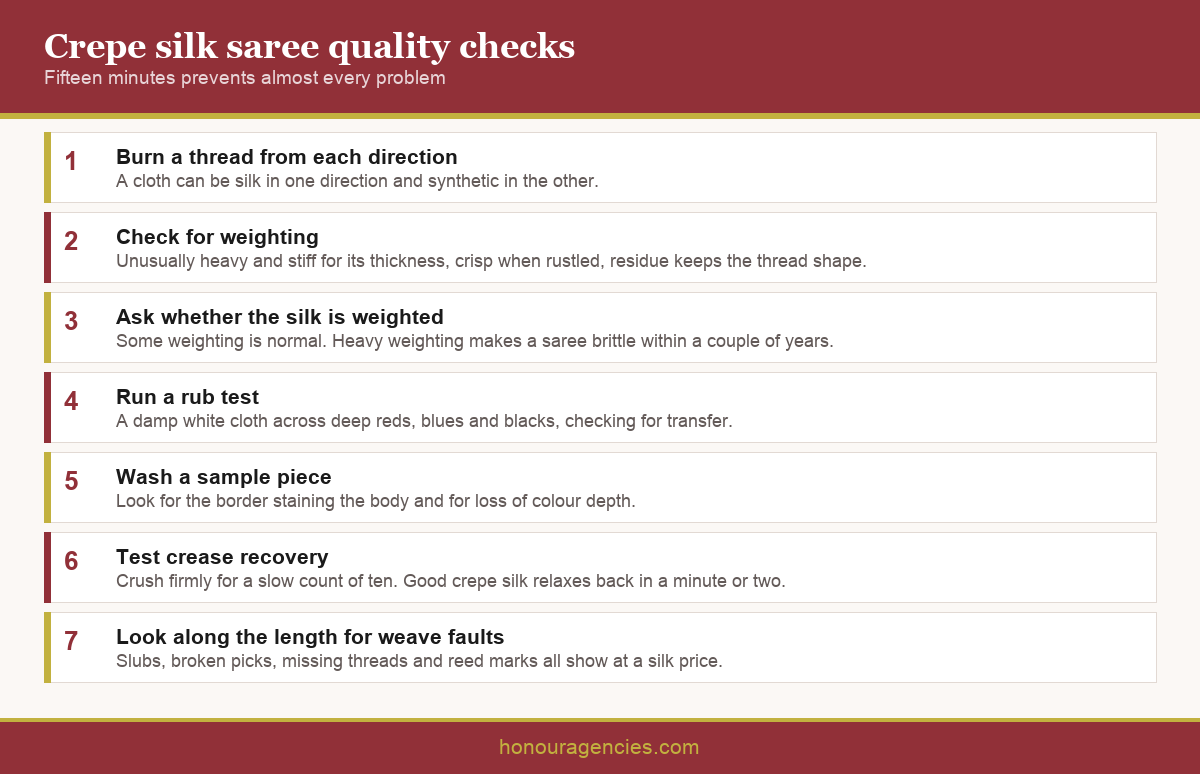
Test both directions separately where you can. A cloth can be woven with silk in one direction and a synthetic in the other, which produces a blend that passes a casual burn test on one thread and fails on another. Pull a warp thread and a weft thread and burn them separately if the fibre content matters commercially.
Do the test on a thread from the actual roll or saree, not on a sample the supplier hands you. Ask permission, do it openly, and note that a reputable supplier will have no objection at all. Reluctance is itself informative.
Weighting is the most damaging fault in the silk trade and the hardest for a customer to detect. Silk loses mass during degumming, and some producers restore that mass with metallic salts so the cloth feels heavier and more luxurious than it should for its price.
The effect is a saree that feels wonderful in the shop and deteriorates fast. Heavily weighted silk becomes brittle, splits along fold lines, and can develop small cracks and holes within a couple of years even with careful storage. The customer blames the retailer, not the mill.
Test for it. A weighted silk feels unusually heavy and slightly stiff for its thickness, sounds crisper when rustled, and burns leaving a residue that keeps the shape of the thread rather than crumbling to powder. That last sign is the clearest.
Store weighted stock separately if you decide to carry any. It ages faster than unweighted silk, so it should be sold through rather than held, and mixing it into general stock guarantees that some of it will still be on the shelf when it begins to deteriorate.
Ask the supplier directly whether the silk is weighted and by how much. Some weighting is normal and acceptable. Heavy weighting is not, and a supplier who cannot answer the question is not a supplier to buy silk from.
Colour bleed is the most common cause of returns on silk. Run the rub test first, pressing a damp white cloth firmly across the saree, particularly on rich reds, deep blues and blacks. Any transfer onto the white cloth is a warning.
Then wash a sample piece in the way a customer realistically will, and look for the ground losing depth, one colour running into another and the border staining the body. Deep colours next to pale ones are the classic failure, and the fault is unrecoverable once it happens.
Check crease recovery, which is what buyers are paying a crepe premium for. Crush a section firmly in the hand for a slow count of ten, release it, and watch. Good crepe silk relaxes back within a minute or two, leaving only a soft impression. Poor cloth holds a sharp crease.
Look along the length for weave faults. Slubs, broken picks, missing threads and reed marks are all visible on an unrolled saree in good light and all conspicuous in a garment that sells at a silk price. Our note on identifying quality stock for resale covers the wider inspection routine.
Buy against a written description that names the fibre content, the weight and whether the silk is weighted. A quotation that says crepe silk saree and nothing more leaves you no position at all if the stock disappoints.
Store silk properly, because it is more sensitive than most stock. Keep it away from direct light, which fades and yellows it unevenly, and away from damp, which stains it permanently. Refold periodically so that permanent creases do not set along the same lines.
Avoid plastic for long term storage. Silk needs to breathe, and sealed plastic traps moisture against the cloth and encourages yellowing. Cloth or paper wrapping is better for anything held across a season.
Sell the fabric accurately. A customer told honestly that a saree is a polyester crepe at a polyester price will come back, while one who discovers a silk saree was not silk will not. Description is the whole of the relationship in this category. Retailers stocking Kerala kasavu ranges apply the same principle to purity claims there.
Crepe silk sarees wholesale rewards buyers who verify rather than trust. Pull a thread and burn it, check for weighting by handle and residue, run a rub test and a wash test for bleed, and crush a section to judge crease recovery. Those four checks take fifteen minutes and prevent almost every problem this category produces. Honour Agencies has supplied wholesale sarees and fabrics from Ernakulam for 35 years. To discuss a silk requirement, contact our team.
Q: How can I tell real silk from polyester? A: Burn a few threads from the selvedge. Silk burns slowly, smells of burning hair, self extinguishes and leaves a brittle bead that crushes to powder. Polyester melts, smells chemical and leaves a hard plastic bead.
Q: What is weighted silk? A: Silk treated with metallic salts to restore mass lost during degumming, making it feel heavier and more luxurious. Heavily weighted silk becomes brittle and splits along folds within a few years of normal use.
Q: How do I detect weighting? A: The cloth feels unusually heavy and stiff for its thickness and rustles crisply. On a burn test the residue keeps the thread shape rather than crumbling to powder, which is the clearest single sign.
Q: What is art silk? A: Usually viscose, a legitimate fabric that burns fast like paper with little residue and no hair smell. It has a proper place in a range but should never be bought or sold as silk.
Q: How do I test for colour bleeding? A: Rub a damp white cloth firmly across the saree, especially on deep reds, blues and blacks, and look for transfer. Then wash a sample and check whether the border stains the body.
Q: What does good crease recovery look like? A: Crush a section firmly for a slow count of ten and release it. Good crepe silk relaxes back within a minute or two leaving a soft impression, while poor cloth holds a sharp crease.
Q: Why does crepe silk look matt rather than shiny? A: The crimped yarn structure scatters light, giving quiet depth of colour rather than surface shine. A saree that gleams brightly under shop lighting is more likely a polyester crepe than a silk one.
Q: How should silk sarees be stored? A: Away from direct light and damp, wrapped in cloth or paper rather than sealed plastic, and refolded periodically so permanent creases do not set along the same lines.
Q: Is polyester crepe an acceptable product to stock? A: Entirely, when it is described accurately and priced accordingly. It is durable and economical. The only real problem in this category is selling one fibre under another fibre's name.
Q: What should a silk purchase order specify? A: Fibre content, fabric weight and whether the silk is weighted. Our comprehensive boutique buying guide covers writing a usable specification.

Or login with