
Women danim jacket
$249.00

Red formal dress
$129.00

Man winter blazer
$149.00$99.00
Subtotal$477

 General
American demand for Indian sarees is driven by a large diaspora, a growing wedding and event market and boutiques stocking authentic handloom ranges. For suppliers and buyers arranging bulk saree export to the USA, the commercial side is rarely the hard part. Compliance is. This guide covers how sarees are classified for US customs, what labelling law requires, which documents accompany a shipment, and how to structure freight and payment so a consignment clears without sitting at the port.
Every textile article entering the United States is classified under the Harmonized System, applied in the US as the Harmonized Tariff Schedule and published by the US International Trade Commission. Classification drives the duty rate, and it turns on fibre content and how the fabric was constructed rather than on what the item is called commercially.
This matters commercially because a cotton handloom saree, a silk saree and a synthetic blend can attract materially different treatment. Two consignments described identically on an invoice as sarees may not be treated identically at entry. Confirm the classification with a licensed customs broker before you quote a landed price to a US buyer, and state fibre content precisely on the invoice rather than using a generic description. Our wholesale saree export guide for international buyers covers the wider export process this sits inside.
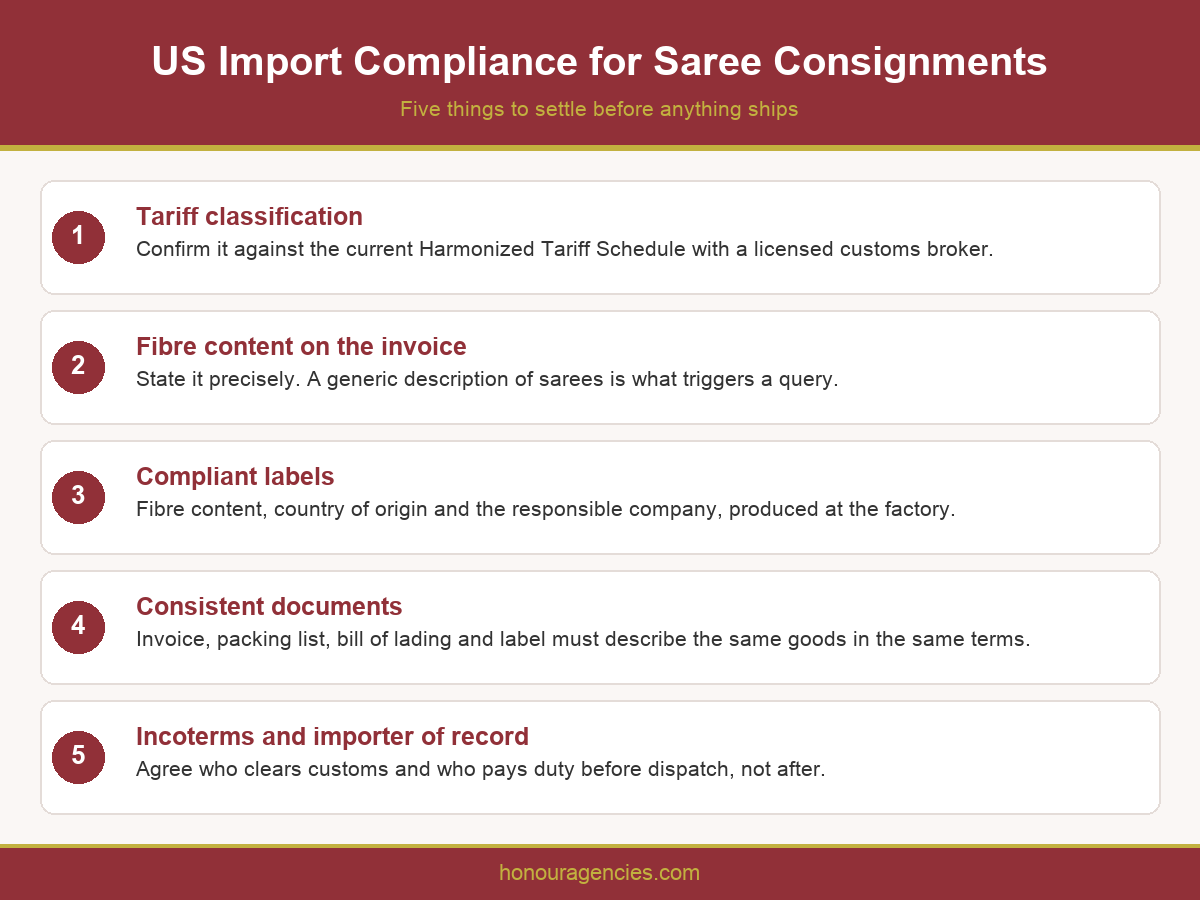
US labelling law is specific and it is enforced. Under the Textile Fiber Products Identification Act, textile products generally must carry the fibre content by generic name and percentage, the country of origin, and the name or registered identification number of the business responsible for the product. The Federal Trade Commission publishes plain language guidance on labelling under the textile and wool acts.
Country of origin marking is a separate requirement from fibre content and must be legible and permanent enough to reach the end purchaser. Care labelling obligations may also apply. The practical point for an exporter is that labels have to be produced correctly at the factory, not corrected at the border, because relabelling a held consignment in a US warehouse is slow and expensive. Build label approval into your sample sign off alongside shade and finish.
Labelling obligations sit with the party placing the goods on the US market, but the practical work happens at the factory in India. Agree explicitly who is drafting the label wording, who is approving it and who carries the cost if a consignment has to be relabelled. Leaving that unstated is how a compliance question turns into a commercial dispute after the goods have already shipped.
Treat the label as part of the product specification. Have your US buyer approve the exact label wording and placement at the same time they approve the physical sample, and keep an approved copy on file. This single step prevents most labelling problems on repeat orders.
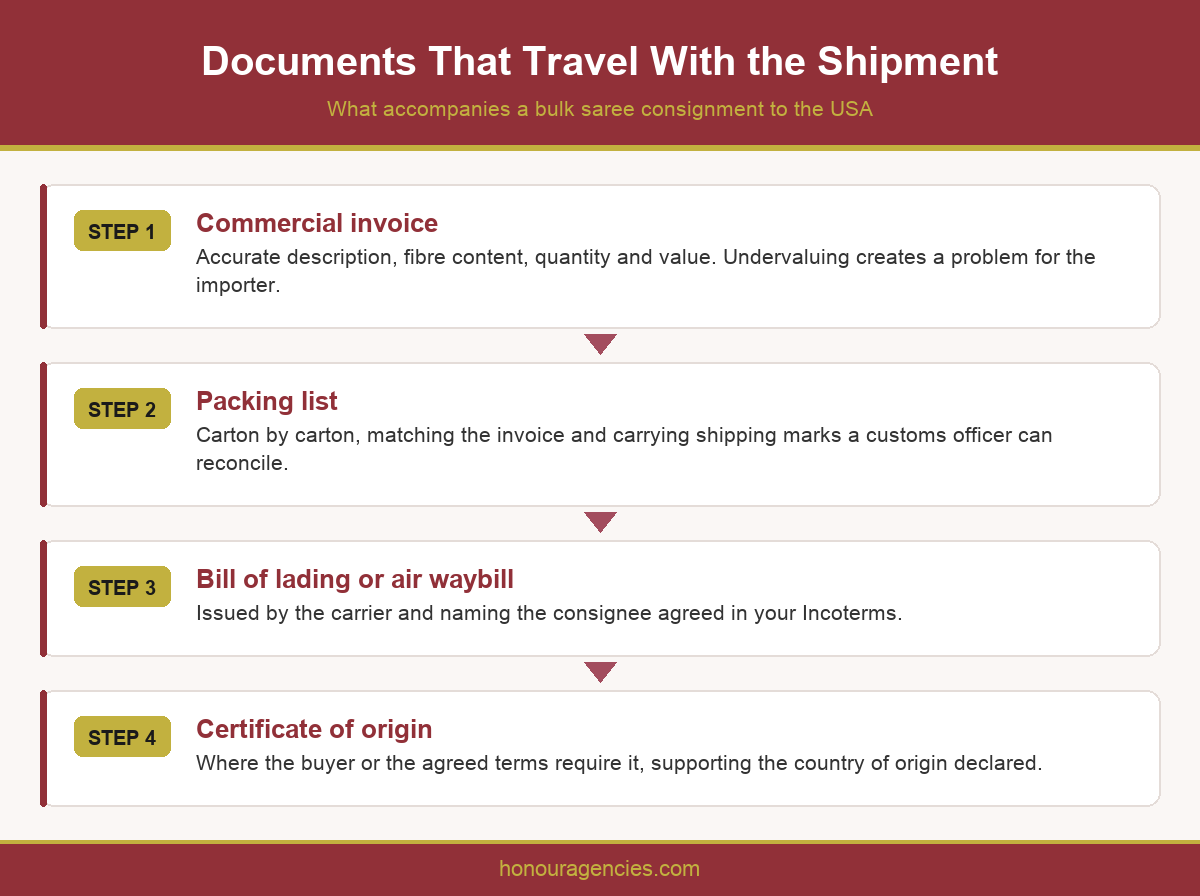
A textile consignment to the USA normally moves with a commercial invoice showing an accurate description, fibre content, quantity and value, a packing list matching the invoice, a bill of lading or air waybill, and a certificate of origin where the buyer or the terms require it. US Customs and Border Protection treats textiles as a priority trade area, which means descriptions and declared values receive real scrutiny.
Keep the paperwork internally consistent as well as accurate. The description on the commercial invoice, the packing list, the bill of lading and the label should describe the same goods in the same terms. Discrepancies between documents are what trigger a query, and a query on a textile consignment is rarely resolved in a day.
Accuracy matters more than completeness. An invoice that undervalues goods or describes them vaguely creates a compliance problem for the importer that is far more damaging than any duty saved. Most first time exporters engage a licensed customs broker to handle entry, and the cost is small relative to a consignment held for query. The buyer of record is responsible for the entry, so agree early who is acting as importer.
Sea freight is the default for bulk saree consignments to the USA because volume weight economics favour it, with transit typically measured in weeks rather than days. Air freight suits urgent replenishment and high value silk ranges where the freight premium is small against the goods value. Choose deliberately rather than defaulting to whichever the forwarder quotes first.
Incoterms decide where responsibility transfers and who pays duty, insurance and inland transport. A first time buyer often prefers terms that place customs clearance with the seller, while an experienced importer with a broker usually prefers the opposite. On payment, a letter of credit protects both sides on a large first order, while established relationships typically move to an advance and balance split. Whichever you choose, put the terms in writing before dispatch.
Insurance deserves a decision rather than an assumption. Marine cargo cover is usually arranged separately from freight, and whether the seller or the buyer holds it follows directly from the Incoterms agreed. Confirm the sum insured reflects the commercial value of the consignment and not just the freight cost, and check whether the policy covers goods while they sit in a warehouse awaiting clearance rather than only while in transit.
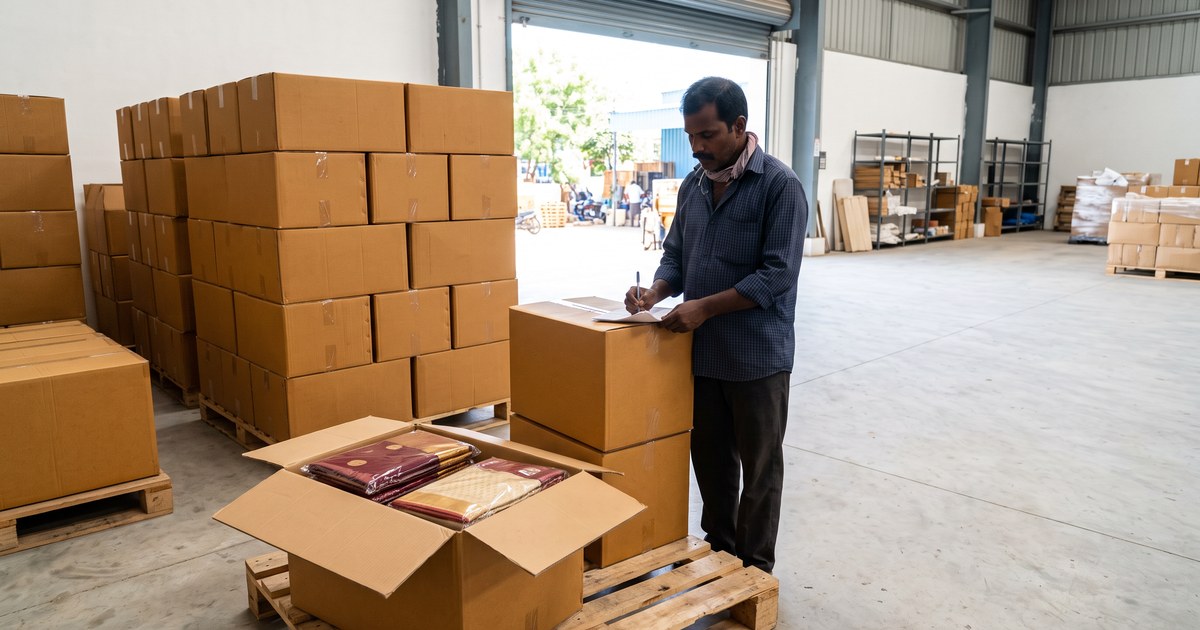
Sarees are a delicate cargo travelling a long way, and packing decides how much of a consignment is saleable on arrival. Sea transit to the United States exposes goods to humidity, temperature swings and handling at several points, and textiles absorb moisture readily. Poly wrapping individual pieces, using moisture absorbing sachets inside cartons and avoiding direct contact between fabric and untreated cardboard all reduce the risk of staining and mildew.
Carton specification matters as much as the wrapping. Cartons should be strong enough to stack without crushing, sealed against dust, and labelled with the shipping marks that match the packing list so a customs officer can reconcile a physical carton against the paperwork quickly. Mismatched or missing shipping marks are a routine cause of delay during examination.
Zari and metallic borders deserve particular attention, because they tarnish in humid transit and the damage is not always visible until the pieces are unpacked in the US. Discuss protection for these ranges specifically rather than assuming standard packing covers them, and agree in writing who bears the cost if a consignment arrives damaged. That question is answered by your Incoterms and your insurance cover, not by goodwill after the event.
Build the timetable backwards from the buyer's selling season. Production, sea transit and customs clearance each consume time independently, and a delay in any one of them lands the stock after the demand it was ordered for. Overseas buyers stocking for a wedding or festival season should agree the dispatch date rather than the production date, because only the first of those reflects when goods will actually be available to sell.
Bulk saree export to the USA is well trodden ground, and the consignments that run into trouble are almost always the ones where classification, labelling or documentation was treated as an afterthought. Confirm the tariff classification, get labels approved with the sample, keep invoice descriptions accurate, and settle Incoterms and payment before anything ships. Honour Agencies has supplied wholesale sarees from Ernakulam for 35 years and works with international buyers across the USA, Canada and the UK. To discuss a US order, contact our team or ask for our export documentation pack.





Or login with